Article - Defending Palestine Solidarity Activism in Europe

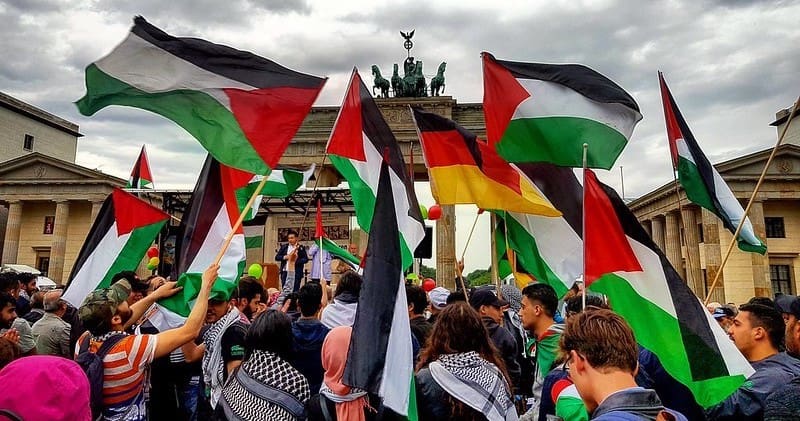
The governments of France, Spain, and Germany have ramped up efforts to repress Palestine solidarity activism. Palestinians and their allies in these countries are facing more legal measures to criminalize their rights to boycott and critique the Israeli regime than ever before. How does each context differ? What is at stake for Palestinians and their allies in each country? What has been done and what needs to be done to counter these troubling developments?

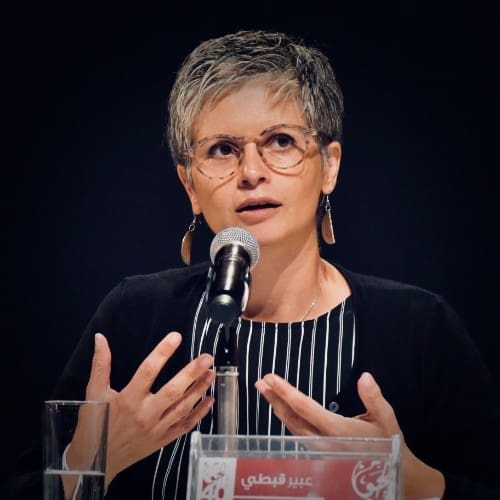
Abir Kopty and Nadia Silhi Chahin join host Nadim Bawalsa in conversation to answer these questions and more.

Nadim Bawalsa is Associate Editor with the Journal of Palestine Studies. From 2020-2023, Nadim served as Al-Shabaka’s commissioning editor. He is a historian of modern Palestine, and author of Transnational Palestine: Migration and the Right of Return before 1948 (Stanford University Press, 2022). His other work has appeared in the Jerusalem Quarterly, the Journal of Palestine Studies, NACLA Report on the Americas, and as well as in edited volumes. He earned a joint doctorate in History and Middle Eastern & Islamic Studies from New York University in 2017, and a Master’s in Arab Studies from Georgetown University’s Center for Contemporary Arab Studies in 2010. In 2019-2020, he was awarded a PARC-NEH fellowship in Palestine.  
Al-Shabaka policy member Abir Kopty, holds an MA in Political Communication from the City University, London, and is currently a PhD candidate at the Institute for Media and Communication Studies, Freie Universität Berlin. Her research interests include power dynamics in online communities and the use of social media networks for social and political activism.

Latest Analysis

 Civil Society
On November 4, 2025, the UK government tabled an amendment to the Crime and Policing Bill to curtail protest rights under the pretext of “cumulative disruption.” The revised Bill is now in the House of Lords Committee, where it is scrutinized before advancing toward final approval. The amendment signals a profound shift in how the state regulates public protest. While the government presents the Bill as a neutral public order measure, it emerges directly from sustained national demonstrations for Palestinian rights and introduces new legal concepts that threaten long-established democratic freedoms. This roundtable examines the Bill’s political drivers, legal architecture, and wider implications for social movements and civil liberties in the UK. It shows that the amendment is not simply a public order measure; it is a coordinated political and legal project to narrow the space for dissent in the UK. While Palestinian solidarity is the immediate target of the crackdown on freedom of assembly, the roundtable argues that the consequences will reverberate across labor organizing, racial justice, climate activism, and broader democratic participation.
 Politics
“We’re all going to end up in Jordan,” remarked a young man from Al-Jiftlik, a Palestinian village in the Jordan Valley. His comment reflects growing despair in the West Bank countryside, where Israeli settler-colonial expansion has intensified to unprecedented levels. This is particularly true in the Jordan Valley, the agricultural heartland along the West Bank’s eastern frontier with Jordan. Once known among Palestinians as the “bride of the Jordan Valley,” Al-Jiftlik now illustrates the gravity of Israeli state-sponsored settler expansion on Palestinian land, having transformed from a prosperous agricultural community into one under siege and facing sustained displacement pressure. Since the beginning of Israel’s genocidal war on Gaza in October 2023, land seizure in the West Bank has shifted from creeping settler encroachment to a vicious military-backed campaign of territorial theft. This commentary shows how the Israeli regime’s land appropriation policy in the West Bank, once justified through bureaucratic-legal land seizure orders, has now increasingly shifted toward direct settler takeovers. This shift does not indicate a change in objectives but rather an escalation of existing settlement expansion mechanisms, signaling the growing power and influence of the settler movement over Israeli policy.
Al-Shabaka Fathi Nimer
Fathi Nimer· Feb 3, 2026
 Politics
The announcement of the National Committee for the Administration of Gaza (NCAG), a 15-member technocratic body chaired by Ali Shaath, signals a shift toward depoliticized governance in Gaza amid ongoing genocide. Shaath, a Palestinian civil engineer and former deputy minister of planning and international cooperation, will lead an interim governing structure tasked with managing reconstruction and service provision under external oversight. While presented as a neutral technocratic governing structure, the NCAG is more likely to function as a managerial apparatus that stabilizes conditions that enable genocide rather than challenging them. This policy memo argues that technocratic governance in Gaza—particularly under US oversight, given its role as a co-perpetrator in the genocide—should be understood not as a pathway to recovery or sovereignty, but as part of a broader strategy of genocide management.
Al-Shabaka Yara Hawari
Yara Hawari· Jan 26, 2026