




About This Episode
Episode Transcript
The transcript below has been lightly edited for brevity and clarity.
Brendan Browne 0:00
It’s easy to stand up on stage and be seen to be a vocal proponent and a vocal supporter of Palestine and to express your disgust, but it has to yield actual results. There has to be some kind of commitment to boycott, divestment, and sanctions. There has to be some kind of consequences for having Irish universities partner with Israeli institutions that are engaged in providing the apparatus that supports the war. There has to be some kind of wider consideration of Ireland’s links to Israel.
Yara Hawari 0:35
From Al-Shabaka, the Palestinian Policy Network, I am Yara Hawari, and this is Rethinking Palestine.
Last month the Irish government announced that it would intervene in the South African-led genocide case against the Israeli regime at the International Court of Justice. The government, alongside Spain, Belgium, and others, has also announced its readiness to recognize the state of Palestine. Irish Prime Minister-elect Simon Harris delivered a strong speech at the beginning of April 2024 where he said, “Prime Minister Netanyahu, let me say this to you this evening. The Irish people could not be clearer. We’re repulsed by your actions. Ceasefire now and let the aid flow safely.”
This hasn’t come out of nowhere. The Irish government has delivered consistent critique of the Israeli regime since the beginning of its assault on Gaza last October. However, many in the Irish solidarity movement have felt that the rhetoric hasn’t been strong enough and is not reflected in action and policy.
Indeed, there are deep historic connections between the Palestinian struggle for liberation and the Irish struggle against British colonial domination. These connections have transformed into a vibrant solidarity movement, which includes trade unions, student groups, and political parties.
Joining me to discuss all of this today is Dr. Brendan Browne, Interdisciplinary Scholar at Trinity College Dublin. Brendan has taught courses on international humanitarian law and transitional justice, and has for over a decade worked on various projects related to Palestine. Brendan, thank you for joining me on this episode of Rethinking Palestine.
Brendan Browne 2:10
Thanks for having me on.
Yara Hawari 2:11
I think that many people take this connection between Ireland and Palestine for granted. Could you tell us a bit about the history of the struggles and the affinity for one another?
Brendan Browne 2:22
Yeah, absolutely. I mean, you’re right. People look at Ireland as certainly the most vocal European nation when it comes to standing in solidarity with Palestine. And there are reasons for that.
We in Ireland have our experience of resisting colonial violence. We’ve had over 800 years of experience of British colonialism next door. We’ve engaged with various struggles over time. We have experience of issues that Palestinians are all too familiar with — like forcible transfer, forced displacement, being starved through the Great Hunger that we experienced in the mid-1800s, which was a colonial act of violence. So we have that natural empathy when it comes to standing in solidarity with the Palestinian cause, with those Palestinians who have experienced, as I say, much the same in many ways.
And that solidarity has manifested itself in many ways. Throughout history, we’ve seen that resistance movements in both Palestine and Ireland have actually come together — in the 60s, 70s, and into the 80s — and discussed tactics, discussed anti-colonial resistance, and actually broke bread together in Lebanon. Although that is a really closely guarded secret. If you want to try and get information on that, it’s nearly impossible — I’ve tried to do so.
And another area where we have very close connections is the prisoner movement. Irish republican prisoners have been in constant conversation with Palestinian prisoners, and I know vice versa as well. Recently, for example, just to give you one example: upon the death of Khader Adnan, a letter of condolence was sent from the Bobby Sands Trust — Bobby Sands being one of the most famous Irish Republican prisoners — to Khader Adnan’s widow, to express solidarity with the family and with the struggle.
And actually, during time I spent working at Al-Quds University in Palestine, I was invited to come into the Abu Jihad Museum on campus and invited to look through some of the prison archives and some of the communications that had been smuggled out of the prisons. During my analysis of that archival material, I did see the words “Bobby Sands” written amidst the Arabic. So these connections are really strong, really ingrained, and really, really important.
What I would also say is that the Irish government back in the 1980s was one of the first governments to recognize the PLO, and one of the first governments to call for greater engagement with the PLO on an international stage. So there is precedent for Ireland taking a lead when it comes to high-level diplomatic efforts. And I guess that’s maybe why in the present moment there’s a little bit of false hope, I would say, when it comes to the role that the Irish government is currently playing — but not what it may play in the future. And I think that’s also critically important.
Yara Hawari 5:36
I think it’s remarkable how many Palestinians of a certain age know Irish revolutionary songs, and you’ll find these people in the unlikeliest of places. And I think for a lot of Palestinians, even if they don’t know the full history between the two struggles, they know that affinity is inherent in them. They know that the Irish people have historically supported and continue to support the Palestinian struggle.
Whilst Ireland and Palestine share a lot of similarities — some of which you mentioned, in their experiences of colonialism — there are also a lot of differences. And I think there’s one particular area where comparisons have actually been detrimental to the struggle for liberation in Palestine, and that’s peace and reconciliation.
Can you explain why that is?
Brendan Browne 6:26
Absolutely. And maybe it’s also worth saying at this stage that in my experience, when Palestinian comrades and colleagues look at the Irish experience, it’s almost like it’s been a liberatory moment for Ireland. But what I would add to that is that it is a partial liberatory moment.
Ireland remains a physically divided island. And I think that’s important. The six counties in the North of Ireland remain part of the wider United Kingdom, subject to British colonial oversight. And I do think we need to really pay attention to that.
But what I would say is that the North of Ireland — I grew up there during the period of time known as the Troubles, albeit in the middle of the Troubles. I did experience what that looked like, growing up in a space of active conflict. But I’ve also been lucky enough to have transitioned out of that conflict and now live in a much more peaceful — albeit segregated, I would say — existence in the North of Ireland.
And it’s our peacebuilding process that I think is important in our context, very significant. It has meant that we now don’t see each other as enemies in terms of Catholics and Protestants. We now enjoy the same rights. We now enjoy the same access to the labor market — which was very different in the sixties. We now enjoy the same access to education, the same ability to travel freely — all the things that were obviously restricted at the start of the Troubles.
So we have a peacebuilding process in the North of Ireland that, whilst deeply flawed, I would say is in many ways successful. At the same time, it’s a bit Janus-faced in that regard. Whereas peacebuilding in the context of Palestine, as everybody knows, has been nothing but a ruse — has been about concession, has been about applying and pouring tonic on any sort of sense of Palestinian rights and liberation.
So that is one of the major differences when you view the Irish peace process alongside peacebuilding attempts that have been trialed in the context of Palestine. And actually, one of the areas that is particularly problematic is the exportation of a Northern Ireland peace process model into the context of Palestine. It’s a highly problematic thing that says this is the way that you are meant to bring about peace in your space. And it’s very, very decontextualized. So I think that’s some of the key differences when it comes to Ireland and Palestine that need to be more fully understood and interrogated.
Yara Hawari 9:08
And what’s remarkable is that we do see a lot of attempts that literally try and copy-paste the Irish experience of peace and reconciliation onto the Palestinian one. And as you’ve so articulately pointed out, it just doesn’t work. They’re two different contexts.
Brendan Browne 9:24
Absolutely. And I think people long for — and rightly so — something that works. They want the model, they want to hold on to something. And who in their right mind is going to say that peacebuilding is problematic? You come across as some kind of lunatic if you say that. But actually, you’re weaponizing peacebuilding when you try and impose it upon people without addressing lots of the structural issues in the room.
And I mean in our own context in the North of Ireland as well — we have made great attempts at engaging in people-to-people type projects on the ground in Belfast. I was a product of these projects. But whereas in the eighties and nineties they didn’t really work as well, because the wider political reality wasn’t being addressed — the wider structural problems weren’t being addressed. We were just being brought together to sort of talk to each other and assume that that would be enough to trickle down and build peace.
What’s happening now — and you’ve written about this yourself, Yara — is people are bringing that model of contact theory, people-to-people processes, into the Palestine context and saying, look, if you only talk to each other, things like this will get better in the future, without actually saying, well, no, we need to radically look at the way society is structured here. We need to look at the militarized nature of Israeli society. We need to look at the rights that you enjoy and that I don’t enjoy.
So I do think it’s really important. And the last point I would make on that — and maybe this is a bit cynical — is that it’s become quite a big business. It’s a big industry. Exporting the peace process from Northern Ireland has seen a proliferation of NGOs who’ve made this their modus operandi and exported it to other conflict zones — not just Palestine, but to other spaces. And I think when you do that, you flatten power dynamics in a way that is deeply problematic. I really wish people would stop doing it.
Yara Hawari 11:39
Oh yeah, if I wanted to start a project or an NGO on peacebuilding and dialogue in Palestine between Palestinians and Israelis, I would get a ton of money. Peace itself has become such a dirty word in Palestine, because from our experience it’s been used as a mechanism to obscure the reality between Palestinians and Israelis as occupied and occupier. And aside from that, it’s also been shown time and time again that these dialogue projects in Palestine don’t work.
Brendan Browne 12:11
And I don’t want to come across as dismissive as well, because in my context in the North of Ireland, there is space for these projects to be successful now — because we have parity of esteem, because we have a situation where I’m no longer a second-class citizen, because we have a political road map that says we can all reach what we want through consensus collectively. And therefore I’m able to engage in these types of people-to-people projects on a level footing. Whereas that, as you said, isn’t the case in Palestine.
And there are a lot of these people-to-people projects in the North of Ireland that are happening sort of under the radar and that do incredible work. So I think that’s important when we look at the Irish context, but again, it just shows you how sometimes when you compare two spaces, you can lose the nuance in the middle.
Yara Hawari 13:08
Brendan, I want us to focus a little bit now on the solidarity movement. As you’ve already said, the historic solidarities resulted in what is today a vast and diverse Irish-Palestinian solidarity network that transcends the border that divides Ireland.
Can you describe what this network looks like and the kind of work it does?
Brendan Browne 13:31
Yeah, I absolutely can. I’ll start, as it seems everybody is at the moment, pre-October 7th. The solidarity movement in Ireland was already vibrant. Your introduction talked about trade unions, academic links, and so on. We also in the past have had some really incredible individuals who came over to Palestine — people I know who were on the flotilla back in 2009, other people who’ve been engaged in NGOs and helped set up partnerships between Irish universities and Palestinian NGOs and Palestinian universities.
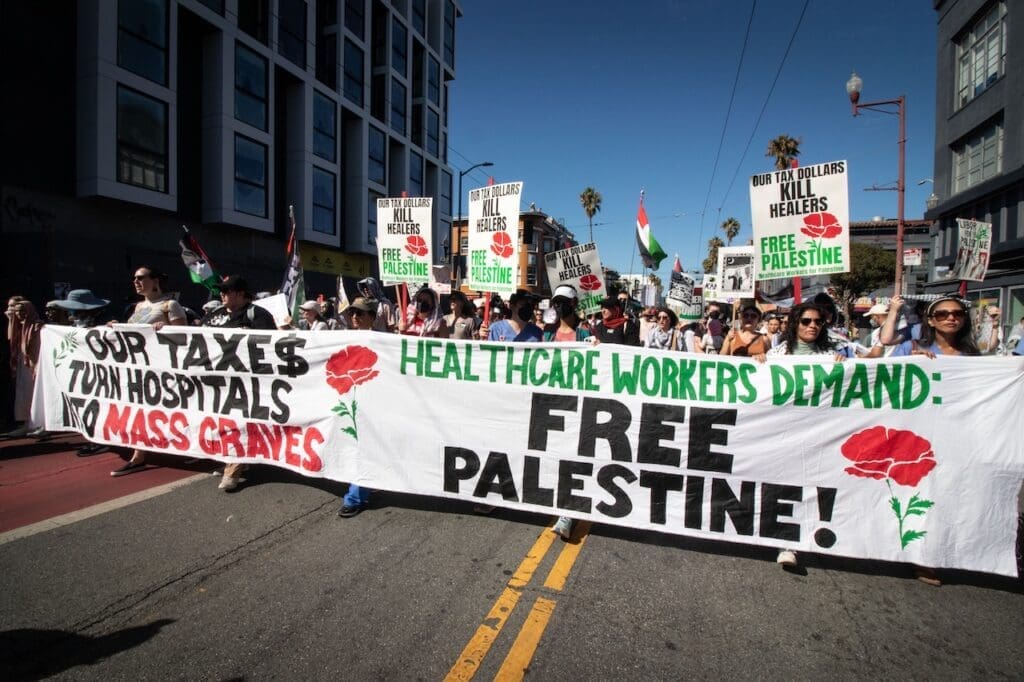
And there was an Ireland Palestine Solidarity Campaign that existed, set up to coordinate all of our advocacy for Palestine pre-October 7th. Post-October 7th, the advocacy and activist community in Ireland has exploded. You have a whole range of different groups that have been set up to advocate for various aspects of Palestinian liberation, each focusing on certain areas specifically. For example, Healthcare Workers for Palestine is an organization that was set up. You have a group called Mothers Against Genocide that was set up in Belfast. You have a group called Gaels for Palestine, which is the Gaelic Athletic Association showing their support for Palestine. Again, mostly done in coordination under the banner of the Ireland Palestine Solidarity Campaign.
So I would say it’s extremely active and very vibrant. At its height — I can’t remember if this was December, the dates are all a bit of a blur — I think we had almost 200,000 people on the streets in Dublin on a Saturday, protesting and demanding an end to what was going on in Gaza and demanding that our government push forward with tangible actions to hold the Israeli government to account.
So I would say it’s a really vibrant community. Their intentions are excellent. I would also say that at times, like any activist solidarity collective, you have disagreements over tactics, over language, over what to do next. And I think at times that leads to a little bit of fragmentation. But I suspect that happens everywhere in the world. By and large, the solidarity movement in Ireland is there, it’s growing, it’s really vibrant, and it’s really impressive.
Yara Hawari 16:18
If you’re enjoying this podcast, please visit our website al-shabaka.org where you will find more Palestinian policy analysis and where you can join our mailing list and donate to support our work.
Brendan, you recently wrote a piece entitled “Reading Irish Solidarity with Palestine through Ireland’s Unfinished Revolution” for the Journal of Palestine Studies. And in it, you talk about how this grassroots organizing and sentiment that you just mentioned is not reflected at a policy level in Ireland.
We have seen comments from the Irish government condemning Israeli actions in Gaza, but it’s not been as radical as many would like. Can you talk us through this disconnect between the grassroots and the policy level?
Brendan Browne 17:03
Yeah, absolutely. I was speaking to Palestinian friends recently who were getting really quite excited about the language that the new Irish Taoiseach Simon Harris came out and used the other day — when he said, Netanyahu, we are repulsed by your actions, and demanding that aid be let into Gaza. I mean, it is very strong as a rebuke, it’s very strong language and very strong rhetoric. But it’s just exactly that — rhetoric.
And actually, Francesca Albanese, the Special Rapporteur, who spoke at the University of Galway recently, said the Irish government has a strong reputation of standing in solidarity with Palestine. However, it is very clear that that is a rhetorical stance. So she actually called it directly and called it out. She said: these are just words if they are not met with concrete actions.
And at the same moment when he was using that language, his party voted down a bill that would have prohibited settlement produce from being sold in Ireland. So you can see the disconnect there.
It’s easy to stand up on stage and be seen to be a vocal proponent and a vocal supporter of Palestine and to express your disgust, but it has to yield actual results. There has to be some kind of commitment to boycott, divestment, and sanctions. There has to be some kind of consequences for having Irish universities partner with Israeli institutions that are engaged in providing the apparatus that supports the war. There has to be some kind of wider consideration of Ireland’s links to Israel if you are actually that repulsed. Words are just words if they’re not matched by actions — as we all know.
And he’s not the only one. Micheál Martin, the Irish foreign minister, may be saying some strong things at the moment — saying things along the lines of wanting to recognize a Palestinian state — but it wasn’t too long ago that Micheál Martin was in Israel pointing at a hole in the sky on that Israeli hasbara mission post-October 7th, when everybody was saying, can you not see that this is the pretext for what’s coming?
So when it comes to the activist community, we take a lot of the rhetoric with a pinch of salt. And when it comes to the government — the Irish government is one thing, but the Irish political spectrum itself is broad and diverse. You have other political parties in Ireland that have also been very vocal when it comes to holding Israel to account and standing with Palestine. One of the largest republican groups on the island, Sinn Féin, has a long and proud history of standing in support of the Palestinian people. But even they have been challenged by the activist community to say they’re not doing enough. They were asked very clearly recently not to send political representatives to the White House on St. Patrick’s Day — which is a tradition in Ireland — and we asked them, we demanded that they don’t go over and legitimize “Genocide Joe.” Unfortunately, they didn’t heed us on the ground, and that has caused a fissure, a disconnect, between a lot of the activist community and Sinn Féin.
And also, the Israeli ambassador still resides in Ireland, is still given airtime on our national radio stations and national TV programs to spout off some of the most ludicrous stuff. So there is that disconnect. Talk is cheap — we need to see actions.
Yara Hawari 21:00
So the Irish government has committed to one particular action, and that’s intervening in South Africa’s case at the ICJ. Do you think that might be a signal of more bold action to come?
Brendan Browne 21:13
Well, I’m trying to find the balance between being a complete cynic. I don’t want to be that person all the time. But okay — on the one hand, that’s a good move. That’s a symbolically important good move. And we have called for that. We’ve been demanding that the Irish government join the South African case right from the beginning, when it became clear that South Africa was going to bring this case to the ICJ.
It seems now that when the case has been presented, when the evidence is there, when it’s very clear — when most of the legal commentators in the world and some of the most learned scholars on genocide and international law have said, look, this is a pretty clear-cut example — I think it’s then a pretty safe bet to join the case as well. And listen, I’m pretty sure — somebody may correct me if I’m wrong — but I believe Ireland is joining the case as part of a group of states: Ireland, Spain, Belgium, maybe Malta as well, joining as a bloc within the European Union.
So, finding that balance of cynicism — yes, that’s a positive thing. But that type of case needs to be matched by other concrete actions on the ground, those that I’ve mentioned before. I would love the Irish government to fundamentally look at all of its partnerships with Israeli institutions, with Israeli commercial deals, in much the same way that it did when Russia invaded Ukraine. Because it shouldn’t be the case that you apply double standards here — if you’re going to apply something, you apply it consistently. If this is your line in the sand, apply it equally, fairly, and equitably.
So yes, on the one hand it’s a good move. But let’s see more.
Yara Hawari 23:25
And it’s really important to point out, as you’ve done, that Ireland does have various levers it can use to create more pressure — commercial and trade relations, diplomatic relations. But unfortunately, we’re not seeing that kind of action, just as we’re not seeing it from other European states or from very few states around the world. So it’s really about creating that level of pressure that will translate into action.
And I think it feels like the global political climate is seriously deteriorating — and that’s probably the understatement of the century. But how do you see the solidarity movement adapting to this climate?
Brendan Browne 24:08
You’ve actually pointed out something really important there that I’d like to add to, which is that Ireland also has a history of being very vocal when it came to the anti-apartheid movement. So it’s not like we have to dig too far into our historical past to find precedent for what to do.
Ireland has experience of cutting ties with an apartheid state. It has experience of not trading with an apartheid state, of not handling apartheid goods, of not engaging in sporting activities or platforming cultural events, of looking fundamentally at university links — with South Africa. So the blueprint is there. All you have to do is move along with it and ask: how can we use that in the present moment? Because, as you know, the language of apartheid has become extremely normalized when it comes to discussing the reality on the ground in Palestine. So we have that framework, we have that language. I would just like the Irish government to use it again, more fully.
Yara Hawari 25:13
And Brendan, just to interject there — why do you think that’s not happening?
Brendan Browne 25:18
That’s a really good question, Yara. Why is it not happening? I mean, I think Palestine is an exception. We know that in the global sphere there is exceptionalism when it comes to the Palestine case. We know that Israel does get a softer ride at times, for a variety of reasons.
But I do think that tide is changing. I am hopeful and optimistic. And I do think that this Irish government won’t be able to ignore the demands of the activist movement, because one thing I would say to give everybody hope: we’re not going away. We haven’t shrunk as a collective. Our marches are still there. The ebb and flow in terms of their size over time, as you’d expect — but our advocacy doesn’t ebb. We have a day of action next week across the island of Ireland in the university sector, where people are coming together to walk out of universities and carry out other direct actions, to hold teach-ins, to platform Palestinian voices, to talk strategy. So our advocacy grows, even if the optics of being on the street ebb and flow at times.
So I don’t know exactly why the Irish government isn’t doing more. I suspect it’s because of this exceptionalism that does seem to happen in lots of different places. But can you imagine how powerful it would be if Ireland was that country in Europe — the one that set it off? Because I think the domino effect that would happen would be quite significant. And as I said, Ireland is part of a smaller group of European nations that are having these conversations around strategy and what to do and how to come together. Nobody likes to predict things in the future — it makes fools out of wise men.
Yara Hawari 27:07
I think Ireland is well placed to play that role in Europe, to create the domino effect — not just because of the historic solidarity, but because of its current vibrant Palestine solidarity movement. We can only hope that might happen. And as you said, the tide is shifting. It’s just a question of how far it will go. And I think that’s something yet to be seen.
Brendan Browne 27:30
I would say that sometimes we need to look at Ireland a little less through the romantic, wistful, rose-tinted glasses. There are issues in Ireland when it comes to a rising far-right presence. Ireland has an awful record when it comes to asylum — people who come to Ireland seeking asylum, fleeing other theatres of conflict, end up in a system called direct provision. Ireland itself is not an easy place to live comfortably and well if you don’t earn above a certain amount of money. It is not a socialist utopia by any stretch of the imagination, and we have one of the highest costs of living in Europe. Trying to get a house in Ireland is really, really difficult. I have students who talk about sleeping in their cars because they can’t afford student accommodation.
So I wouldn’t want Ireland to be viewed as a utopia of post-coloniality. If anything, there’s a lot of work to be done in Ireland. And actually that is where we have a lot to learn from other struggles around the world — and certainly Palestine can teach us that. We can come together and find the ways that we are transnationally vulnerable, the ways that we are connected that we should maybe be more sensitive to when it comes to growing our movement.
I think we need to find ways that we are vulnerable together — how we are all interconnected, how empire impacts us, how neoliberal development impacts us, how the divide between the Global North and the Global South is becoming much more stark, and how we want to combat that. Because I don’t think that divide serves any of us in the movement — it obviously serves other people very well, but it doesn’t serve us as activists. So in Ireland, we will continue to grow, we will continue to do our advocacy work, we will continue to learn, and hopefully grow alongside our comrades in Palestine and work towards what will be inevitable Palestinian liberation.
Yara Hawari 29:49
I think that’s a nice thing to end on. Brendan, thank you so much for coming on this episode of Rethinking Palestine.
Brendan Browne 29:55
Thanks for having me.
Yara Hawari 29:59
Rethinking Palestine is brought to you by Al-Shabaka, the Palestinian Policy Network. Al-Shabaka is the only global independent Palestinian think tank whose mission is to produce critical policy analysis and collectively imagine a new policymaking paradigm for Palestine and Palestinians worldwide. For more information or to donate to support our work, visit al-shabaka.org. And importantly, don’t forget to subscribe to Rethinking Palestine, wherever you listen to podcasts.

Al-Shabaka: The Palestinian Policy Network is an independent, non-partisan, and non-profit organization whose mission is to convene a multidisciplinary, global network of Palestinian analysts to produce critical policy analysis and collectively imagine a new policymaking paradigm for Palestine and Palestinians worldwide.