


About This Episode
Episode Transcript
The transcript below has been lightly edited for brevity and clarity.
Samer Alatout 0:00
Do I trust the institution? No, but what I do trust is the community that was created, and the community that was created is really powerful. The students are amazing. The faculty and staff that were involved in the encampment are amazing. This coalition that was built will not disappear. There are a lot of steps that are to be taken during the summer, the fall, and the spring that I think will lead to a change in the form of discussion that’s happening now.
Yara Hawari 0:34
From Al-Shabaka, the Palestinian Policy Network, I am Yara Hawari, and this is Rethinking Palestine.
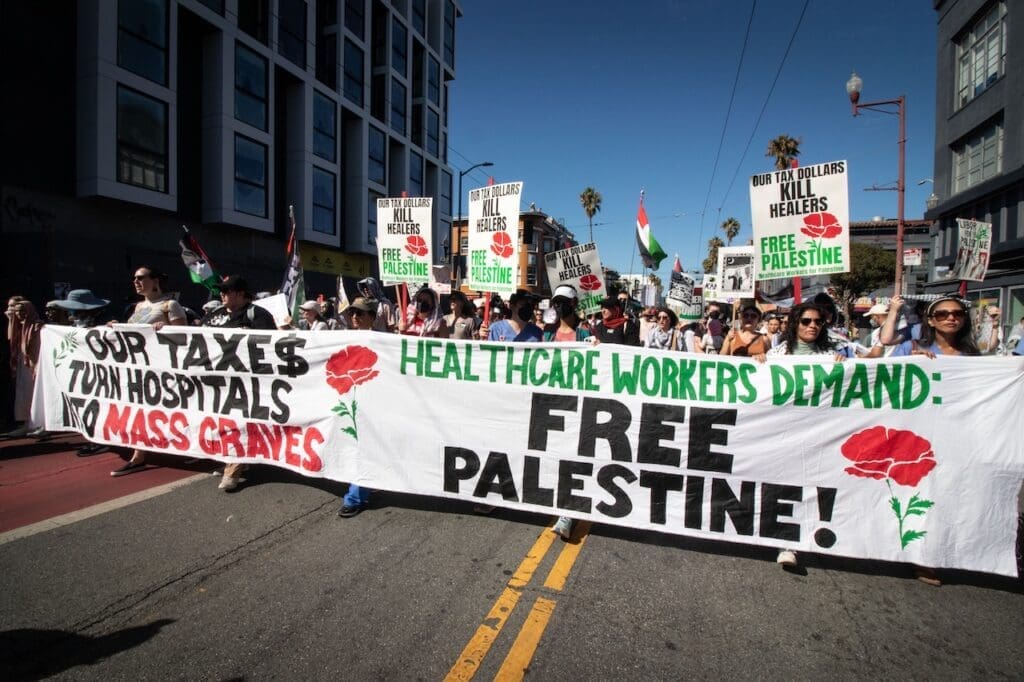
Over a month ago, students at Columbia University in New York set up an encampment on campus grounds in solidarity with the Palestinian people, especially those in Gaza facing the ongoing genocide. Their demands to the university administration are simple: to disclose and divest from those complicit in the oppression of Palestinians.
This encampment shortly led to other student encampments across American university campuses and now even further afield, including the UK and beyond, all under the banner of disclose and divest from genocide. Whilst perhaps unprecedented in the case of Palestine, these encampments and protests follow a long legacy of student mobilization in the US against imperialism and war.
And just as their predecessors did, these students have faced brutal repression from police and security forces. Hundreds of students and faculty members have been injured, arrested, and even suspended from their institutions. They’ve also faced smear campaigns by the media and agitators who tried to paint the picture of hate-filled, violent protests, when in fact the opposite has been true.
Palestinian American professor Samer Alatout is the Buttel-Sewell Professor in the Department of Community and Environmental Sociology at the University of Wisconsin-Madison, as well as a faculty advisor for the Students for Justice in Palestine chapter at the university and a member of Al-Shabaka.
Professor Alatout was at his local student encampment when he was assaulted and detained by police. Today he joins me on this episode of Rethinking Palestine to discuss the significance of the student uprising from the perspective of a faculty member. Professor Alatout, thank you for joining me on this episode of Rethinking Palestine.
Samer Alatout 2:24
Thank you, Yara.
Yara Hawari 2:26
Professor, before we go into what happened to you, it would be useful to hear a little bit about the background of these protests and encampments as you understand them.
Samer Alatout 2:34
There is a long history in the United States of student activism, and university campuses have been famously active with protests during, for example, the civil rights movement in the 1960s, during the anti-Vietnam War movement in the 1960s and 70s, then the anti-apartheid movement in the 1980s, and now of course against Israeli apartheid, occupation, and genocide in US universities.
So there is a long history of student activism, and almost always those student activist movements have been brutalized by police force and police violence, and almost always, they affected change.
So while they are ongoing, they are faced with violence. And then within a decade or so, they seem to succeed in changing the discourse — around, for example, the Vietnam War, or civil rights, or apartheid South Africa. They seem to have changed the discourse around those, and you end up with a tidal kind of change in general, not only at the university level.
And so usually when people talk about student movements in the US, people are often proud of those movements — of course, in hindsight. So for example, the university here, the university chancellor in the 1980s apologized for how the university dealt with the students during the Civil Rights era, and they issued an official apology for how they brutalized the students in the 1960s and 70s. They recognized that later on, but at the time these movements happened, there was a lot of brutalization.
Yara Hawari 4:43
That’s an important historical background to today’s student protests, which are anti-war and anti-genocide, but they also have specific demands around disclosure and divestment.
Is it common for American universities to have investments in companies that are complicit in the Israeli regime’s oppression of the Palestinian people?
Samer Alatout 5:07
I don’t know how many people recognize what that investment is and how it happens, but each university has an endowment of some sort. The university has funds that come from gifts or profits from inventions at the university. Those funds become huge at points. For example, my university has about $4 billion. Harvard, of course, has more than $50 billion. But in total, I think the largest 15 universities have about $320 billion in their endowments.
And so what the universities do is invest those endowments in funds — in diversified portfolios, basically buying stocks in companies. These are usually hidden; we don’t know where these stocks are. But there is so much investment, for example, in Lockheed Martin, or Hewlett-Packard, or Motorola Solutions — all of which provide support to Israeli genocide and Israeli occupation.
So for example, Lockheed Martin sells F-16s, which have been prominent in what has happened in Gaza and in other places over the last four decades. HP — Hewlett-Packard — has biometric systems that are used by Israelis to surveil and track Palestinians throughout the West Bank and Gaza. Motorola provides surveillance to Israeli security systems. Elbit Systems is an Israeli company that builds drones and surveillance systems. And there are so many others.
So the universities, because their funds are invested in portfolios — meaning a group of stocks — do invest in these companies. And of course, the profits that come out of those investments go into doing research and paying salaries and funding the general working of the university.
The problem we are having now is that we don’t know what the investments are. At my university, which is very typical of other universities, the university’s foundation — which holds the money and invests it — is created as a separate entity from the university itself. So the university does not control the foundation. The foundation is not very open about its investment strategies or its investments. So we don’t know anything about what kinds of investments are there or where they are. The assumption is that they have them in these companies, but we need to know more about where this money is.
Yara Hawari 8:32
And that seems like quite a reasonable demand — to ask for disclosure. And it’s not unusual for students to ask for divestment, right? It does fit in the context of this long history of student activism against US imperialism and war that you previously mentioned.
Samer Alatout 8:51
Definitely. One thing that this student movement asks for — if you see the slogans — is disclosure first. Disclosure means that these funds should be transparent about where the money is invested. That’s a very basic democratic principle, especially for public universities, but even private universities: to know where the investment is going.
So disclosure is really important, and this is what we are fighting for now. And then the other thing is divestment, which has been practiced often. During the anti-apartheid movement, that was precisely what the students were asking for during the late 1970s and 1980s — for universities to divest from businesses that enabled apartheid in South Africa.
And like I said before, all of these companies I mentioned are enabling Israeli occupation, genocide, and the displacement of Palestinians. And the assumption that we cannot know whether the university is investing in them and profiting out of death and war is important to challenge.
And so the anti-apartheid movement succeeded in the end in forcing the universities to divest, but it also succeeded in a larger scheme of things — businesses started to divest from South Africa and other private companies started to do that, not only the public ones.
Yara Hawari 10:35
And divestment has been a demand of Palestinian civil society by consensus for nearly two decades now. The students are very much answering that call that was made by the BDS movement in the early 2000s.
Samer Alatout 10:51
Yeah, absolutely. And I think what happened in the United States — I cannot speak for other countries or other regions, but in the United States — BDS became a somewhat normalized discourse.
What I mean by that is that there is so much pushback against BDS in the US, right, at a governmental scale. Congress is intervening. The Assembly in Wisconsin and the Senate — our local governance institutions — have written laws saying that we cannot actually boycott Israel and we cannot divest from Israel, that any calls for that are illegal. But at the same time, you find that there is a public discourse that was invigorated initially by the BDS movement.
Here, because Palestinian voices are becoming much stronger and profoundly more effective in the US — which was not the case a few years back — I think that has to do with social media, but also with the fact that Palestinian American scholars and activists have reached a point where they do not want to be silenced anymore or pushed to the background. And I think they are willing to take the risks.
So for example, myself and many other people in the US are taking so many risks. Not from our universities necessarily, because in the end I’m tenured, which means I have certain protections for my job. But also — being able to stand firm against Zionist propaganda and against organizations that mobilize to attack Palestinian voices and Palestinian activists.
There is a sense in which we stepped beyond the line that used to scare us from speaking out. And so now when they speak against us, we speak and we defend and we argue. And I think something has shifted — maybe more Palestinians are here in the US too, and more organizing has happened in the last 20 years. And of course, the BDS successes that happened in the last 20 years have also proved to be effective in some ways. The question is how to carry that forward into the future. And I think the student movement is taking all of that experience into account while working for divestment at this point in the United States.
Yara Hawari 14:03
If you’re enjoying this podcast, please visit our website al-shabaka.org where you will find more Palestinian policy analysis and where you can join our mailing list and donate to support our work.
Columbia University was the first student encampment in the US and there has been a lot of media attention on it. I was wondering if you could perhaps tell us a bit about what’s been happening at your university, the University of Wisconsin-Madison, and perhaps also share with us what happened to you when you visited your student encampment.
Samer Alatout 14:36
At my university, the students started an encampment on the 29th of April, a Monday, and the encampment was amazingly beautiful.
That’s the thing that people don’t always understand — the students are able to create a world that we all look forward to living in. Our students built an encampment that included Jewish, Muslim, Christian, and any number of religions, any number of races, any number of countries of origin. Such a beautiful presence of a community, and it started to cultivate a communal context that is really unheard of within Madison. Many people, especially people of color and people from other countries, were commenting about how the encampment was the only place where they had felt recognized, seen, and appreciated. There was a cultivation of a different kind of relation between people.
What happened is that the university refused to talk to the students before they took down the encampment. And of course, the students refused to take down the encampment, because the tents were on the one hand symbolic — because of what’s happening in Gaza, the students wanted to symbolize that with a real image of tents and by sleeping there. But the other thing is that they felt that the relationship between the administration and them was a relation of power, undergirded by the notion that the administration could call the police and resort to police violence at any moment. There was a threat the whole time: if you do not take the encampment down, we will call the police; if you don’t take the encampment down, we will not talk with you.
In the meantime, we were talking to the administration, asking them to talk to the students, and they refused. So Wednesday morning comes and we hear that the police is coming. Then we go — faculty, staff, and other students who are not in the encampment — to kind of build a human chain around the encampment to protect them.
And this is where — maybe I should talk about my role as a professor and how I see myself. I think often we forget the elements of being a professor that are more important than just the pedagogical and educational elements, and those are that we are there to nurture the students, to protect them. Sometimes we protect them in terms of livelihood, sometimes we protect them emotionally. I take that seriously — that we are there to love them and to be there for them. They are part of us. To cultivate that kind of community or kinship relation, rather than a relation of power built on law or regulations — that is important to me as a professor.
When that happened, I stood between them and the police, and I was at all times in contact with the police and the administration, urging them not to escalate and to deescalate when they came into the encampment. They didn’t.
I think I was targeted in part because I’m a Palestinian. But in general, if you look at it, the police violence led to the detainment of four professors. And guess what — all four professors are professors of color. That was a huge embarrassment to the university and to the students. Most of the ones who were attacked violently and arrested were also students of color. And that’s not because there were no white professors or staff or students — there were a lot — but that begs the question of how the police decide and whether they are trained well enough to protect the civil rights of minorities and people of color.
In any case, they attacked us, and I tried to hold my ground, and I got hurt. You may have seen the pictures and videos because it became a viral moment — I was injured. But in the end, after that, the administration said they would meet with the students. The students took the tents down, but within an hour they put them back up. The encampment continued, and that proved to the administration that they were fighting the will of the students and that it would not work that way.
I think there was an embarrassment that spread within the administration — about the targeting of faculty of color, but also about the police violence enacted against what was a very peaceful encampment that was all about poetry, music, and a celebration of life.
Then at some point, I was part of the mediating and negotiation team. I later withdrew from it because I was really angry with the administration about the way they were sending out messages suggesting that the reason I was detained was because I was violent. I thought they were doing that underhandedly. And I decided to withdraw from the meetings.
Then on Monday, there was a big break in the conversation between the students and the administration — the students withdrew from the discussion because, rightly so, they felt that the administration was not giving them anything and was not moving on their requests. I tried to intervene so that the police was not called again, and probably had a hand in getting the chancellor to meet with the students, which was one of their demands. The next day she met with them, and we ended up with an agreement that does not fulfill the issue of disclosure and divestment, but does give some wins.
For example, a person will be hired to look into support for people who come from war-torn countries and displaced people, especially from Gaza — that’s in the agreement. The agreement also stipulated that it is an agreement between the administration and SJP, Students for Justice in Palestine, which has been vilified for the last year across the US. That was meaningful. There was also an agreement to bring three scholars from Palestinian academic institutions once a year, with extensions possible. And they will review all of the international division programs with an eye on increasing the potential for helping students who come from Gaza or the West Bank.
There were a few things. But I think the key recognition is that the chancellor herself cannot dictate to the foundation what to do with the money. However, she committed to having meetings with the foundation. And now we have in the Faculty Senate — which is the governance institution of the faculty — resolutions on divestment and disclosure that are going to go through, hopefully beginning of the fall. So we are working on those already. They are almost ready to be introduced early in the fall.
Yara Hawari 23:28
It’s not a surprise that police patterns of brutality are reflected on these campuses, targeting people of color. For centuries, people of color have always been the first ones to be brutalized by police and security forces. So that was not surprising at all.
But I do want to take a moment and reflect on what you said at the beginning of that answer — that these spaces cultivated what a different kind of society could look like. And I think in and of itself, that is somewhat of a movement gain.
A lot of people are talking about what a win looks like in these situations, in these encampments. And I think there are so many gains that have been made, even if some students and some campuses haven’t been able to achieve their original demands. That leads me to my next question about the big conversations around when the encampment ends, or when students enter into those conversations with administrations — there are so many different factors to take into consideration. Not all campuses are the same, not all student groups are the same, people studying and working in different environments. And so I think that question will be ongoing for months to come.
But do you have hope? Or do you trust the administration to continue this conversation around disclosure and divestment? Because even though that has been a promise by the chancellor, a lot of people might not have faith that it will actually happen.
Samer Alatout 25:07
That’s a great question. In the agreement, there are timelines for all of these things. So the students can always pressure the institution because of those timelines — there are deadlines for when each of the demands will be accomplished, or each of the wins.
But I’ll go back to your question about the new kind of world that the students have succeeded in creating. My argument to the administration from the beginning has been that, by threatening police force, what they seem to imply is that the administration is the university. I said it often: the administration is not the university. The university is a constellation of groups — students, faculty, staff, and the administration. And governance means that we all have a stake in how the institution presents itself and represents us, and that we all need to be able to feel that we belong.
From the students’ perspective, they need to know that they belong. And the way that they know that they belong is by actually participating in governing the institution itself. My argument has always been that the threat of violence builds a relation of power that basically pits the university administration and the students on two opposite sides and does not see them as working for the same institution.
And so I argued often that the administration needs to actually think of the students as part of it, for it, from it — they belong to us, as do faculty and staff. Those relations shouldn’t be relations of power and force undergirded by the threat of violence; they should be relations of kinship and belonging. Then the encampment can be seen as a protest by the students that is trying to tell the administration: we need a voice in the governance of this institution. We need a voice in how investment is done and what the ethics of investment are. How do we decide what to invest in?
So I think the answer to your question — do I trust the institution to do that? No, I do not trust the institution. But what I do trust is the community that was created, and the community that was created is really powerful. The students are amazing. The faculty and staff that were involved in the encampment or around it are amazing. This coalition that was built will not disappear, and it’s already working on the next steps. There are a lot of steps to be taken during the summer, the fall, and the spring that I think will lead to a change in the form of discussion that’s happening now.
I think one of the things the administration has been doing is saying that the encampment is illegal, and that because it’s illegal, they are bringing in police force. And I keep thinking about how they’re understanding the encampment as a state of exception — as an exceptional protest maneuver by the students that necessitates police force. While they don’t reflect — and this is the irony — they don’t reflect that the students are doing that because of the exceptional status of Gaza, because there is a genocide. And that is the real exception.
If there is a genocide happening in Gaza or anywhere in the world, and students take it upon themselves to help stop that genocide, or to take steps that will lead to stopping the genocide, the occupation, and the apartheid regime — it is because that situation is exceptional that they went the exceptional route of building an encampment. And the administration fails to see how Gaza is exceptional, or that it is a genocide. And they need to rethink that.
Yara Hawari 30:09
I think just because some of the encampments have ended, it doesn’t mean that the movement has. If anything, this has been and continues to be such a huge win for the movement. I think we need to be more mindful and reflect on the gains that have been made. And one of the ones you’ve highlighted has been the widening of this coalition, this community that insists that this genocide won’t be committed in their name.
This is my final question, and maybe a bit repetitive, but as a faculty member and as a Palestinian, how do you see your role in this student uprising?
Samer Alatout 30:47
It’s a really interesting thing. In a way, I wanted to contribute as much as possible of my knowledge and whatever experience I have — in Palestine and here, through my studies and my academic understanding of the situation. But I also wanted to let the students lead, because they are amazing. Even the student negotiators were just powerful — so powerful — and I was very, very proud of them.
And so the challenge is understanding your role as an advisor — in my case — or for other faculty as supporters, while at the same time recognizing that this is a student-led movement. So to frame it in that way, sometimes you have to back up and just let the students do what the students do. My role is support. I saw myself as a supporter of the students. I did participate in the negotiations and the mediation with the administration, but for the most part I saw it as supporting the students and their ideas. At times I gave them my opinion if they asked for it, but in general I was just there to support them.
And I said, even to the Faculty Senate and to the chancellor, that if you bring the police again, I am going to be there. So it’s like — you’re putting the whole community into upheaval, because I will not let the students be brutalized. Whatever happens to the students should happen to me and to the other faculty and staff. And I hope they understand that.
Yara Hawari 32:46
Professor, thank you so much for your time. I’m grateful for your safety following your experience at the student encampments. We hope to have you on Rethinking Palestine again soon.
Rethinking Palestine is brought to you by Al-Shabaka, the Palestinian Policy Network. Al-Shabaka is the only global independent Palestinian think tank whose mission is to produce critical policy analysis and collectively imagine a new policymaking paradigm for Palestine and Palestinians worldwide. For more information or to donate to support our work, visit al-shabaka.org. And importantly, don’t forget to subscribe to Rethinking Palestine, wherever you listen to podcasts.
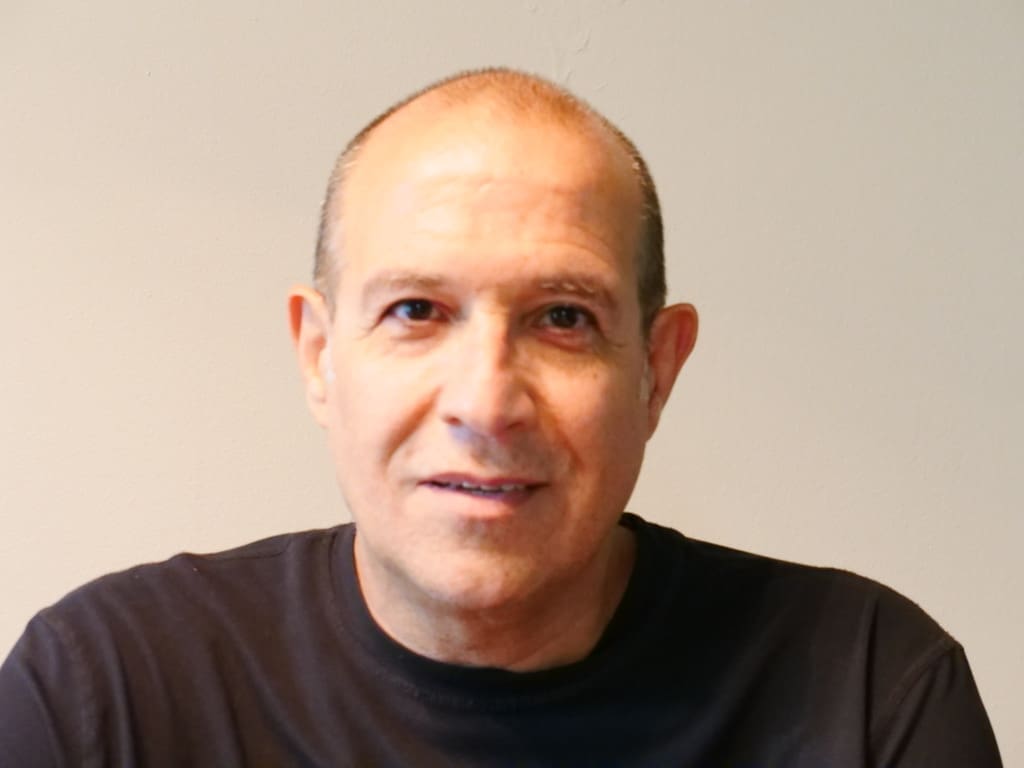
Samer Alatout is an associate professor in the Department of Community and Environmental Sociology and the Nelson Institute for Environmental Studies at the University of Wisconsin, Madison. He has published extensively on water and environmental politics in historic Palestine (1900-2010) and is now working on a book on the subject. Alatout has also published on the politics of occupation (water, the apartheid wall). Most recently, he’s been researching the state building process in Palestine. He is on the Executive Council of the International Water History Association and sits on the editorial boards of a number of academic journals, including Political Geography and Resilience.

Al-Shabaka: The Palestinian Policy Network is an independent, non-partisan, and non-profit organization whose mission is to convene a multidisciplinary, global network of Palestinian analysts to produce critical policy analysis and collectively imagine a new policymaking paradigm for Palestine and Palestinians worldwide.