Article - Corporate Accountability in Palestine: Grassroots Strategies

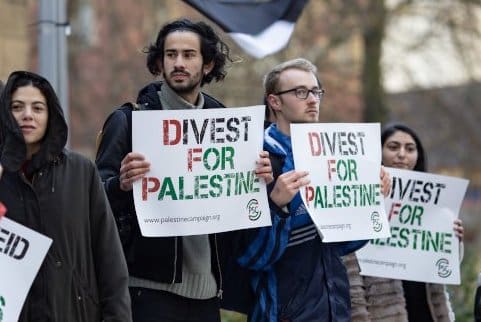
In recent years, Palestine solidarity activists have pressured corporations to end their complicity in the Israeli regime’s violations of Palestinians’ rights. As a result, companies like Ben & Jerry’s, Veolia, and Pillsbury, among others, have pulled their products and services from Israeli markets, albeit to varying extents. How, exactly, have these successes been achieved? What are some of their limitations, and how hopeful should we be for a proliferation in corporate boycotts of Israel?

To answer these questions and more, host Nadim Bawalsa was joined by Sandra Tamari and Omar Barghouti for Al-Shabaka’s first policy lab of 2023.

Omar Barghouti is a Palestinian human rights defender and co-founder of the Palestinian-led Boycott, Divestment and Sanctions (BDS) movement for Palestinian rights. He is a co-recipient of the 2017 Gandhi Peace Award. He holds bachelor’s and master’s degrees in Electrical Engineering from Columbia University, NY, and is pursuing a PhD in Philosophy (ethics) at the University of Amsterdam. He is the author of, BDS: The Global Struggle for Palestinian Rights (Haymarket: 2011). His commentaries and views have appeared in many mainstream outlets including the New York Times, the Guardian, MSNBC, CNN, Le Monde, among others.

Nadim Bawalsa is Associate Editor with the Journal of Palestine Studies. From 2020-2023, Nadim served as Al-Shabaka’s commissioning editor. He is a historian of modern Palestine, and author of Transnational Palestine: Migration and the Right of Return before 1948 (Stanford University Press, 2022). His other work has appeared in the Jerusalem Quarterly, the Journal of Palestine Studies, NACLA Report on the Americas, and as well as in edited volumes. He earned a joint doctorate in History and Middle Eastern & Islamic Studies from New York University in 2017, and a Master’s in Arab Studies from Georgetown University’s Center for Contemporary Arab Studies in 2010. In 2019-2020, he was awarded a PARC-NEH fellowship in Palestine.  
Latest Analysis

 Politics
As the US and Israel escalate their assault on Iran, the Israeli regime has been constructing a war economy to sustain prolonged military campaigns while evading accountability. In September 2025, Prime Minister Benjamin Netanyahu urged Israelis to transform the country into a “Super Sparta” of the Middle East—more militarized, economically self-reliant, and capable of sustaining protracted conflict despite mounting external pressure. This policy brief argues that this rhetoric reflects an emerging doctrine: a political-economic project structured around permanent national mobilization, preventative warfare, and accelerated defense-industrial expansion. Yet the Israeli regime’s shift toward self-reliance is not producing full autarky. Instead, the war economy is consolidating into a hybrid model that combines domestic substitution in critical defense sectors with deeper integration into transnational supply networks, thereby dispersing sanctions risk. This configuration blunts the impact of conventional accountability tools, such as fragmented or weakly enforced arms embargoes. As a result, effective international responses must move beyond traditional sanctions frameworks and instead target the material infrastructure and dependency nodes that sustain Israel’s war economy.
Ahmed Alqarout· Mar 11, 2026
 Politics
Noura Erakat and Jake Romm joined us for a policy lab episode on how Gaza helped shatter the old status quo and what that break reveals about the world being built in its wake.
 Civil Society
On November 4, 2025, the UK government tabled an amendment to the Crime and Policing Bill to curtail protest rights under the pretext of “cumulative disruption.” The revised Bill is now in the House of Lords Committee, where it is scrutinized before advancing toward final approval. The amendment signals a profound shift in how the state regulates public protest. While the government presents the Bill as a neutral public order measure, it emerges directly from sustained national demonstrations for Palestinian rights and introduces new legal concepts that threaten long-established democratic freedoms. This roundtable examines the Bill’s political drivers, legal architecture, and wider implications for social movements and civil liberties in the UK. It shows that the amendment is not simply a public order measure; it is a coordinated political and legal project to narrow the space for dissent in the UK. While Palestinian solidarity is the immediate target of the crackdown on freedom of assembly, the roundtable argues that the consequences will reverberate across labor organizing, racial justice, climate activism, and broader democratic participation.