








Article - Reclaiming The PLO, Re-Engaging Youth

How can the PLO maintain accountability as both a national liberation movement and governing body? How might Hamas and Islamic Jihad be integrated after decades of exclusion? What models of Palestinian youth leadership can be further developed? Al-Shabaka analysts address these and other questions in this full-length report, a year-long exercise facilitated by Alaa Tartir and Marwa Fatafta.1

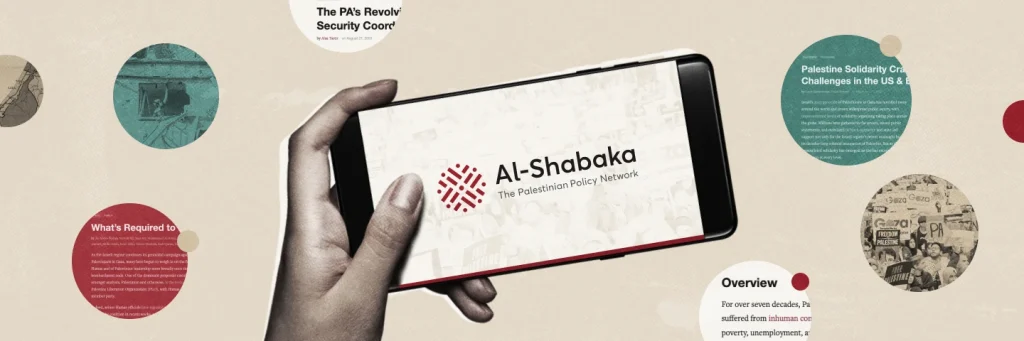
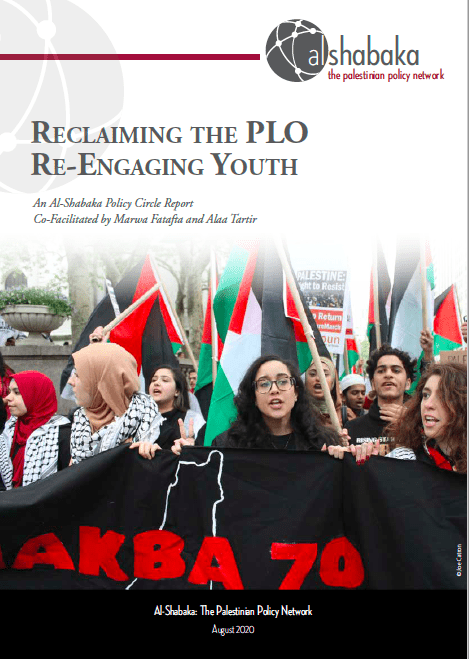
Download here, or click on the image below:
  1. To read this piece in French, please click here. Al-Shabaka is grateful for the efforts by human rights advocates to translate its pieces, but is not responsible for any change in meaning.

Marwa is a Palestinian writer, researcher and policy analyst based in Berlin. She leads Access Now’s work on digital rights in the Middle East and...
Dr. Nijmeh Ali is a Fellow at the National Centre for Peace and Conflict Studies (NCPCS), University of Otago and a lecturer in the GDCR...
Al-Shabaka Policy Member Fadi Quran is a Senior Campaigner at Avaaz and a Popular Struggle community organizer. He previously served as UN Advocacy Officer with...
Al-Shabaka Member Dana El Kurd received her PhD in Government from The University of Texas at Austin. She specializes in Comparative Politics and International Relations....
Belal Shobaki is the Head of the Department of Political Science at Hebron University, Palestine. He is a Policy Member at the Palestinian Policy Network....
(2020, August 13)

Latest Analysis

 Politics
European empires used Christian missions to legitimize conquest in Africa and advance imperial interests, laying the groundwork for a political form of Christian Zionism. British evangelicals were central in transforming Christian Zionism from a theological belief into an imperial strategy by promoting Jewish resettlement in Palestine as a means of extending British influence. This fusion of religious ideology and imperial ambition endures in contemporary Christian Zionist movements, which frame modern Israel as the fulfillment of biblical prophecy and recast Palestinian presence as an impediment to a divinely ordained order. This policy brief shows how these narratives and their policy effects have taken root in the Global South, including in South Africa. In this context, Israeli efforts increasingly rely on Christian Zionist networks to weaken longstanding solidarity with Palestinians and cultivate support for Israeli occupation.
Al-Shabaka Fathi Nimer
Fathi Nimer· Dec 7, 2025
 Politics
On November 17, 2025, the UN Security Council passed Resolution 2803 endorsing US President Donald Trump’s twenty-point plan for Gaza. The vote, pushed through after weeks of US pressure, establishes two supposedly “transitional” bodies to take control of Gaza: a Board of Peace tasked with overseeing aid delivery, reconstruction, and day-to-day administration, and an International Stabilization Force to take over security and disarm Hamas. Notably, the resolution does not refer to the genocide of the past two years, nor does it address accountability for it. Instead, this policy memo shows how the resolution repackages colonial control over the Palestinian people in Gaza, rewards the US—a co-perpetrator of genocide—with control over Gaza and its potentially lucrative reconstruction process, while simultaneously relieving the Israeli regime of all of its responsibilities as an illegally occupying power. Rather than advancing justice, the UN has once again undermined its own legal principles under US pressure.
Al-Shabaka Yara Hawari
Yara Hawari· Nov 20, 2025
 Refugees
Lebanese officials have revived calls to disarm Palestinian factions inside refugee camps, presenting it as part of efforts to curb “illicit weapons” and reinforce state sovereignty. Yet for many Palestinians and regional observers, the refugee-camp disarmament initiative signifies an attempt to recalibrate the region’s security landscape. It also revives traumatic collective memories of earlier disarmament campaigns that left camps exposed to massacres.