






About This Episode
Episode Transcript
The transcript below has been lightly edited for brevity and clarity.
Abdullah Al-Arian 0:00
What we’re seeing now signals a kind of a drastic escalation, just given the severity of the humanitarian toll that this has all taken on Palestinians, to see that Arab states continue to invest in a regional security relationship that they believe is going to serve their interests — the interests not of the people, but the interest of these regimes, that this is the only thing that is keeping them essentially in power — and so they’re willing to do everything in that regard, even if it means dooming the people of Palestine to these horrific conditions.
Yara Hawari 0:37
From Al-Shabaka, the Palestinian Policy Network, I am Yara Hawari, and this is Rethinking Palestine.
Amidst the ongoing genocide in Gaza being perpetrated by the Israeli regime and the accelerated colonization of the West Bank and the rest of Palestine, there have also been regional escalations on various fronts. Israeli forces have been consistently pummeling southern Lebanon throughout the genocide in what they call attacks on Hezbollah infrastructure. But in reality, it’s resulted in not only the killing of Lebanese civilians, but also the destruction of hundreds of homes and evacuations of dozens of villages.
Meanwhile, there have also been provocations with Iran. The Israeli attack on the Iranian consulate in Damascus back in April, which killed two top Iranian commanders among others, and the assassination of the political chief of Hamas, Ismail Haniyeh, on the 31st of July as he was attending the inauguration of the new Iranian president in Tehran. Many internationals have been told to leave the region on the advice of their governments, and a lot of Western-based pundits keep talking about a region on the cusp of war. With so many different players involved and competing interests, nothing is clear.
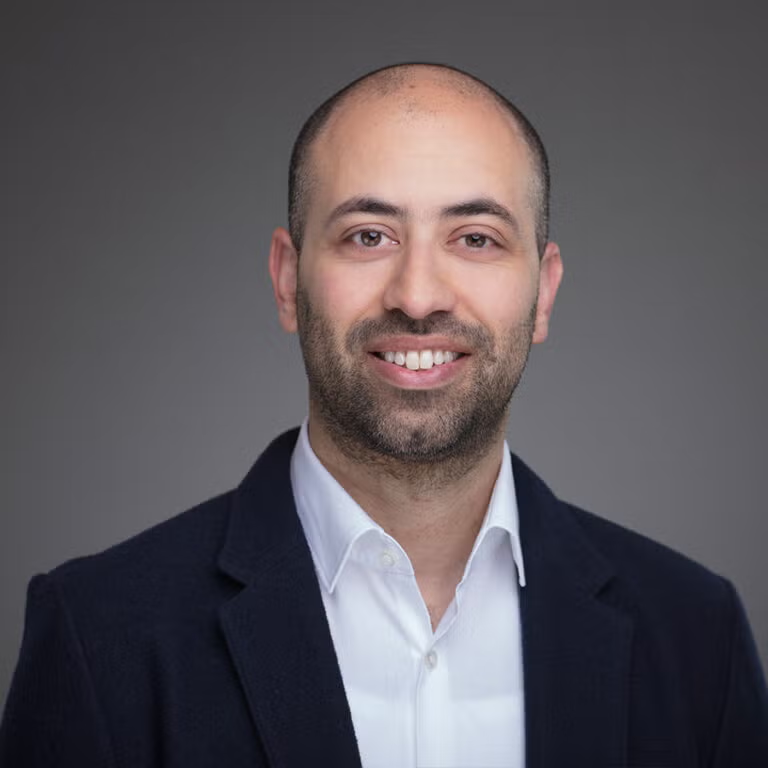
Joining me to discuss all of this is Al-Shabaka Policy Member Abdullah Al-Arian, Associate Professor of History at Georgetown University, Qatar. Abdullah, thank you so much for joining me on this episode of Rethinking Palestine.
Abdullah Al-Arian 2:02
Thanks for having me.
Yara Hawari 2:03
The genocide in Gaza isn’t happening in a vacuum. It’s happening in a wider context of aggressive Israeli settler colonialism, but also shifting alliances in the region, which is very apparent in the way that regimes and leaders have responded to various developments. Can you give us a bit of historical context that will help us understand this?
Abdullah Al-Arian 2:26
I think one of the important things to do when trying to evaluate the role of various regional actors — in particular the various Arab states — is to think through some of the historical developments that have led us to this point.
When we talk about the Zionist project, it was given rise to at the same time that there was a broader colonial project for the entire region. So seeing those things as inextricably linked — the rise of the Arab nation state as we have come to know it very much coincided with the fulfillment of Zionist ambitions in Palestine.
And so what that has meant historically is that Arab states have always determined their course, their development, their fate, in part through their relationship with this settler colonial project in their midst. With the eras of independence, when all of these states more or less achieved their independence from colonial rule, they did so largely on the condition that they would adhere to certain structures — the boundaries between them, the recognition of a broader international relations framework that maintains these states in relation to the state of Israel, which then gets its independence in 1948.
And so as a result, it wasn’t a surprise to many people that the Arab states in 1948 were not in any real serious position to challenge the settler colonial project, given the fact that their militaries had largely been under British and French colonial control and that their heads of state — in many cases monarchs, or even these early forms of elite republican governance — were also very much beholden to imperial interests.
So we already have this deeply intricate relationship in which there was not a significant challenge in the very early years of the Zionist project — which includes of course the thirties and forties, through 1948, and then into the 1950s. This shifts once you start to have revolutionary projects, the rise of Nasserism for instance, but even things like the Ba’ath, the role of communists in the region throughout the 1950s and 60s, that attempt to confront Zionism at that point but obviously fall short in a number of ways.
And I think as a result, we then reach a period by the late seventies and into the eighties where not only do you have things like the Camp David Accords turning a completely different page — having Egypt become the first state to normalize, and it’s the largest Arab state and the most significant in many ways in terms of its political and cultural influence for the previous half century — but that then takes us down a path in which normalization not only becomes an option for these states, but you see the emergence of an entire political elite class that is taking it on as a project.
This is in opposition not just to those large swaths of the populations within their societies that continue to see Palestinian liberation as a core component of their own national identities and as part of both a national and regional political project, but also in line with a realignment toward particularly American influence in this region. These states are being realigned not just strategically and militarily as part of a broader US influence in the region, but even economically, becoming more deeply integrated.
Then the notion of Palestinian liberation becomes completely at odds with most Arab regimes beginning in the 1980s and beyond — with very few exceptions, of course. You see it in Syria and Iraq. Iraq, of course, is meant to serve as a cautionary tale for Arab states, given what happened to it following the US invasion in 2003.
And so once we get closer to this moment, there’s a need to take into account the events and developments of the last decade that have in some ways upended that previous order. On the one hand, you had Arab states slowly shifting their interests and their realignment toward a security order managed largely by the United States and Israel, incorporating the political and military classes of various Arab states. But at the same time, you still had — at least on the cultural level, on the popular level, even on the surface political level — a continuation of a kind of rhetorical commitment to Palestinian liberation.
You would see Hosni Mubarak, for instance, still feigning outrage at the latest Israeli incursion — during the Second Intifada, for example. You would see the withdrawal of ambassadors from capitals like Cairo and Amman. And Palestinian liberation would still be spoken about as a core component by the political class of most Arab states. Certainly normalization never really extended beyond narrow political normalization. You didn’t see massive cultural or educational exchanges; economic exchanges were quite limited.
All of this, of course, changes in the last decade. Once normalization expands to a number of other states — countries like the UAE and Bahrain and Morocco, as well as Sudan — the commitments that arise out of those more recent agreements tend to go far deeper. You start to see much more tourism exchange, educational exchanges, far deeper economic ties being established.
So the question is: what changed? I would argue that really thinking about the Arab uprisings as the moment where the final break between Arab populations and their ruling regimes occurs is key. This is a moment in which you start to see mass uprisings across the entire region making significant demands and airing numerous grievances — one of which is of course on the question of Palestine, but not exclusively. A lot of them are social, political, economic demands, with political freedom being the foremost demand. We start to see very short-lived experiments attempting post-authoritarian transitions in places like Egypt and Tunisia, but even in places like Libya and Yemen, which end up devolving into very destructive civil wars.
All of this is to say that as those uprisings are rolled back quite aggressively and quite violently — we see the coup that takes place in 2013 in Egypt — a new ruling consensus, a new ruling bargain emerges. This is one that no longer has to take popular sentiments into account. This is one that can basically put all of its interests into the hands of the US-Israeli security arrangement being developed for the region. We see it in the deeper military and intelligence ties, the deeper economic ties. And now for the first time, you no longer have any serious expressions — even rhetorical expressions — about the Palestinian issue.
So that by the time we get to fall 2023, Palestine has basically been erased from the entire regional agenda. No one is really talking about it in any serious terms. It’s not even the tenth agenda item at an Arab League summit, or in terms of what the Arab regime press is covering on a day-to-day basis. It’s become completely forgotten. And that of course is very much by design.
And what we hear about more and more is not just this massive wave of normalization projects, but the prospect of Saudi Arabia as being the final feather in the cap, so to speak — the largest prize that Israel and the US have been attempting to bring about as a means of paving the way for even broader normalization, bringing in countries like Pakistan and Malaysia perhaps, and then basically putting an end to the Palestinian question once and for all.
Yara Hawari 11:12
There is palpable anger at the Arab regimes for their inaction amidst the ongoing genocide. And I think it’s not surprising, especially given the historical context that you just laid out. But I do think some are surprised at even the lack of rhetorical condemnation of the genocide by Arab regimes and leaders.
What are some of the things that have stood out to you in recent months that speak to this?
Abdullah Al-Arian 11:45
Well, I think if you told someone even just a few years ago or a decade ago or more, the idea that the military capabilities of Arab states would be mobilized in support of an Israeli genocidal operation, the genocidal war that has been unleashed on Palestinians, people would say, no, that’s a bridge too far. That’s not something that Arab regimes could ever dream of doing, let alone actually putting into practice. And yet that’s exactly what we’ve seen in terms of the mobilization of various Arab forces as a means of shielding Israel in the midst of its genocidal atrocities in Gaza, in the West Bank, by protecting them from any retaliatory strikes.
If you told people just a decade ago that while the population of Gaza is being starved in the worst famine, the worst starvation policy and siege that we’ve seen in modern times, and yet the Arab states would be rerouting trade goods and food for Israelis, I think people would have been shocked and would have basically said, no, that that could never happen. Despite everything we know about these regimes, this would be something too far.
And I think that has been quite shocking for a lot of people. I mean, we know, for instance, that Egypt has maintained its role in the siege of Gaza for going on two decades now. And yet what we’re seeing now signals a kind of drastic escalation, just given the severity of the humanitarian toll that this has all taken on Palestinians, to see that Arab states are only reacting to continue to invest in a regional security relationship that they believe is going to serve their interests.
And again, the interests not of the people, but the interest of these regimes — that this is the only thing that is keeping them essentially in power. And so they’re willing to do everything in that regard, even if it means dooming the people of Palestine to these horrific conditions.
I think that has been, for many people, a surprise — despite everything we know, as I said, and despite all of that history. But seeing it kind of devolve to this level has been really unnerving. And I think what this speaks to is one fact: I don’t think that we’ve ever seen this much of a disparity, a gap, between where the Arab populations are and where their leaders are.
Despite all of the horrific authoritarian rulers they’ve had in the past, despite everything we know about that history, we’ve never seen this wide of a gap. And what we know about that, of course, is that this kind of picture is unsustainable in the long term. You cannot maintain yourself in power through sheer force indefinitely. You can do it here and there, but it’s not something that is sustainable for the long term.
And given everything we’re seeing in terms of Israel’s standing in the region — given its military performance, given the fact that we’re starting to see even just the first steps of some kind of international accountability at bodies that were completely off limits to Palestinians in the past, the ICJ, certain other segments of the United Nations — the fact that those conversations and those actions are beginning speaks to the fact that for these regimes, at least, their positions are becoming more precarious.
The United States, which of course has built an entire regional security arrangement that incorporates all of these various state apparatuses, has never seen its credibility perhaps worse than it is right now. There are going to be many open questions going forward in the wake of this — not just for the Zionist project, but what it means for these Arab regimes as well.
Yara Hawari 15:32
If you’re enjoying this podcast, please visit our website al-shabaka.org where you will find more Palestinian policy analysis and where you can join our mailing list and donate to support our work.
Speaking of the US, at the time of this recording, the US Secretary of State, Antony Blinken, just visited Qatar — where you are based — in what the US government framed as an effort to inject urgency into the ceasefire talks. What can you tell us about this latest effort compared to previous efforts, and what role has Qatar been playing in all of this?
Abdullah Al-Arian 16:15
More and more, I think we are seeing an emerging critique of these negotiations as being, as I’ve said before, no more than bad political theater.
The fact that it takes 10 months to agree on terms that everyone already knows — we know exactly what a ceasefire would look like. We know what it would require. We know what the terms would be, even the phases of things like the exchange of captives. We know about Israeli withdrawal from various territories. We know about lifting the siege that would allow the 2.3 million people in Gaza to get their needs met. All of that is very well known. We know the outlines of it.
So the fact that it has taken this long has produced a sense that these discussions were not only never serious, but that they were actually being deliberately designed to forestall the genocidal war that Israel is waging — that this is about maintaining the ability to continue to wage this war while having this charade of a negotiations process.
And of course you do have states that are involved, attempting to wield whatever leverage and whatever credibility they have to be mediators in this process. But ultimately this comes down to the fact that we know Israel is not serious. It’s becoming more and more clear — if it wasn’t already — that Israel has never been serious about agreeing to a ceasefire, and that the United States has also never been willing to exert any meaningful pressure on Israel.
It’s been said many times that with one phone call, the US president could have brought this to an end, the way past US presidents have. Again, of course, not before there was tremendous death and destruction waged by Israel in previous wars in Lebanon in the 1980s, and in the West Bank during the Second Intifada, and then more recently. But that political will has not been there with this administration. We’re seeing the most pro-Israel US administration in history, and as a result, these negotiations have led nowhere.
A state like Egypt is also very much playing a crucial role in these talks and is, from everything we’re hearing, attempting to extract its own advantages and benefits — playing this role as a way to position itself more closely and realign itself even further with the US and Israel, continuing to faithfully police the border with Gaza, to limit the aid going in, to limit Palestinians who are able to leave in order to seek crucial medical treatment. I think there’s also something to be said about the role of all of these states in that regard.
Yara Hawari 19:24
In addition to what you so aptly described as political theater negotiations, we also know that there were a lot of discussions going on behind closed doors about the day after — the ceasefire, reconstruction in Gaza. Much of it, of course, is nefarious and ill-intentioned, if not all of it. Can you tell us about some of the actors in these discussions and what their interests are?
Abdullah Al-Arian 19:49
So much of this is still unfolding in real time. It’s difficult to get a full handle on it. But I think one thing is clear: Israel, and with it the United States, are attempting to redraw both the actual physical map of Gaza — the actual physical space — and to completely reshape what the political leadership picture will look like there in the aftermath.
And part of that involves enlisting a number of regional actors. On the one hand, this certainly includes the Palestinian Authority leadership, which has never really rejected any kind of invitation to play this role. We know that’s exactly the role they have been playing in the West Bank as it’s been taken apart and absorbed piece by piece over 30 years, without being able to do anything. And so part of the picture would obviously involve including them in any kind of new governing structure.
There continues to be talk about a lasting Israeli occupation, at least in parts of Gaza, dismembering Gaza in a way that would maintain territories under full Israeli occupation. There have been — and again, these are all rumors and reports — talks about the role of other Arab states potentially playing a role as occupying forces. Not as a means of protecting the Palestinians or aiding in the rebuilding and tending to the needs of the survivors of genocide, but in fact, just being there as yet another policing force.
All of these are incredibly concerning from the perspective of Palestinians. At the same time, we saw recently a meeting of the various Palestinian factions coming together to pledge that they would form some unity government that would potentially play that role. And so at least from the statements we’ve seen coming from Hamas, they also envision a post-war Gaza that is governed collectively by all of these different factions, but based on certain common understandings — and the idea would be, of course, not to concede either territorially to an Israeli occupation or even to a kind of subcontracted Arab occupation.
Yara Hawari 22:06
And of course, so many of these international discussions are taking place without any Palestinian presence.
Abdullah Al-Arian 22:13
Yeah, that’s right. I think this has been the dilemma from the very beginning — the fact that a lot of these decisions are being made by actors that do not have Palestinian interests in mind and are attempting to leverage this for their own particular interests, without any Palestinian representation, whether in these talks or in the actual governing structure that is then established.
Any of these attempts will lack legitimacy. There will simply not be acceptance. I think that’s been made clear by the people of Gaza. Everything that we’ve heard — not just in these recent months, but historically — has been that they will not accept a foreign occupying force, irrespective of where it comes from, and one that doesn’t take their needs or their political will into account.
Yara Hawari 23:08
Abdullah, I know it’s difficult to predict what might happen in the coming weeks and months and things can change so quickly, but do you see this expanding further into a wider regional war?
Abdullah Al-Arian 23:25
I think there was certainly a window for that to occur. What we saw at the very end of July with the dual assassinations by Israel — both in Lebanon and in Iran — threatened to upend the state of things as we’ve come to know it, which is kind of much more low-level tit-for-tat exchanges and retaliations. There was that moment. But now that we’re further removed from those events and we’ve seen a lack of any serious retaliation — not to say that there might not still be retaliatory attacks or strikes of some sort — whatever shape they take, at least at this stage, seems less likely to produce that kind of massive escalation that people were fearing.
We know that the US has also deployed far more of its military capabilities in the Gulf region as a means of acting both as a deterrent and to reaffirm its support for Israel — and the idea, at least potentially, that it would be embroiled in some broader regional conflict, which we were told all these parties would like to avoid. Maybe except for Israel, of course, which is attempting to provoke this kind of outcome.
I think from the Israeli perspective, this has always been part of the strategy — to try to deflect from its massive failure. Again, this is according to all of the leading Israeli military officials: they did not accomplish their military goals in Gaza, and we’re now going on 11 months of this genocidal war. So perhaps as a means of deflecting from those failures, they seek to embroil the broader region into a far bigger conflict, one that would, at least from the Israeli perspective, enlist the US as an actor in it.
But that could also be the reason why we’re not necessarily seeing the kinds of reactions that a lot of these groups — whether we’re talking about Hezbollah in Lebanon, whether we’re talking about the Iranian military — are refusing to be lured into what appears to be a trap. At the same time, they continue to issue statements saying that they reserve the right to act on their own timeline. So there are clearly other calculations taking place.
Yara Hawari 25:40
Abdullah, you spoke about this a little bit earlier, but perhaps you can expand your thoughts a little on how the genocide in Gaza will affect the region in years to come.
Abdullah Al-Arian 25:52
I think it’s an important question. As I said before, there was a trajectory for the region that we saw as recently as probably a year ago, in which Palestine had been relegated really to the margins. Again, I wouldn’t ever say that in terms of what it meant for the populations, but certainly in terms of it playing a mobilizing force or having the capacity to forge part of the political identities of even new and upcoming generations — largely because of a very aggressive attempt by regimes to erase it completely.
We’ve seen this even in literal terms. When I say erasing, I mean even Saudi Arabia has, as recently as this year, actually removed Palestine from its textbooks. The map of Palestine has been completely removed. So there was a sense that this was the agenda as it was developing.
And this current moment, the events of the last year, have completely upended that in ways that it’s still too early to fully envision. But certainly the political identities, the solidarities, even the very vocabulary being shaped right now — particularly, I would say, among younger generations of Arab youth, perhaps some who were too young to experience both the highs and especially the lows of the Arab uprisings over a decade ago — are now envisioning a different kind of politics. One that is not cowed by fear of authoritarian reprisal. One that sees in the struggle for Palestine a broader regional struggle for their own liberation from these forces.
And you can measure it in so many different ways. Even if large marches are only possible in certain capitals, one thing we have seen is the massive economic boycotts and what that has led to. We’re starting to see Arab populations expressing themselves politically in ways that we perhaps didn’t really account for in the past — expressing themselves through their roles as consumers within their own societies, and even as producers, when we think about the role that industry is poised to play through the massive trade relationships that some Arab states have had with Israel.
So I think all of this is to suggest that there is a different kind of politics being forged, which we can hopefully continue to learn from and think about — what possibilities that poses going forward, both for Palestinians, but also for the broader populations of this region.
Yara Hawari 28:39
Abdullah, I think we’ll leave it there. Thank you so much for joining me on Rethinking Palestine.
Rethinking Palestine is brought to you by Al-Shabaka, the Palestinian Policy Network. Al-Shabaka is the only global independent Palestinian think tank whose mission is to produce critical policy analysis and collectively imagine a new policymaking paradigm for Palestine and Palestinians worldwide. For more information or to donate to support our work, visit al-shabaka.org. And importantly, don’t forget to subscribe to Rethinking Palestine, wherever you listen to podcasts.