




About This Episode
Episode Transcript
The transcript below has been lightly edited for brevity and clarity.
Layla Kattermann 0:00
One should know their rights. Their current oppression is usually unconstitutional and unlawful. The police certainly are exercising unlawful conduct.
Diala Shamas 0:11
I tell people, don’t stop speaking out, don’t stop opposing genocide. You are on the right side of history, even though it doesn’t feel that way oftentimes.
Yara Hawari 0:27
On October 7th, 2023, Hamas’s military wing, the Qassam Brigades, launched a guerrilla operation beyond the Israeli military fences that encircle Gaza, killing an estimated 1,400 Israelis. Since then, the Israeli regime has embarked on a renewed bombardment campaign and has intensified the siege of Gaza, as well as increasing repression in the West Bank and across colonized Palestine.
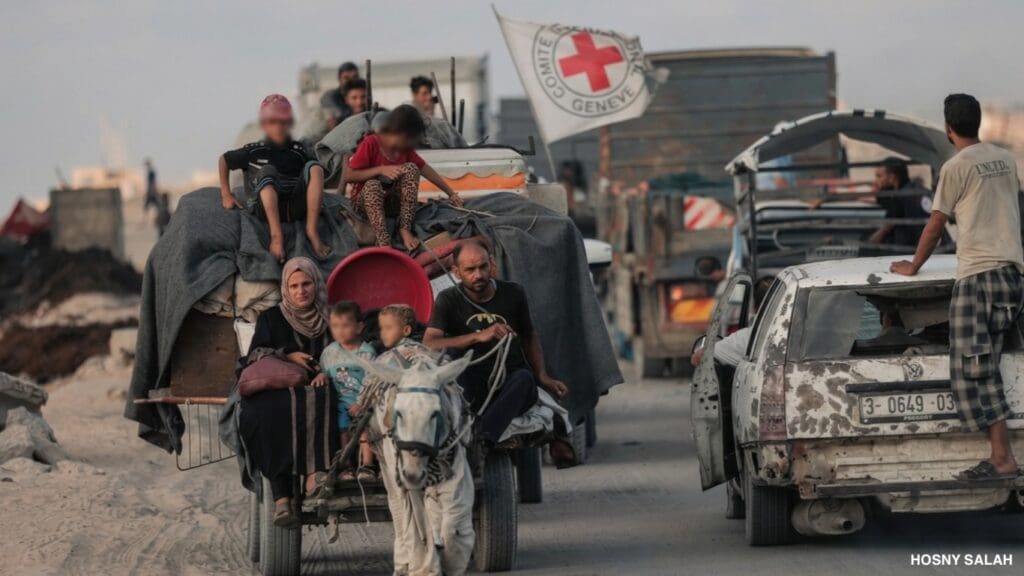
At the time of recording, the Gaza Strip was still under Israeli regime bombardment. The number of Palestinians killed are over 5,000, with at least 2,000 of them children, and the number is still climbing. Many people are still missing, trapped under the rubble of their own homes. This is an ongoing genocide of Palestinians in Gaza.
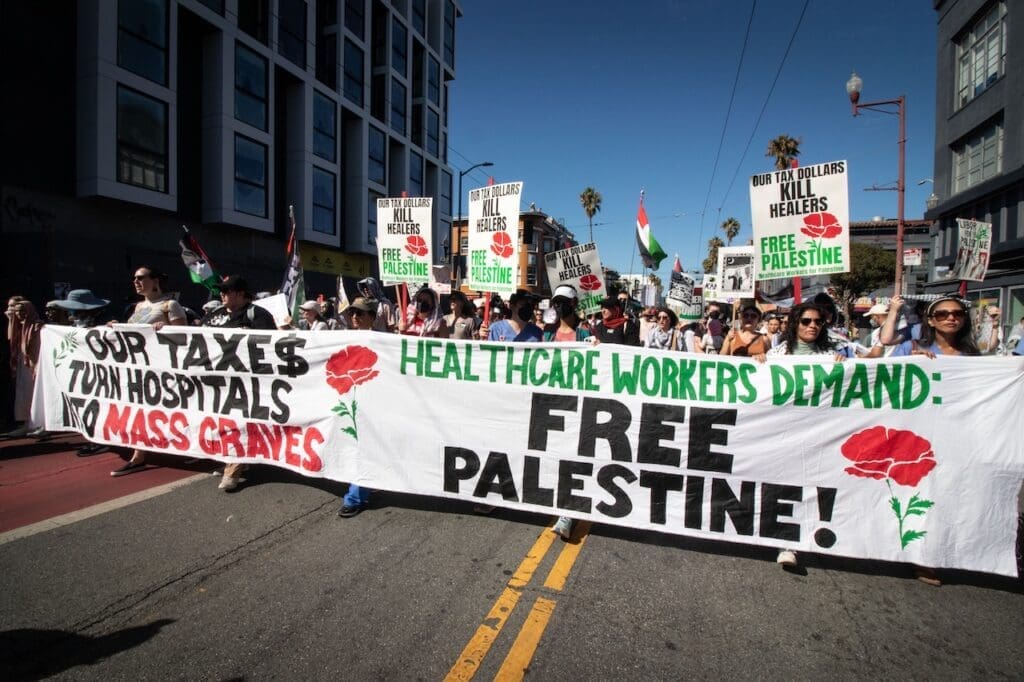
Meanwhile, hundreds of thousands of people around the world have hit the streets in their hometowns, declaring solidarity with the Palestinian people. Organizations and groups have also put out statements condemning the Israeli regime, not only for its most recent onslaught, but also for its decades-long colonial occupation of Palestine.
Yet this widespread international solidarity has been facing repression and an Orwellian crackdown from governments and various different actors. Joining me to discuss what this repression looks like and how we can challenge it are two guests.
Firstly, Layla Kattermann is the monitor project manager for the European Legal Support Center. Layla studied international studies at Leiden University in the Netherlands and specialized in the Middle East, focusing on the media discourse surrounding Palestine and Israeli regime disinformation. Layla is also a co-founder of the National Student Coalition for Palestine in the Netherlands.
And secondly, Diala Shamas, senior staff attorney at the Center for Constitutional Rights, where she works on challenging government and law enforcement abuses perpetrated under the guise of national security in the US and abroad. Prior to joining the Center for Constitutional Rights, she taught and supervised legal clinics at Stanford Law School and CUNY Law School. She also represents and advises social justice and human rights advocates as they face repression at the hands of the state and private actors in regards to Palestine.
Let’s start off with an overview of what we have been seeing in the way of repression of Palestinian solidarity activism. Layla, perhaps we can begin with you. What has this looked like in Europe?
Layla Kattermann 3:04
The kind of repression we’re currently seeing in Europe is the manifestation of its decades-long attempt to connect the Palestinian identity and experience to terrorism and antisemitism.
Although the right to protest is considered an important right in Europe and demonstrations are an indicator of a healthy democratic system, several countries such as Germany, France, and Austria are violating that right by banning pro-Palestine demonstrations. In Germany, not only are protests being banned, but activists are also being harassed by the police for wearing a kuffiyeh or holding a Palestinian flag.
It is also turning into surveillance. We have also witnessed police violence and arrests for showing solidarity with Palestine. In Berlin alone, actually, we have counted 600 detentions since the 11th to the 20th of October. It has been the worst in Berlin where, for example, the Berlin Senate for Education, Youth and Families sent a letter to all Berlin school authorities and supervisors asking to ban kuffiyeh in schools, among other things.
But these other things are any demonstration of activities or expressions of opinion and support of Palestine. So wearing relevant clothing, having stickers with texts like “Free Palestine,” wearing the map of Palestine on a necklace, using expressions such as “Free Palestine” — they have not only been asked to ban such activities on school premises, but also to notify the police when that happens, which even includes primary schools.
In one primary school, the school director was actually suspended for not complying with this ban. Even in France, which is considered the place for protests, the French have also banned protests in cities like Paris and Toulouse. People have not stuck to these demonstration bans.
They still went on the street, not only in France but also in Germany, which has caused a lot of upheaval in the media as well as a lot of police brutality, which were trying to break up these demonstrations. Other forms of repression also include smear campaigns, online deplatforming, withdrawal of use of venues, cancellations of events, disinvitations, threat of legal action. Some people have been fined for having a Palestine flag or umbrella with the kuffiyeh on it. And of course, there’s also loss of employment or suspensions from positions, from political parties or municipalities, etc., for expressing solidarity with Palestine.
The current racist arguments used to justify the repression is not surprising considering the rise of far-right parties in Europe, which have consistently dehumanized migrants, refugees, and Muslims in European foreign and internal politics. But the attack on Palestinians is currently very, very visible.
Yara Hawari 6:07
Diala, what has this looked like in the US?
Diala Shamas 6:11
In the US, we’ve seen a range of incidents of repression, everything from state repression to private repression. On the state side, we’re seeing law enforcement, including the FBI, approach people for questioning — so-called voluntary interviews. The incidents that I’ve heard of are all Palestinians, including people who might have immigration concerns, or where they’re leveraging their immigration status to try to get them to speak with them.
We’ve also seen local police departments circulate notices indicating that they’re going to be doing special monitoring or surveillance of pro-Palestine protests. We of course saw this from the highest levels of government — Biden in his speech said that he was instructing law enforcement to monitor the situation closely. And he was referring to people who are speaking out about Palestine. I mean, that’s how we all understood those remarks.
We’ve also had, here in New York City, the mayor essentially equate protesters who were marching and speaking out in support of Palestinian rights with support for terrorism. We’ve seen that across the board — different elected officials across city, state, and federal levels too. So it’s really concerning when you have this kind of huge power imbalance. You have members of Congress and elected officials talking about student groups, naming individual students, citing student organization statements. That feels really unprecedented.
And then there’s the private repression. We’ve seen this really at frightening levels. There have been campaigns to target and shut down events. This weekend, we were all supposed to be gathering at the conference put on and hosted by the US Campaign for Palestinian Rights. But the Hilton Hotel received so many threats that they ended up cancelling the event.
We’ve also seen a surge in hate crimes. Of course, everybody’s heard at this point of Wadea, the six-year-old in Chicago who was stabbed to death 23 times because he’s Palestinian.
And then we’ve also seen — and this is what I think we’re seeing a lot of coverage of — the sort of professional consequences. We’re seeing the doxxing, which means the posting of private, identifying information of people who are speaking out in support of Palestinian rights or who are speaking out against the genocide against the Palestinians in Gaza, suffering a range of professional consequences, getting fired from their jobs.
We’ve seen that happen at academic institutions, at hospitals. I’ve been in touch with a therapist who’s been fired because they posted something on their social media. And that’s really happening at a scale that we don’t even fully grasp yet. I think it’s happening across the country.
Another example of the doxxing is we’ve seen these Israel-aligned organizations pay for trucks to project the faces and names of students on campuses that have signed statements condemning Israeli atrocities in Gaza. So these are acts of intimidation. They’re intended to have mental health consequences as well as professional consequences.
And these same organizations, as well as individuals, are emailing and calling employers and demanding that their employees face consequences as a result of their speech in support of Palestinian life and rights. The scale of this is still to be seen, but we noticed that most of the targets of a lot of this kind of private doxxing and targeting and private repression are not only Palestinians and Arabs and Muslims, but people of color.
The most public example of this is the NYU student, Ryna Workman, who has drawn the full force of condemnation from the university as well as public officials and newspapers. And I think it’s not a coincidence that the folks who are standing in solidarity with Palestinians are also from marginalized groups themselves and are facing the brunt of this repression.
Yara Hawari 11:09
There’s a lot of people that feel like this kind of repression is unprecedented. Do you think that’s the case? And if so, why?
Layla Kattermann 11:18
No, I don’t think it is unprecedented. The repression of the Palestine solidarity movement or Palestinian rights advocacy did not start with the latest bombardment of Gaza. The ELSC has been monitoring Europe’s crackdown on Palestine solidarity since 2019.
The silencing of Palestinian human rights advocacy, which violates the freedom of expression, assembly, and association — the three freedoms that are fundamental in opening civic space — is not only violated for Palestinians, but also for anyone expressing solidarity with the Palestinian cause.
And it is currently being — I mean, not only currently, but especially now — justified with a racist depiction of Palestinian voices and advocates as terrorist threats and being inherently antisemitic. I’d say that by inscribing the other as a barbaric threat and the self as a moral security, the strategy promoted by Europe to counter Palestine solidarity has made Europeans think in the terms of George Orwell’s 1984 Newspeak, where the objective of Newspeak was to invent new words and strip undesirable ones from their unorthodox meaning.
That is to say, the language used by European media, politicians, and police orders which currently justify this repression is aimed at making a thought diverging from the colonial mainstream narratives literally unthinkable.
At the moment, we see a very strong effort of European politicians and media to socialize Europeans to think and act on Palestine in a way that echoes the “us versus them” and “civilized versus uncivilized” dichotomy of 9/11. However, the mechanisms and tactics used to silence criticism of Israel today are not as visible as imprisonments and murders of dissidents were in the past.
So instead, Israel and Europe practice something that Jasbir Puar calls “the right to maim,” meaning the right to permanently damage or disable a people’s physical, psychological, and organizational strength. So Israel attempts to disable more Palestinians than it kills, such as in the March of Return, and Europe attempts to damage more civil societies than it shuts down.
However, what is different now is that several European states are actually actively shutting down civil societies and criminalizing solidarity groups such as Samidoun, as well as widely used slogans like “from the river to the sea, Palestine will be free.” But what is happening right now might be unprecedented in terms of its criminalization, but at the same time, it is the continuation of a trend that Europe has been working on for five years, such as the implementation of the IHRA definition or anti-BDS motions, which all now are, of course, blowing up in the face of the Palestine solidarity movement.
Diala Shamas 14:11
I think there’s a question of quality and scale. I think it’s not unprecedented to the extent that we have seen all of these avenues of repression for a very long time.
We’ve seen law enforcement target Palestine advocates. We’ve seen campus suppression of activism. We published a report called The Palestine Exception to Free Speech many, many years ago, documenting this. But I do think that the scale is unprecedented. I know from conversations with Palestine Legal, who’ve been doing this — the main organization in the US that supports advocates for Palestinian rights when they face instances of suppression — they’ve never seen these kinds of numbers coming in.
And I think the way to understand this — it’s helpful to think of the sort of architecture of repression. Over at least a decade, there’s been the building of this kind of infrastructure to repress Palestine speech and advocacy, whether it’s through the passing of legislation, whether it’s through the development of these theories of antisemitism or support for terrorism, whether it’s the funding and development of organizations like the Lawfare Project or Shurat HaDin. And so that’s the architecture, and then in a moment like this, it’s like you can just flip a switch and activate it all at once.
So it’s all of the same features, but at a scale that does really feel unprecedented. But these are machines that have become very well-oiled in many ways over a long period of time.
And I would say the only silver lining is, because this has been a longer process — this didn’t all just start yesterday — we also have institutions and professionals who are able to jump in this moment of crisis and provide a line of defense. And I’m here referring to organizations like Palestine Legal and the huge network of attorneys that they’ve built up. Our own organization, CCR, is also able to step in.
We are able to meet this moment. But there’s also a dire need to expand and handle an unprecedented caseload.
Yara Hawari 16:35
If you’re enjoying this podcast, please visit our website, al-shabaka.org, where you will find more Palestinian policy analysis, and where you can join our mailing list and donate to support our work.
So what kind of work have the European Legal Support Center been involved in, in light of this repression?
Layla Kattermann 16:55
So we are movement lawyers, so we are accountable to Palestinian civil society organizations, and we use the law in a pragmatic way. We’re aware of its critical aspects, which usually make law an exploitative tool. So we acknowledge that law is used as a tool of oppression, but we also see law as a tool of resistance that can mobilize people.
We have three pillars at the ELSC: defend, monitor, and advocacy. The defend pillar works as a filter between clients and lawyers. So we offer co-counseling and expertise and also help clients to make campaigns for cases.
We have two approaches to cases. We have offensive cases, which are aimed at holding actors accountable, such as, for example, the case of Anna Younes, where an organization in Germany called RIAS, which monitors antisemitism, adopted the IHRA and had been monitoring Palestinian activists. They made a secret dossier about Anna, portraying her as antisemitic, and she was disinvited from several events. So we sued them for the violation of privacy laws.
Then there’s also another offensive case, which is the BT3P Collective lawsuit against the German Bundestag, against the anti-BDS motion with lawyer Ahmed Abed. In that regard, we already won dozens of cases which defied the legality of that motion.
And then, of course, there are defensive cases where we deal with the damage made by their oppression. I personally work in the monitor sector, where we have collected over 700 incidents of repression in the last three years. And that is excluding the more than 100 incidents that we have collected since October 7th.
Yara Hawari 18:48
Diala, you began talking a little bit about the work that you and your organization have been involved in. Can you expand upon that for us?
Diala Shamas 18:56
Just in the past couple of weeks, we’ve all been in rapid response mode. It’s very hard to strike this balance of focusing on repression and making sure that people are protected as they speak out, and also not lose the focus on what’s happening in Gaza and in Palestine. And so I think the first thing I would say is we’ve been really focused on trying to offer language and analysis, as well as legal analysis, about what Israel is doing against the Palestinian people in Gaza.
We, for example, offered legal analysis that supports what everybody is saying, which is that what Israel is doing is genocide against the people in Gaza, but also laying out US complicity. So we don’t want to lose sight of really the focus here, which is calls to support Palestinians in Palestine.
But at the same time, we have to step up our work to support those who are doing the important advocacy in the US. So we’ve been in rapid response mode, representing individuals who’ve been contacted by the FBI for questioning. We have been fielding calls from people across the country who are dealing with consequences in their workplace for speaking out about Palestine.
I know Palestine Legal is really holding a lot of this. And they’ve been building out an attorney network. A lot of employment law experts are needed right now. A lot of advice on how to handle incidents of doxxing, both in terms of your personal safety as well as your online reputation.
It’s sort of an all-hands-on-deck situation. And it has been really great to see so many people within the legal community reach out and ask how they can support. And so the network is growing to meet that need.
Yara Hawari 21:03
What kind of advice would you give people and groups who are organizing at the moment and who might be feeling apprehensive or fearful in light of all of this?
Layla Kattermann 21:13
My main advice is not to be intimidated. The allegations and accusations that the media and so on use against the Palestine solidarity movement are nothing new. I think we should be confident enough in encountering them.
There’s also a big defiance achievable through numbers. The demonstration bans in Berlin — although the police really tries their best to prevent any assembly or protest from happening — when there are a lot of numbers, they can’t do much. So even though there’s a demonstration ban in Germany and there was one in France, people still went on the streets in huge numbers, so huge that the police couldn’t do anything. Of course they can still be violent, but people will stick together and march regardless.
And apart from that, I think it is the time to speak out against what is happening more than ever before. A lot of people are — I think it is also the time to join forces. To connect with other people at your place of employment or study or elsewhere who share the same passion or will to do something about it, and to organize together.
Smear campaigns, for example, which target a person, usually aim to isolate a person from society. It is always easier to attack one person than a group. So there’s definitely strength in numbers when it comes to defying the current repression.
Diala Shamas 22:50
I think the first thing I’d say is we have to remind ourselves that although we’re seeing this unprecedented repression, we’re also seeing an unprecedented amount of solidarity and people speaking out against what’s happening to Palestinians in Gaza right now.
And we’ve always said this: the rise in repression is in direct correlation with the growing movement for Palestinian rights.
Concretely, I tell people, don’t stop speaking out, don’t stop opposing genocide. You are on the right side of history, even though it doesn’t feel that way oftentimes.
I also tell folks to be cautious. We’re all really angry and outraged, are experiencing a sense of abandonment. We’re all watching these images on our screens of just some of the most horrific scenes. It’s really hard to be our best selves in that moment. It is a moment of rage, of frustration, of sadness. And also, that’s when we most see lapses in judgment. So I think keeping that in mind as we see rises in repression is really important. We can’t, as Palestinians, as advocates for Palestinian rights, afford the luxury of a lapse in judgment.
If you’re contacted by law enforcement for questioning, know that you don’t have to speak with them. So this is my little mini know-your-rights: make sure you just tell them that your lawyer will call them, take their number, and reach out to Palestine Legal or the Center for Constitutional Rights, or your local National Lawyers Guild chapter, or your local CAIR chapter, or your local ACLU chapter.
There are many resources within the movement to support you in that moment. And that’s fine. It’s a normal thing to do.
In terms of the employment piece of it, if you’re being called into a meeting with your employer or your school administration, try to get a consult before going into that meeting, or don’t go in alone. And also, document everything. Keep writing notes, send yourself emails — something with timestamps of events as they come in, because all of that will probably be useful down the line.
If you’re experiencing doxxing, if you’re being harassed online, reach out to Palestine Legal, and their network has people who can help with those particular situations. It might also make sense to try to be preemptive and reach out to your employer or your university administration to let them know that that’s happening and make sure that they’re hearing first from you and not from those who are trying to smear you.
And remember, you’re not alone. Speak out about the repression rather than be silent about it. It’s actually really helpful to be doing that. I think historically, we’ve gone back and forth on this question of whether we want to be advertising how difficult it is to speak about Palestinian rights because we don’t want to be discouraging folks from doing it. But at this point, it’s well past that. Everybody knows that this is happening. And I think when you speak out, you also draw support and solidarity and can also build organizing.
So organizing within your professional network or community — we’ve seen really inspirational models of artists coming together to support each other. We’ve seen people in the medical profession offer up support and find employment when someone’s lost a job. I think that’s the level at which we’re seeing solidarity, and it’s a really important way to be building resilience in these moments of heightened targeting.
Yara Hawari 26:36
Apart from your own organizations, what legal resources would you suggest for people navigating this repression and this moment?
Layla Kattermann 26:47
There are several know-your-rights resources available online, also on the website of the ELSC. We listed a lot of legal resources for several different countries, so that is accessible to everyone.
There are also a lot of collectives of lawyers at the moment, per country, which are actively helping the Palestine solidarity movement. But more than anything, one should know their rights. Their current repression is usually unconstitutional and unlawful. The police certainly is exercising unlawful conduct.
In those situations, it’s always useful to record the police, to register the officer and unit number, and to publicize it. One shouldn’t experience such repression and then deal with it alone. It is very helpful to publicize it. Once you do that, people also reach out to you, and that’s how you can also get a group that will support you.
At the moment, people really are helping each other and standing in solidarity with each other against this repression that we’re seeing. So what’s really important to remember is that you’re not alone. You can report to us, the ELSC. And if any lawyer is listening, please connect with us. And more than anything, just know that there are several ways in which you can fight back and that you shouldn’t accept any of this repression.
Diala Shamas 28:09
Definitely check out resources on Palestine Legal’s website. They have a range of resources, including things other groups have put out, whether it’s law enforcement contacts, doxxing, navigating the university campus setting — that sort of thing.
If it’s specifically regarding state repression, whether it’s federal or local law enforcement, there are a range of organizations that can support you. Contact Palestine Legal — they may be able to also refer you. And I mentioned your CAIR office, your local ACLU, the Center for Constitutional Rights. If that’s the only thing that you remember in that moment, we can try to find somebody to also refer you.
Those are the main legal resources. But I think, also to the point of building up our resilience, these are of course all the legal resources that we need in the first line of defense. But I’d also be remiss to not mention the importance of taking care of yourself. And I’m not necessarily referring to the sort of self-care mode of that, but remembering to breathe and to remember that you are in community, and to reach out to others within your community, because that is actually the thing that allows us to keep going.
These are really, really difficult times. We’re all feeling it. But we don’t really have a choice other than continuing to speak out. We all need to be doing it right now. And the consequences might be dire for us here in the US, but they are really, of course, far worse for the people in Gaza, as well as all over historic Palestine.
Yara Hawari 30:00
I think we’ll stop there. But thank you to both of you for this really important information and uplifting episode in light of everything that’s going on.
Rethinking Palestine is brought to you by Al-Shabaka, the Palestinian Policy Network. Al-Shabaka is the only global independent Palestinian think tank, whose mission is to produce critical policy analysis and collectively imagine a new policymaking paradigm for Palestine and Palestinians worldwide. For more information or to donate to support our work, visit al-shabaka.org, and importantly, don’t forget to subscribe to Rethinking Palestine wherever you listen to podcasts.
Layla Kattermann is the Monitor Team Manager at the European Legal Support Center (ELSC). Layla studied International Studies at Leiden University and specialized in the region of the Middle East, where she focused on the politics of law, the media discourse on Palestine and Israeli disinformation. She is also a co-founder of the Student Coalition for Palestine in the Netherlands.
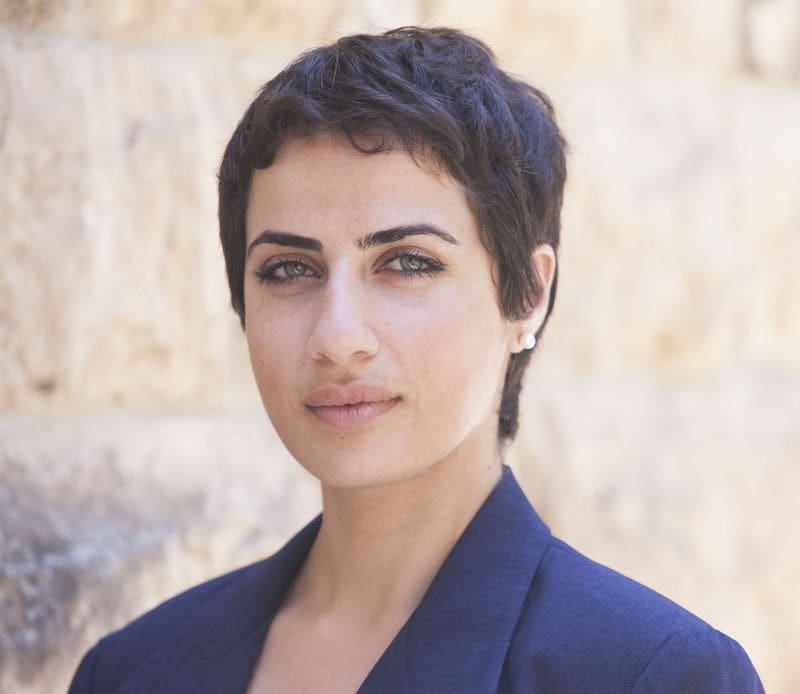
Diala Shamas is a Senior Staff Attorney at the Center for Constitutional Rights (CCR), where she works on challenging government and law enforcement abuses perpetrated under the guise of national security, both in the US and abroad. Prior to joining CCR, Diala was a clinical supervising attorney and lecturer in law at Stanford Law School, and a senior staff attorney supervising the Creating Law Enforcement Accountability & Responsibility (CLEAR) project at CUNY School of Law.

Al-Shabaka: The Palestinian Policy Network is an independent, non-partisan, and non-profit organization whose mission is to convene a multidisciplinary, global network of Palestinian analysts to produce critical policy analysis and collectively imagine a new policymaking paradigm for Palestine and Palestinians worldwide.