


About This Episode
Episode Transcript
The transcript below has been lightly edited for brevity and clarity.
Yara Hawari 0:00
I don’t care that Piers Morgan uttered the word genocide. I don’t care that the Guardian published an editorial recognizing the horrific situation in Gaza. I care about the millions of people who have hit the streets consistently in solidarity with Palestine, and I think it’s there where we’ll see real possibility for change.
From Al-Shabaka, the Palestinian Policy Network, I am Yara Hawari, and this is Rethinking Palestine.
For more than two months, the Israeli regime has been preventing any form of aid from entering Gaza. It’s important to clarify that the aid that was entering before this was a drop in the ocean and was far from meeting the basic needs of a population facing genocide. But the situation has significantly worsened over the last few months, and hundreds of thousands of people are now literally starving.
In addition to this forced starvation campaign, the Israeli army has decided to expand its military ground offensive and bombardments under the ominous title of Operation Gideon’s Chariots. Netanyahu wants to gain what he calls operational control over the entire Gaza Strip. So dire is the situation now that even some of Israel’s staunchest allies, including the UK and Canada, have rebuked Netanyahu.
This has also coincided with a shift in some mainstream media spaces, and a common phrase that has been thrown around recently is that the tide is turning on the genocide in Gaza. But is this really the case? Joining me to discuss this is Al-Shabaka policy fellow Tariq Kenney-Shawa. Tariq, thank you for joining me on this episode of Rethinking Palestine.
Tariq Kenney-Shawa 1:56
Thank you for having me on, Yara, as always.
Yara Hawari 2:00
So this phrase of the tide turning has been used a lot, especially in the last two weeks. What are people talking about exactly?
Tariq Kenney-Shawa 2:08
I want to talk about whether the tide is actually turning. I’m not sure that’s a fully accurate statement. I think of course, what we’ve been noticing over the past couple weeks and maybe over the past two months has been more voices from the mainstream media space that are maybe not saying genocide explicitly, but more outright condemning the indefensible, which is Israel’s starvation policy on Gaza. And my reading of this is that there has been more of a visceral reaction to the reports and images of starving children coming out of Gaza than there have been to the 18 months of aerial bombardment and killing through bombardment, bombs, and bullets and all that.
I think maybe there might be a conversation to be had about whether there are people who perceive a difference in how people are being killed in that sense, whether it’s through starvation or bombs, and maybe some people believe that the starvation tactic is more indefensible than blowing up a school because they buy into Israel’s narrative that they’re targeting Hamas.
But I think that it all ties down to what I would call the Trump effect. Since coming into office, Israel has been acting with even more of a blank check under Trump’s administration than they were under Biden.
Before the ceasefire collapsed, Israel was only permitting a performative trickle of aid into Gaza. But I think that aid was very performative. What the Biden administration did and did so well was create a situation in which Israel could get away with the genocide in the long run.
They did so by providing this facade of sorts, using this humanitarian rhetoric, talking about the importance of getting aid in. I think too many in the international community and in the mainstream media saw this as facilitating a situation in which this was a gruesome war, but at least, you know, the powers are trying to get some aid in during that period.
What’s happened since the ceasefire is that Israel has not allowed any aid in, and the Trump administration hasn’t engaged in that performative aid provision mission. The difference is that while the fundamentals of this genocide remain the same—the killing from the air, the killing from the ground, and the mass starvation campaign—it’s become a lot more transparent as to what’s happening.
The Trump administration has kind of done away with any of the performative steps that the Biden administration took to insulate Israel from international criticism by pretending there was an aid mechanism going on.
And I think that is really what has changed over the last two months or so.
Yara Hawari 4:54
Tariq, you mentioned voices in the mainstream media, and we’ve seen editorials from the likes of the Guardian and the Financial Times, really damning pieces on the West’s inaction and Israeli aggression. Pieces that I think would have been more welcome 19 months ago and feel far too late now.
But also, to be quite frank, entirely hypocritical because in these editorials, there’s absolutely no reflection on the role that the mainstream media has played in manufacturing consent for the genocide to take place in the first place. And for this situation of mass and forced starvation, lest we forget that these media outlets were parroting Israeli propaganda lines for months on end.
Whilst also systematically dehumanizing Palestinians. We didn’t reach this point out of nowhere; there were systematic steps that were taken to get to a point where Palestinians are so dehumanized that only now are people beginning to be horrified. Even Piers Morgan has had this epiphany. But what’s noticeable about this shift?
And you mentioned this, it’s not that all along this has been genocidal, it’s that only now is it becoming genocidal, as if the bombing, the killing, the wanton destruction, everything else up until this point was fine. But now this is where the red line has been crossed. You mentioned about sort of the lack of that performative action, but is this also because people are conscious of a reckoning with complicity in the genocide?
Tariq Kenney-Shawa 6:35
It really depends. When we’re talking about the mainstream media, I think it really varies platform to platform. So, for example, as you said, the Guardian and the Financial Times are both great examples of relatively mainstream publications that have come out with very strongly worded condemnations of the widespread complicity in the genocide in Gaza.
But then on the other side of the spectrum, we have the New York Times, we have BBC News, which are very much seen as these liberal bastions of objectivity and really maintain that reputation. And they have yet to reverse their complicity and their role in manufacturing consent for this genocide.
For example, the BBC continues to describe basically any medical source in Gaza as Hamas-run or Hamas-affiliated, which, automatically, is seen as a means of discounting any reports from Gaza. So I think that first of all, when we’re talking about the tides shifting, I really don’t want to jump the gun. I want to be realistic about who is shifting these tides. And so I think there’s a long way to go before the tides actually shift when it comes to other mainstream platforms like the New York Times and BBC.
But I do think that these other platforms, like the Financial Times or the Guardian, are recognizing what is absolutely a shift in public opinion. That means growing opposition to Israel’s genocide in Gaza, which is especially pronounced in the West, in the US. For months now, the US public has been exposed to images of the atrocities being committed in Gaza, and that’s largely thanks to social media, which makes the proliferation of those images possible.
And that wouldn’t happen without social media. And of course, there’s a lot of censoring and there are many ways that news and reports from Gaza are being censored and silenced, but still a lot of those images get out. And I think platforms like Financial Times, platforms like the Guardian, platforms like the Washington Post, are responding to that shift in public opinion by kind of recognizing the fact that more and more people are recognizing the indefensible nature of this genocide.
I’m not sure about the legal aspects of it because these outlets manufactured consent for the Iraq War and have never faced any consequences for that. But I do believe in the saying that five years from now, 10 years from now, everyone is going to say that they were against this.
I think part of this is a reckoning in that sense. It’s a recognition by these platforms that as more and more people turn against this and see this as completely indefensible, they’re going to want to be on the right side of history, and some platforms are just further along in this process than others.
I do not doubt that even the New York Times and the BBC are going to reach this point. But I think by the time that they do, it’s going to be far too late.
Yara Hawari 9:22
We know from history that after World War II, for example, suddenly everyone had been part of the resistance against the Nazis. When Mandela was freed, suddenly everyone was part of the anti-apartheid movement. So there is precedent for this kind of behavior. I want to switch gears a bit and think about the diplomatic level, because we have also seen some slightly stronger rhetoric from some of Israel’s staunchest allies.
As I mentioned earlier, in a joint statement released on Monday the 19th of May, the British Prime Minister Keir Starmer, French President Emmanuel Macron, and the Canadian Prime Minister Mark Carney said that their respective countries would take “concrete actions if the Israeli regime continued its expansion of military operations in Gaza,” and then they also, of course, called for humanitarian aid to be immediately allowed in.
And this was a sort of “stop the latest military assault or else” kind of statement. But I think the “or else” is not particularly compelling, especially given the concrete actions that the UK, for example, has taken so far, which have been the suspension of negotiations over a future trade deal, the summoning of the Israeli ambassador to the UK, and sanctioning a few settlers in the West Bank. These are really very performative actions that amount to nothing more than a slap on the wrist.
And of course, I don’t need to remind everyone that there was a red line and sort of ultimatum that was given before, during this genocide. Back in 2024, Rafah was considered a red line. We all remember when the “Hands off Rafah” social media post went viral and we saw a lot of other countries branding around their sort of “what else,” but Israel then proceeded into Rafah. And we saw what happened. It was completely decimated.
And the thing is, the UK could be really strong on this. It does have leverage because the UK is still selling arms to Israel, arms that are used to kill Palestinians. They are still flying RAF planes from their bases in Cyprus to fly over Gaza on reconnaissance missions, where they share the information collected with the Israelis. So they could, if they wanted to, set in motion concrete actions that could lead to, for example, an arms embargo.
But the reality is that under Keir Starmer’s government, they won’t do that. So I’m just wondering if you think there is a possibility that some countries will take more concrete actions, unlike the UK, which is obviously performing outrage.
Tariq Kenney-Shawa 12:13
I’m glad you kind of brought up the Rafah red line example, because I think what I’m seeing now is where that tide shifting stops. The tide might be shifting when it comes to public opinion. The tide might be shifting when it comes to even a substantial section of the mainstream media. And I think that the governments of Britain, Canada, and France—they’re reacting to that.
But I very much see them as reacting because they want to return the paradigm to the Biden status quo, which was the continuation of genocide, but under this facade of international law and processes and human rights, and minimal aid provision. What I see in Britain’s actions and Canada’s actions and France’s actions—while they’re absolutely taking steps, whether those steps will actually be implemented and will actually affect the situation is an entirely different question.
If you listen, for example, to David Lammy’s address to Parliament, he was making a very heartfelt and desperate appeal to the Israeli people, right? If you listen to him, he is giving us something to work with. And I think Bezalel Smotrich kind of responded to him directly when he said very publicly about why they decided to let in those, I think it was 98 trucks that they eventually let in, in total over the week.
I think the first day it was nine aid trucks that they let in. And Bezalel Smotrich was saying, “We’re only doing this so that our international allies can get off our back and let us finish the job in Gaza. That’s the only reason why we’re doing this.” And he very explicitly was saying, “These nine aid trucks, they’re not even a drop in the water. They won’t fundamentally change the situation at all. Palestinians are still starving. This is just to get our international allies that we need the weapons from, we need the financial support, and we need the diplomatic shielding from to get off our backs.”
And so while it kind of, you know, goes back to what we were discussing earlier about the Trump effect—the traditional liberal world is saying, and what I mean by the traditional liberal world is Britain, Canada, France, and their approach—now, what they’re saying is that this Trump-approved process of not engaging in the performative aid provisions, that’s not okay, but the Biden paradigm, that’s fine. We can return to the Biden paradigm of, you know, full-on genocide with a performative trickle of aid. That is something that we support. “Israel, work with us. Let us get back to that paradigm, and you can continue to finish the job.”
That’s basically it. And I think that, you know, when it comes to other countries and across the global South, I think we will continue to see countries stepping up, doing, trying to do more—countries like South Africa, continuing to pressure, countries like Colombia, joining in that process. Even Spain seems to be taking a stronger stance, but again, I think we have to think about the loopholes in each of the steps that they’re taking. And at the end of the day, the question of whether that’ll be enough to actually deter Israel is an entirely different question.
And the answer to that, in short, is no.
Yara Hawari 15:22
If you’re enjoying this podcast, please visit our website, al-shabaka.org, where you’ll find more Palestinian policy analysis and where you can join our mailing list and donate to support our work.
The Spanish Parliament passed a motion not long ago calling on the government to impose an arms embargo on Israel in response to its assault on Gaza. And it was introduced by the Leftist Alliance, which is part of the ruling coalition. And then it also recommends reforming Spain’s foreign trade legislation to prohibit military agreements with any state accused of committing genocide or crimes against humanity.
But the motion is non-binding, meaning that there are still quite a few stages that it has to go through before it becomes a binding resolution. And the EU also announced that it was going to review its trade agreements with Israel. So it’s difficult to see or to think about these actions as anything more than performative.
I think Spain is possibly the one where we can maybe think about more seriously as a country that is willing to take more concrete action. But all of this feels far too late. We’re also seeing people pointing to things shifting in Israel. And in particular they’re pointing to statements said by opposition politicians, including Ehud Barak and Yair Golan, who is the opposition leader.
And it feels like people are really sort of grasping desperately onto anything. Like, when you talked about David Lammy sort of really making a plea to Israel, to Israeli society, “Give us something.” It feels like this is sort of in that same vein. Yair Golan, the opposition leader, he said recently, he said that Israel is on the way to becoming a pariah state like South Africa was. And he said that a sane country does not fight against civilians, does not kill babies as a hobby, does not give itself the aim of expelling populations.
Now, this went viral in Israeli society. People were so shocked by this, and Netanyahu attacked him and accused him of blood libel, of course. But some in the international community are seeing this as a sign of hope, and they’re already positioning Golan as this antidote to Netanyahu. But it’s worth reminding people who this man is. Golan is, of course, an ex-Israeli army general, as they all are, and at the start of the genocide, he was enthusiastically calling for the starvation of all of Gaza.
In fact, on the 13th of October, 2023, he said the following—he said, “First of all, close all the electricity switches to Gaza. I think that in this battle, it is forbidden to allow a humanitarian effort. We need to say to them, listen, the captives are released from our side. You can die from starvation. It’s totally legitimate.”
Is Golan having a change of heart, or is he just reading the room and preparing himself to be the favorite of the international community to take over after Netanyahu? I think the latter. And I think also the shift is not happening in Israel. I don’t know if you’ve seen those latest polls that were done in Israel with regards to support of the genocide, but overwhelmingly Jewish Israeli citizens support the ongoing assault, the ongoing starvation, and the expulsion plans for Palestinians in Gaza.
Tariq Kenney-Shawa 19:18
I very much see it just as a matter of style over substance. These people have tactical differences with the current Israeli government, right? Yair Golan, we heard a similar statement from Ehud Olmert, the former Israeli PM who I think called the ongoing genocide a war of annihilation. And I think that at the end of the day, Golan, Olmert, Netanyahu, Smotrich—they all have the same ultimate objective, which is, you know, kind of based on the idea of maximum land with minimum Palestinians.
However, Olmert in my opinion, and Golan, that type of Israeli is a little bit more strategic and recognizes that the best way for Israel to achieve its end goal of maximum land with minimum Palestinians is to do so a bit more gradually and to shield their actions behind lofty, empty facades of human rights rhetoric, like “Israel is the most moral army in the world” and stuff like that. And they recognize that absolutely what Netanyahu is saying and what Smotrich is saying, their rhetoric combined with their actions in Gaza is absolutely turning Israel into a pariah state.
So I think it’s just, you know, again, it’s just that’s a great microcosm of Israel as a whole, right? Because it’s just a matter of people with different figures, with different tactics and the same objectives. And then it ties into the wider population, right? I mean, I think it was over 80% of the Israeli population supports the ethnic cleansing of Gaza, and then 47% of Israelis support the extermination of Gaza’s population. Not much else needs to be said about that.
So I think we can absolutely read the relatively minor tactical differences between Israeli leaders as just differences in style over substance. And I think it’s also important to kind of look into the future and imagine what would happen—Netanyahu’s not going to be in power in Israel forever. Obviously Israel’s right wing, the likes of Smotrich and Ben-Gvir, they’re there to stay and they’re only proliferating. But all it would take is a more quote-unquote moderate government in power in Israel for governments across the West, the US, the UK, to basically throw their arms up in the air and declare victory and say, “Now we can continue returning to our status quo of unconditional support of Israel, and we can be happy about it. We can be proud about it.”
And I think that, you know, Israel can continue its literal actions on the ground the same way if they had different leadership that didn’t say it so plainly. That would fundamentally change things. And I think that again, we’re going back to the same thing where, going back to David Lammy’s speech, I mean, he’s not saying that they’re cutting Israel off. He’s not saying that they’re really applying conditions to its relationship with Israel. What he’s saying is that they’re applying conditions to the relationship with this current Israeli government at this current moment.
And all this current Israeli government needs to do is give them the tools and the words to kind of prevaricate and return to that initial status quo.
Yara Hawari 22:32
Right, because it’s a freeze on future trade negotiations, not on the current trade deals that they have or the arms deals that they have.
Tariq Kenney-Shawa 22:44
Another thing I would say is that I think this is a really important case study in how genocide and ethnic cleansing is carried out in the 21st century. I think one of the biggest differences that separates genocide in the forties, 1940s and fifties and sixties to today is that, you know, genocide has become a much more public process, right? And you know, I think genocidal states or genocidal entities have to contend with the fact that their actions are going to be telegraphed to the world for the world to see.
And that’s not to say that they’re not going to engage in genocidal acts. And that’s not to say that they’re going to change their genocidal objectives. It just means that they have to do it in a different way, right, in a way that covers it up in some ways and makes it a little bit more gradual process that normalizes it as a whole. And I think they have to manufacture consent for it so that the public doesn’t step in and call for intervention. And I think that is one thing.
And then the other thing that we’re learning is how much public response it’s going to take to trigger intervention, right? At what point in the genocide are we going to get to before not only the public says this is enough, but until the point that they can influence the actions of actual policymakers? And I think that is a huge disconnect. That is the main disconnect.
Yara Hawari 24:08
Right, because we have seen massive mobilization for Palestine and Gaza all over the world and consistently for months on end. And I think what this moment really tells us is that people power is not as powerful as we think it might be. And that democracy does not exist in countries where, you know, they are so proud of their democracies.
You know, if there is an overwhelming majority of people that have been against this genocide, why has it continued for so long? And so I do think that this moment is a very reflective moment. I think it tells us a lot about the world in which we live in, and I think there is a realization that the current world order is coming to an end.
And I think, you know, in that sense that the genocide has gutted the liberal rhetoric of a world order and it’s really stripped away its foundational illusions.
Tariq Kenney-Shawa 25:13
I think that hits the nail on the head because if you look back at the last 10, 20, 30, 40 years since the end of World War II, bring it back all the way till then, you know, Gaza isn’t the first genocide. Gaza is the first digitalized and telegraphed genocide to be seen across the world on social media. Sure. Like you say, over the past couple of years, I think what we’re seeing is a far wider problem that Gaza is opening the door for. It’s acting as a warning of sorts, but what we’re seeing is that democracies across the globe, I think, are increasingly insulated from mass politics, period.
And because of that, I think we need to ask ourselves, okay, how do we in general affect policy change if our democracies, if our governments are so fundamentally isolated from the traditional process of mass politics, you know, building people power, building enough support to get behind policy?
And I think tying this back to an individual issue, for example, like, I mean, gun rights—gun rights in the US, a vast, vast majority of Americans want tighter gun restrictions. But to this day, because of the pro-gun lobby and because of the ideological issue that it’s become, it’s not actually being enacted into policy.
And so what does that mean when such substantial majorities of people can be behind a certain policy change or a certain topic or a certain issue and not have that implemented in any way, shape or form? How do we even, how do we move forward in terms of how we organize and organize power? I think that completely changes what it means to be organizing and resisting in today’s day and age.
Yara Hawari 26:50
So, Tariq, that leads me on to my final question. How can we mobilize in this moment where people in the mainstream media and Western political institutions are backtracking?
Tariq Kenney-Shawa 27:05
I think what we’re dealing with right now is, again, it’s much bigger than Gaza. It’s much bigger than Palestine. I think what we’re dealing with now is, again, it’s fundamentally how do we engage in democratic mass politics or why would we engage in democratic mass politics if mass politics has less and less influence on our governing structures and our governing institutions?
My generation has always grown up to at least kind of believe if you get enough people in your camp, if you can cultivate the support of enough people, that’ll inevitably lead to political change, right? And I think that that idea was kind of started getting shattered as early as, you know, the Arab Spring, the Occupy Wall Street movement, and basically every attempted systemic revolution slash popular movement since, right?
But then what comes next if power is not affected by mass politics? Then what is our role in politics? And I’m not, I don’t have an answer to that. If our role as everyday civilians is to cultivate growing opposition to Israel’s genocide in Gaza, for example, in the hopes that enough pressure someday will be placed, for example, on the US government, but if the US government is becoming increasingly insulated from public pressure, especially on this topic because it’s so dependent on entrenched interests like the pro-Israel lobby or the military industrial complex, and if it is ultimately beholden to those over the demands of popular opinion, then where does that place us as civilians?
Yara Hawari 28:55
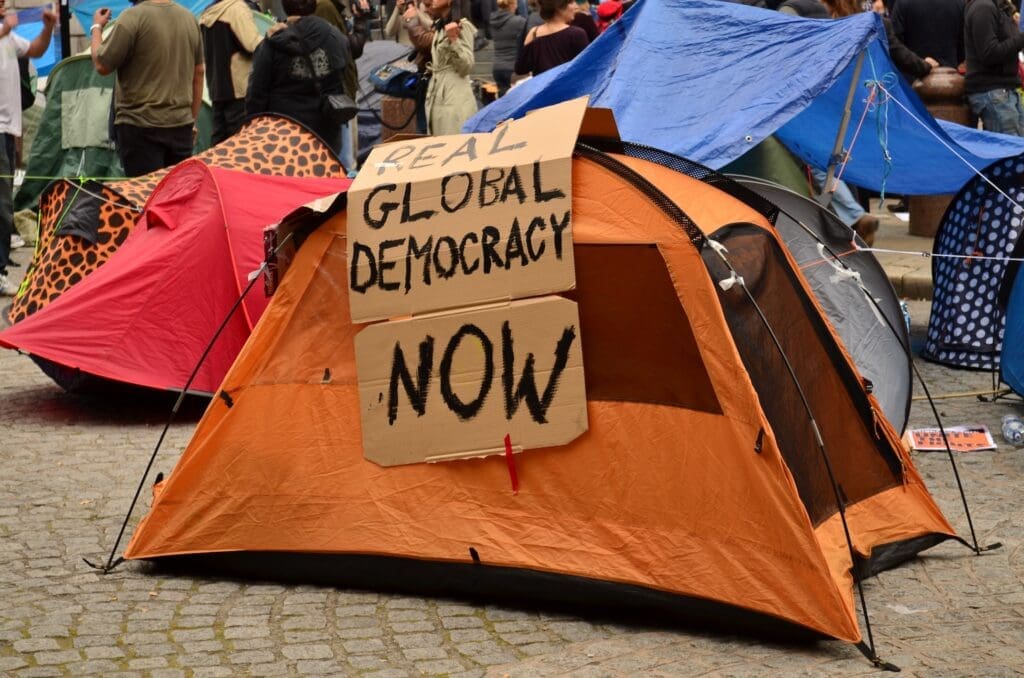
Yeah, I think you’re right, that this moment does require us to reflect on a different kind of politics and, you know, to realize that this is all connected to a question of global and capital interests as well. And if you know, these massive demonstrations, these massive disruptions for literally months on end from protests in the streets, from, you know, campus encampments, from the shutdown of weapons factories, all of these things, if they’re not enough to even shift the needle a little bit, because, you know, we’re not even talking about a massive shift. We’re talking about even just a small shift. If that’s not possible, what does that say about our political system? What does that say about the world order?
And I think, you know, in many ways as I said before, I think this world order is crashing down. And I think it is scary in a way. The unknown is always frightening. But I think one thing that I hold onto with change is that there’s always possibility. And also we have to remember that the world order that we have been living in since World War II was not a world order that benefited the majority of people around the world. It was, you know, it’s supposed to be one that provides stability, self-determination, territorial integrity for all these states worldwide.
But the reality is far more complex than that. In many cases, the world order has been used to support the continued colonization and the exploitation of countries in the global South. So this facade is falling. And I think that can be a frightening thing for some, but I think there is possibility, or we are entering into an era of possibility to create something entirely different.
This isn’t to romanticize or to overstate the possibility for that. But I think, you know, we have around the world seen massive radicalization and politicization of people because of the genocide in Gaza. And I think for me, I’m more interested in those people than the sort of the people in the mainstream media.
For those who think this phrase, the tide is turning, is being tied to—I don’t care that Piers Morgan uttered the word genocide. I don’t care that the Guardian published an editorial recognizing the horrific situation in Gaza. I care about the millions of people who have hit the streets consistently in solidarity with Palestine. I think it’s there where we’ll see a real possibility for change, but I think it requires massive, massive reflection on the current political system, a massive reflection on the current world order.
Tariq Kenney-Shawa 32:21
I think where this conversation is headed kind of reminds me a lot of all other conversations that we’ve had at Al-Shabaka in terms of future visioning, right? And in terms of if and how we can envision a political future. And, you know, there’s all these theories. I mean, there’s hypernormalization, capitalist realism, like all these, you know, I’m not the first one to say this, basically, is that I think at this stage of capitalism, it’s been very difficult to envision a world that is not a capitalist world, right? For example.
And I think in many ways it is also very difficult to envision a world in which Israel does not exist as an apartheid genocidal entity, right? And I think that the one possible first step in this process of thinking of new ways to engage in mass politics, both when it comes to Palestine and even wider than that, is really taking on a conscious effort to attempt to step outside of the boundaries that we have created for ourselves or fallen into in terms of our ability to envision or picture a new world, a different world, a world that is not confined by the realities of capitalism or by the realities of perpetual occupation and apartheid.
And I think it’s extremely, sometimes it’s extremely difficult to envision a world that is outside of those confines, and that makes it extremely difficult to envision a world in which policy is not necessarily changed by mass politics. And I think that if we’re trying to answer that question in the long run, I think it first takes us trying to, you know, think about and again, envision a future that is separate or outside of the confines of capitalism, of occupation, of apartheid.
I know that that can sound really lofty, and I’m just throwing around kind of terms and stuff, but I think it’s really simple. It’s just a status quo that has been so thoroughly entrenched over so many years that it can become extremely difficult to think outside of. I think that the first step we need to do is to try to figure out how to think outside of the status quo that we’ve become just so used to, and that has become so deeply ingrained in our mindsets. I think that’s just a first step to then thinking about, okay, if the tactics and strategies we’ve been using for decades just don’t apply anymore, or aren’t as effective as they might have been in the past, what might work in this new world, right? And what could work for a future that we want to achieve?
And I think that it’s just like that first step of trying to, you know, I don’t know, call it thinking outside of the box or outside of the status quo or the norms that we’ve gotten so used to. But I think even doing that is an act in itself, and is extremely difficult. It’s a process, but I think it is something we need to do because how can we think about tactics and strategy when, to be honest, sometimes we can’t even envision the alternative, the end goal, the end objective?
That is a first step, and I don’t know what it looks like, but I think at least we can recognize that that’s something that we can do.
Yara Hawari 35:50
I think we’ll leave it there. Thank you so much for joining me on this episode of Rethinking Palestine.
Tariq Kenney-Shawa 35:57
Thank you for having me on as always.
Yara Hawari 36:02
Rethinking Palestine is brought to you by Al-Shabaka, the Palestinian Policy Network. Al-Shabaka is the only global, independent Palestinian think tank whose mission is to produce critical policy analysis and collectively imagine a new policymaking paradigm for Palestine and Palestinians worldwide. For more information or to donate and support our work, visit al-shabaka.org. And importantly, don’t forget to subscribe to Rethinking Palestine wherever you listen to podcasts.
Yara Hawari is Al-Shabaka’s co-director. She previously served as the Palestine policy fellow and senior analyst. Yara completed her PhD in Middle East Politics at the University of Exeter, where she taught various undergraduate courses and continues to be an honorary research fellow. In addition to her academic work, which focused on indigenous studies and oral history, she is a frequent political commentator writing for various media outlets including The Guardian, Foreign Policy, and Al Jazeera English.
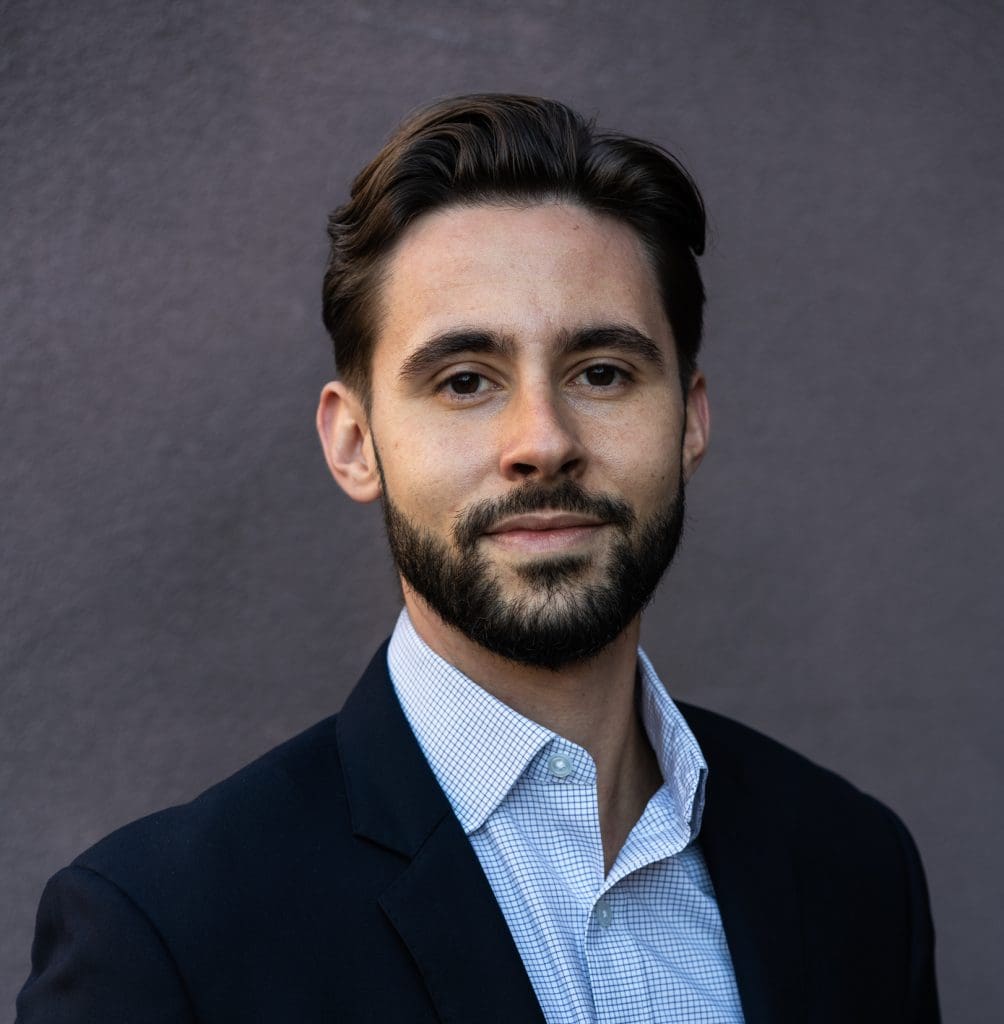
Tariq Kenney-Shawa is Al-Shabaka’s US Policy Fellow and co-host of Al-Shabaka’s Policy Lab series. He holds a Masters degree in International Affairs from Columbia University. Tariq’s research and writing have covered a range of topics, from the role of open-source intelligence in exposing Israel’s war crimes to analysis of Palestinian liberation tactics. His writing has appeared in The Los Angeles Times, Foreign Policy, and The Nation, among others. Follow Tariq on Twitter @tksshawa and visit his website at https://www.tkshawa.com/ for more of his writing and photography.