








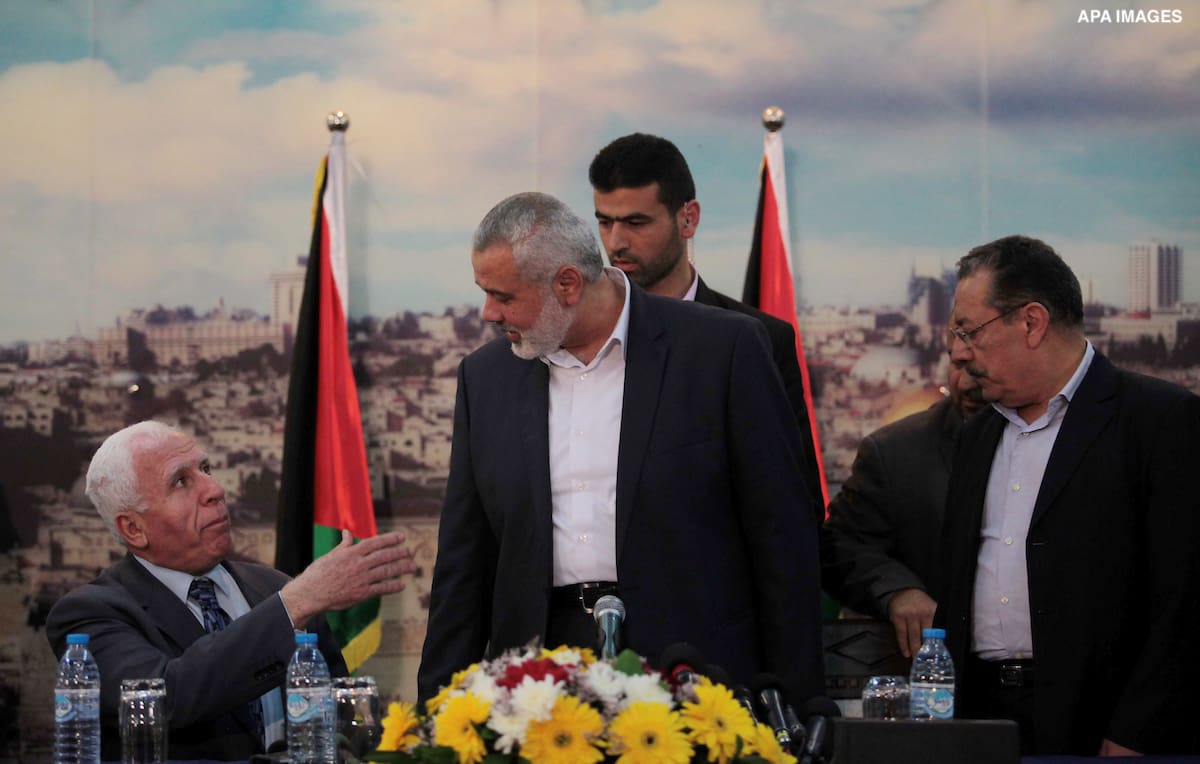
As the Israeli regime continues its genocidal campaign against Palestinians in Gaza, many have begun to weigh in on the future of Hamas and of Palestinian leadership more broadly once the bombardment ends. One of the dominant proposals circulating amongst analysts, Palestinian and otherwise, is the revival of the Palestine Liberation Organization (PLO), with Hamas as a member party.
Indeed, senior Hamas officials have signaled renewed interest in joining the coalition in recent weeks, and former Palestinian Authority (PA) Prime Minister Salam Fayyad recently argued that the PLO must expand its membership to include both Hamas and Islamic Jihad in order to secure popular legitimacy. Current PA Prime Minister Mohammad Shtayyeh has likewise indicated a willingness to consider Hamas as a member, provided the movement accepts the PLO’s standing mandate.
But revival of the PLO requires more than bringing Hamas, and possibly Islamic Jihad, into the fold. For the past 20 years, the Fatah-controlled PA has effectively whittled down the PLO to a barren institution, serving primarily its own interests rather than those of the Palestinian people as a whole, as was originally intended. What then, beyond inclusion, is needed in order to resuscitate the viability of the PLO? What resources exist to carry out this effort, and who may champion such a project to ensure a self-determined result?
In an effort to strengthen the generative thinking around these questions, Al-Shabaka revisits a collection of its past works that sought to confront this very topic. Together, these pieces lay bare the reality that the questions many are grappling with today are not new, but rather the continuation of a years-old discussion among the Palestinian community.
Reclaiming The PLO, Re-Engaging Youth
by Nijmeh Ali, Marwa Fatafta, Dana El Kurd, Fadi Quran, Belal Shobaki (August 2020)
In this collection of papers, Al-Shabaka analysts bring a multilayered response to the calls to reclaim the PLO. Belal Shobaki revisits the political evolution of both Hamas and Islamic Jihad, arguing that, after over 30 years of exclusion, the time is ripe to integrate both parties into the umbrella organization. Nijmeh Ali contends with the PLO’s seemingly contradictory nature as both a liberation movement and governing body, arguing that this must first be clarified before an effective form of representation can take shape. Fadi Quran confronts the obstacles in the way of developing authentic leadership, particularly among the youth, and examines the role of resistance as a way out of the morass. Dana El Kurd draws on the diaspora for inspiration, focusing on the Palestinian Youth Movement as a model for how Palestinian umbrella institutions may evolve in an effective and responsive manner. Finally, Marwa Fatafta centers the issue of accountability in the struggle to reclaim the PLO and discusses how to ensure it forms part of the future national movement.
Reviving a Palestinian Power: The Diaspora and the Diplomatic Corps
by Zaha Hassan, Nadia Hijab, Inès Abdel Razek, and Mona N. Younis (May 2021)
This study–the first of its kind–zeroes in on the PLO diplomatic corps and its engagement with the Palestinian diaspora. Together, the four authors unpack the assumption that increased engagement between the diaspora and the PLO diplomatic missions may serve to strengthen the PLO and its representative character. Using a detailed methodology that included interviews with a selection of civil society actors as well as current and former PLO diplomats, the study seeks to assess the potentiality of the diplomatic corps in serving as a key tool to revive both the PLO and collective national aspirations.
Scenario Matrix: Possibilities for the West Bank and Gaza
by Mohammed Al-Rozzi, Yara Asi, Jamil Hilal, Tahani Mustafa, Tareq Sadeq, and Belal Shobaki (May 2023)
The Al-Shabaka Scenario Matrix is a Palestinian-led scenarios assessment exercise that seeks to outline the potential implications and consequences of future political scenarios for Palestinians in the occupied West Bank and Gaza. The matrix presents and analyzes various scenarios that Palestinians are likely to encounter in the near future–including, among others, the revival of the PLO. The matrix utilizes a sectoral approach analyzing the repercussions of these scenarios across specific sectors. To date, the following five sectors are examined: health; governance, security, and the rule of law; the economy; education; and the social sector. Political analysis is likewise provided for each scenario. We invite you to engage with this interactive tool to understand further how a PLO revival may impact various Palestinian sectors.
Palestinian Leadership: What a New Model Might Look Like
by Ali Abdel-Wahab, Tareq Baconi, Marwa Fatafta, Inès Abdel Razek, and Dana El Kurd (June 2018)
In this piece, analysts were asked to respond to three central questions: Which governance model can ensure the full democratic representation and popular participation of the Palestinian people within and outside of the West Bank and Gaza? How can we ensure that a new leadership and institutions are accountable to and meet the needs of the Palestinian people? How can we overcome the geographical and political fragmentation of Palestinians?
In response, Dana El Kurd advocates for a return to the original PLO structure, whereby the Palestinian diaspora would play a key role in refocusing the direction of the Palestinian people. Marwa Fatafta and Inès Abdel Razek propose broader changes, calling for the decentralization of the PLO and PA to give more authority at the local level and break up the current leadership’s power monopoly. Tareq Baconi and Ali Abdel-Wahab recommend the formation of a committee or body outside the current leadership to bring about a new representative model.
The Unity Intifada: Any Role for the PLO?
with Zaha Hassan, Nadia Hijab, and Nadim Bawalsa (July 2021)
The PLO remains visibly absent from popular Palestinian organizing and action, from the Unity Intifada of 2021 to present efforts to resist Israeli settler colonization. This has led many Palestinians to question the organization’s legitimacy and relevance. Do Palestinians still need the PLO? If so, why? Nadia Hijab and Zaha Hassan join host Nadim Bawalsa as they engage with these questions and more in this Al-Shabaka policy lab. Note: This policy lab is only available in English.
The Palestinians and the Necessity of Restoring the PLO
with Nijmeh Ali, Belal Shobaki, and Alaa Tartir (September 2020)
The Israeli regime’s continued annexation of Palestinian land, alongside expanding normalization with Arab governments, makes it imperative for the Palestinians to revive the PLO and reclaim its role as the sole legitimate representative of all Palestinians. Doing so is essential to restoring the Palestinian national project and collective vision, particularly given the failure of the PA and its two-state model. In this policy lab, Belal Shobaki and Nijmeh Ali join host Alaa Tartir to discuss the importance of activating the PLO in the current context and ways to revive the institution as the sole legitimate and democratic representative of the Palestinian people worldwide. Note: This policy lab is only available in Arabic.
2020 and the Palestinian Leadership with Tareq Baconi
with Tareq Baconi and Yara Hawari (December 2020)
In this episode of Rethinking Palestine, Tareq Baconi and host Yara Hawari reflect on the failure of the Palestinian leadership to provide a challenge to the Israeli regime on the ground and to unite an increasingly socially, geographically, and politically fragmented people. Together, they weigh in on the impact of fragmentation on the liberation struggle, the role of Gaza, and possibilities for political reconciliation among the dominant Palestinian factions. Note: This podcast episode is only available in English.
For further analysis on Palestinian leadership and the PLO, we encourage you to review our previous compilation, Focus On: PLO and Palestinian Representation (2017).

Marwa is a Palestinian writer, researcher and policy analyst based in Berlin. She leads Access Now’s work on digital rights in the Middle East and North Africa region as the MENA Policy Manager. She is also an advisory board member of the Palestinian digital rights organization 7amleh. Previously, she worked as the MENA Regional Advisor for Transparency International Secretariat. Marwa was a Fulbright scholar to the US, and holds an MA in International Relations from Maxwell School of Citizenship and Public Affairs, Syracuse University. She holds a second MA in Development and Governance from University of Duisburg-Essen.
Zaha Hassan is a human rights lawyer and visiting fellow at the Carnegie Endowment for International Peace. Her research focuses on Palestine-Israel peace, the use of international legal mechanisms by political movements, and U.S. foreign policy in the region. She previously served as coordinator and senior legal advisor to the Palestinian negotiating team during Palestine’s bid for UN membership from 2010-2012. She received her J.D. from the University of California at Berkeley and an LLM in Transnational & International Law from Willamette University.
Yara Hawari is Al-Shabaka’s co-director. She previously served as the Palestine policy fellow and senior analyst. Yara completed her PhD in Middle East Politics at the University of Exeter, where she taught various undergraduate courses and continues to be an honorary research fellow. In addition to her academic work, which focused on indigenous studies and oral history, she is a frequent political commentator writing for various media outlets including The Guardian, Foreign Policy, and Al Jazeera English.
Dr. Yara M. Asi is an Assistant Professor at the University of Central Florida in the School of Global Health Management and Informatics. Her research agenda focuses on global health, human rights, and development in fragile populations. She is a Non-resident Fellow at the Arab Center Washington DC, a 2020-2021 Fulbright US Scholar to the West Bank, the Fall 2021 US Fellow at Al Shabaka Palestinian Policy Network, and the co-chair of the Palestine Health Justice Working Group in the American Public Health Association. Along with working at one of the first accountable care organizations in the United States, she has also worked with Amnesty International USA and the Palestinian American Research Center on policy and outreach issues. She has presented at multiple national and international conferences on topics related to global health, food security, health informatics, and women in healthcare, and has published extensively on health and well-being in fragile and conflict-affected populations in journal articles and book chapters. Her work has also been featured in The Washington Post, The Guardian, The Nation, +972 Magazine, The Conversation, Al Jazeera, The World, and other outlets. Her forthcoming book with Johns Hopkins University Press will examine war as a public health crisis.
Tareq Sadeq is Assistant Professor of Economics and Dean of the Faculty of Business and Economics at Birzeit University. He holds a Ph.D in economics from the University of Evry Val d’Essonne in France, where he was engaged in the Palestine solidarity movement and served as head of the General Union of Palestinian Students (GUPS). Tareq has published on monetary policy, macroeconomics, econometrics, labor economics, income inequalities, and entrepreneurship. He is also a researcher in Palestine’s Global Entrepreneurship Monitor (GEM).
Tareq Baconi serves as the president of the board of Al-Shabaka. He was Al-Shabaka’s US Policy Fellow from 2016 – 2017. Tareq is the former senior analyst for Israel/Palestine and Economics of Conflict at the International Crisis Group, based in Ramallah, and the author of Hamas Contained: The Rise and Pacification of Palestinian Resistance (Stanford University Press, 2018). Tareq’s writing has appeared in the London Review of Books, the New York Review of Books, the Washington Post, among others, and he is a frequent commentator in regional and international media. He is the book review editor for the Journal of Palestine Studies.
Tahani Mustafa is a lecturer in International Relations in the Department of War Studies at King’s College London, and a visiting fellow at the European Council on Foreign Relations (ECFR). She holds a PhD from the School of Oriental and African Studies (SOAS), University of London, and previously served as senior Palestine analyst at the International Crisis Group. Her research explores international mechanisms of security sector reform and governance in the occupied Palestinian territories.
Nijmeh Ali is a political scientist specializing in peace and conflict studies, with a focus on resistance and activism among marginalized communities, particularly Palestinians. She holds a PhD from the University of Otago and has held positions as a visiting lecturer at the Willy Brandt School of Public Policy in Germany and as a researcher at the National Centre for Peace and Conflict Studies at the University of Otago. Her work challenges liberal frameworks of citizenship and examines strategies of resistance employed by oppressed groups, including in the areas of digital colonialism and surveillance. She is the recipient of the Middle East Studies Association Global Academy Award (2024) and the European Commission’s Seal of Excellence (2022).
Nadim Bawalsa is Associate Editor with the Journal of Palestine Studies. From 2020-2023, Nadim served as Al-Shabaka’s commissioning editor. He is a historian of modern Palestine, and author of Transnational Palestine: Migration and the Right of Return before 1948 (Stanford University Press, 2022). His other work has appeared in the Jerusalem Quarterly, the Journal of Palestine Studies, NACLA Report on the Americas, and as well as in edited volumes. He earned a joint doctorate in History and Middle Eastern & Islamic Studies from New York University in 2017, and a Master’s in Arab Studies from Georgetown University’s Center for Contemporary Arab Studies in 2010. In 2019-2020, he was awarded a PARC-NEH fellowship in Palestine.
Nadia Hijab is co-founder and honorary president of Al-Shabaka: The Palestinian Policy Network. She served as Board President from 2010-2021 and as Executive Director between 2011 and March 2018. A writer, public speaker and media commentator, Hijab’s first book, Womanpower: The Arab Debate on Women at Work was published by Cambridge University Press and she co-authored Citizens Apart: A Portrait of Palestinians in Israel (I. B. Tauris). She was Editor-in-Chief of the London-based Middle East Magazine before serving at the United Nations in New York. She is a co-founder and former co-chair of the US Campaign for Palestinian Rights and now serves on its advisory board. She continues to serve Al-Shabaka in an advisory capacity and support its mission.
Al-Shabaka Policy Advisor Mona N. Younis is an independent strategic planning and organizational development consultant who specializes in human rights. She has extensive experience in research, teaching, philanthropy and non-profit organizations. Mona co-founded the Fund for Global Human Rights (Washington, DC) and the Arab Human Rights Fund (Beirut, Lebanon). She has published on social movements, community development, philanthropy and human rights, and is the author of Liberation and Democratization: The South African and Palestinian National Movements (University of Minnesota Press, 2000).
Mohammed Alruzzi is a Lecturer in Childhood Studies at the University of Bristol, the UK. He earned his PhD in Social Anthropology from the University of Fribourg, Switzerland. Before that, he completed his Master’s degree in Childhood Studies at the University of Edinburgh, Scotland, UK. Alruzzi has worked with many international non-governmental organisations and UN agencies, including Mercy Corps, Terre des Hommes, the Norwegian Refugee Council, World Vision and UNICEF. Through his work experience, Mohammed has developed extensive multidisciplinary expertise in children issues. His research interests include child labour, child detention and education policy.
Jamil Hilal is an independent Palestinian sociologist and writer, and has published many books and numerous articles on Palestinian society, the Arab-Israeli Conflict, and Middle East issues. Hilal has held, and holds, associate senior research fellowship at a number of Palestinian research institutions. His recent publications include works on poverty, Palestinian political parties, and the political system after Oslo. He edited Where Now for Palestine: The Demise of the Two-State Solution (Z Books, 2007), and with Ilan Pappe edited Across the Wall (I.B. Tauris, 2010).
Inès Abdel Razek is the Co-Director of the Palestine Institute for Public Diplomacy (PIPD) and its digital platform Rabet, an independent Palestinian organization focusing on international mobilization and digital campaigning for Justice, Freedom and Equality. From 2019 to 2022, Inès was the Advocacy Director of the PIPD, helping to develop the political networks and international advocacy pillar of the organization. Prior to joining the PIPD, Inès held policy advisor positions in the Union for the Mediterranean in Barcelona, the UN Environment Programme in Nairobi and the Palestinian Prime Minister’s Office in Ramallah, where she advised executive leadership on international aid for development policies. Inès is also a board member of the social enterprise BuildPalestine, Advisory board member of Palestine DeepDive, and policy member at Al-Shabaka, the Palestinian Policy Network. She holds a Master’s degree in Public Affairs from Sciences-Po, Paris. Twitter: @InesAbdelrazek
Fadi Quran is Senior Director for the Middle East and North Africa at Avaaz, where he has worked since 2014. He previously served as UN Advocacy Officer with Al-Haq’s legal research and advocacy unit. He is also an entrepreneur in the alternative energy field, having founded companies bringing wind and solar energy to Palestine and the region. Fadi holds degrees in Physics and International Relations from Stanford University.
Dana El Kurd is Associate Professor of Political Science at the University of Richmond and a senior nonresident fellow at the Arab Center Washington. She specializes in Palestinian and Arab politics, with a focus on mobilization, public opinion, and international intervention. Her book Polarized and Demobilized: Legacies of Authoritarianism in Palestine was published by Oxford University Press in 2020. Her work has appeared in academic journals including Global Studies Quarterly and Democratization, as well as in Foreign Policy, Foreign Affairs, and the Financial Times.
Belal Shobaki is the Head of the Department of Political Science at Hebron University, Palestine. He is a Policy Member at the Palestinian Policy Network. He is the founder and coordinator of the Double Master’s degree program in Public and cultural Diplomacy at Hebron University with University of Siena, Italy. He has published on Political Islam, identity, democratization and Palestinian issue. He is also leading Hebron University team of a 3 years project: Strengthening of National Research Capacity on Policy, Conflict Resolution, and Reconciliation, funded by the Erasmus+ program of the European Union. He has previously taught at An-Najah National University, Palestine and at IIUM, Malaysia.
Alaa Tartir is Al-Shabaka’s program and policy advisor. He is a senior researcher and director of the Middle East and North Africa Programme at Stockholm International Peace Research Institute, as well as a research associate and academic coordinator at the Geneva Graduate Institute, global fellow at the Peace Research Institute Oslo, and governing board member of the Arab Reform Initiative. Alaa holds a PhD from the London School of Economics and Political Science and is co-editor of Resisting Domination in Palestine: Mechanisms and Techniques of Control, Coloniality and Settler Colonialism (2023), Political Economy of Palestine: Critical, Interdisciplinary, and Decolonial Perspectives (2021) and Palestine and Rule of Power: Local Dissent vs. International Governance (2019). He can be followed on Twitter (@alaatartir), and his publications can be accessed at www.alaatartir.com.
Ali Abdel-Wahab is a data analyst and policy researcher with over 8 years of experience in monitoring, evaluation, accountability, and learning (MEAL) in the humanitarian sector. He holds a bachelor’s degree in computer science and applies computational social science and political economy frameworks to his research on Palestinian governance, digital domination, and reconstruction agendas. Ali has authored over 32 policy papers and reports, including work cited in the UN Special Rapporteur’s 2025 report on freedom of expression.