


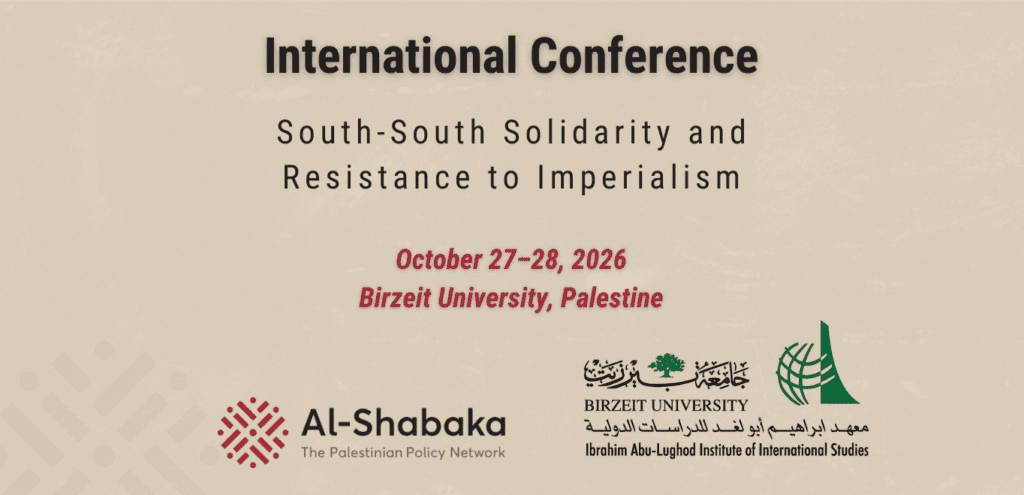
International Conference
Organizers: The Ibrahim Abu-Lughod Institute of International Studies at Birzeit University, and Al Shabaka: The Palestinian Policy Network
Supporting Partners: The Center for Humanities Research at the University of the Western Cape, South Africa, and the National Pedagogical University of Bogota, Colombia.
Date: October 27–28, 2026
Location: Birzeit University, Palestine
In-person and virtual participation
Conference languages: Arabic, English, and Spanish
Call for Papers
In the midst of the ongoing settler-colonial project and genocide in Palestine, shifting configurations of colonial and neo-colonial power worldwide demand closer examination. What was once justified in the language of a so-called “rules-based order” is increasingly giving way to more overt forms of imperial and colonial domination, reflecting and accelerating the erosion of the international system. Across interconnected sites—from military intervention in Venezuela to expanded sanctions on Cuba, from the genocides in Sudan and Palestine to violence in Yemen and Haiti—we can trace a contingent constellation of colonial and imperial forces that is continuously being reconfigured. Attending to these critical nodes facilitates a more precise analysis of the evolving architecture of imperial power, its legal and institutional infrastructures, and its points of fracture and contestation.
At the same time, transnational formations of solidarity have long emerged in opposition to imperialism, settler-colonialism, racial capitalism, and militarized governance. In recent years, these movements have gained renewed momentum, particularly in response to the Israeli settler-colonial regime’s live-streamed genocide in Palestine. They have brought together scholars, activists, policymakers, and civil society actors committed to challenging domination and hegemony, generating new modalities of coordination, knowledge production, and political intervention.
In this regard, Palestine has functioned not only as a site of acute contemporary urgency but also as a generative locus of analytical and political convergence with other resistance movements and solidarity networks. Struggles organized around land dispossession and Indigenous sovereignty, political imprisonment and carceral regimes, economic exploitation and sanctions, and broader projects of decolonization intersect in and through Palestine.
Objective
Building on this understanding, the International Conference on South-South Solidarity and Resistance to Imperialism is conceived as a space for critical engagement, interdisciplinary dialogue, and knowledge exchange. It aims to deepen the understanding of imperialism as both a historical and contemporary constellation of forces while highlighting experiences of resistance and solidarity in Palestine and globally.
Specifically, the conference aims to:
- Deepen critical analyses of imperialism as a historical and contemporary phenomenon, highlighting experiences of resistance and solidarity.
- Bridge theory and practice by convening scholars, practitioners, organizers, and cultural workers representing diverse perspectives across continents and struggles.
- Foster critical academic engagement with South-South transnational solidarity and transhemispheric solidarities, examining their genealogies, infrastructures, and strategic horizons.
- Strengthen advocacy and build actionable solidarity networks across continents while unpacking key opportunities and challenges facing collective action.
The conference addresses a broad and interdisciplinary audience, including academic researchers, political organizers, practitioners, civil society organizations, and representatives of progressive movements. Its distinctive contribution lies in centering transnational solidarities emerging from the Global South and transhemispheric and diasporic communities, positioning these formations not as peripheral to global politics but as generative sites of theory, strategy, and imagination. In doing so, the conference rethinks resistance to contemporary imperial formations beyond conventional North–South paradigms, foregrounding South–South solidarities as foundational to transformative political futures.
Structure and Format
The conference will be organized around four interconnected thematic tracks:
Track 1: Historical Foundations and Contemporary Manifestations
Possible topics include:
- The evolution of colonialism into modern imperialism
- Settler-colonialism as an ongoing project
- The political economy of contemporary neo-colonialism
- Humanitarian aid and its proximity to Western power
- The role of Gulf monarchies and the global billionaire class in shaping neo-colonial power structures
- Comparative perspectives and shared challenges of solidarity
Track 2: Imperial Crimes and International Law
Possible topics include:
- International law as both a tool of resistance and an instrument of imperial power
- State sovereignty and its imperial dimensions
- Building legal solidarity across occupied territories
- Reclaiming and rebuilding international institutions in a multipolar world
Track 3: Solidarity Movements and Grassroots Resistance
Possible topics include:
- Cultural resistance and knowledge sovereignty
- Intersectional approaches to liberation struggles and reciprocal solidarity
- The role of cultural and knowledge systems in sustaining dominance and hegemony
- Anti-capitalist resistance and reducing dependency on Western donor funding
- Resisting the weaponization of the global financial system
Track 4: Economic Justice and Resource Sovereignty
Possible topics include:
- Land reparations and Indigenous solidarity
- Indigeneity and the defense of land
- Resistance to extractive economic models
- Globalization and neo-imperial practices in shaping economic dependency
The conference will be held in Ramallah, with virtual participation options to ensure broad international engagement and accessibility for those unable to travel. It will feature keynote addresses by leading scholars and practitioners, panel discussions, and research paper presentations. Participants will be responsible for covering their own travel and accommodation costs. Conference organizers will provide further logistical information and support closer to the conference date.
Expected Output
Conference papers and proceedings will be published in a joint volume by Al-Shabaka: The Palestinian Policy Network and the Ibrahim Abu Lughod Institute of International Studies at Birzeit University, as well as in additional publication formats, including special issues.
Submission Guidelines
Abstracts of papers (approximately 250 words), along with a short bio, should be sent to [email protected] no later than April 20, 2026.
Letters of acceptance will be sent by May 20, 2026.
Full paper submission deadline: Those selected to participate should submit their full papers (4,000 – 6,000 words) by September 30, 2026.
Abstracts may be submitted in Arabic, English, and Spanish. The conference will provide simultaneous translation in all three languages.

Al-Shabaka: The Palestinian Policy Network is an independent, non-partisan, and non-profit organization whose mission is to convene a multidisciplinary, global network of Palestinian analysts to produce critical policy analysis and collectively imagine a new policymaking paradigm for Palestine and Palestinians worldwide.