- Topics
-
Topics
See our analysis on civil society and how it shapes culture, politics, and policies
Read our insights on the shifting political landscape and what it means for Palestine
Learn more about the policies and practices shaping the Palestinian economy
Strengthen your understanding of the unique conditions for Palestinian refugees across the Middle East
-
- Analysis
-
Analysis
In-depth analysis on existing or potential policies that impact possibilities for Palestinian liberation.
Insights and perspectives on social, political, and economic questions related to Palestine and Palestinians globally.
Concise analysis into a specific policy, its background and implications.
Commentary that brings together insights from multiple analysts.
Compilations of past Al-Shabaka works surrounding a specific theme.
Longer-form, ad hoc projects that seek to confront research questions outside the scope of our regular analysis.
A policy-driven research initiative by Al-Shabaka: The Palestinian Policy Network.
Our monthly webinar series that brings together Palestinian experts.
Featured
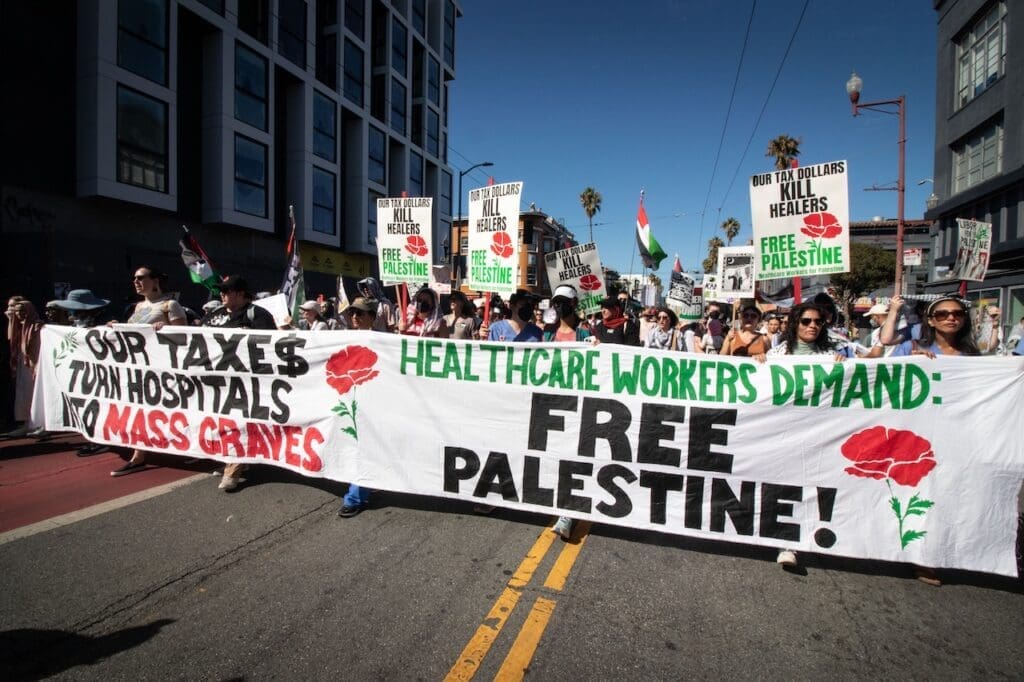
This policy brief argues that the health sciences—from public health to epidemiology, nursing, medicine, pharmacology, and nutrition, among others—have a distinct role to play in preventing and documenting the ongoing Israeli genocide in Gaza and other settings, as well as in generating evidence to inform accountability processes.

 +
+ The Israeli genocide in Gaza has laid bare the extent to which the world remains structured by racial colonial hierarchies and exposed the limits of an international legal order that emerged alongside Western imperial expansion. In this roundtable, Palestinian legal scholar Noura Erakat and Jake Romm, legal advisor and US representative for the Hind Rajab Foundation (HRF), reflect on what becomes of international law after Gaza.

 When four donkeys were evacuated from Gaza to a German zoo in November 2025, their rescue was celebrated as a humanitarian success. Yet while the animals were transported to safety, given new names, and described as leaving behind "hunger and misery, beatings and hardship," Palestinian children have been unable to evacuate amid a relentless ongoing genocide. In this commentary, Asmaa Abu Mezied examines how humanitarian concern operates through racialized hierarchies of grievability that render animal suffering more visible and rescue-worthy than Palestinian human life. She further argues that animal welfare interventions are materially entangled with the dispossession of Palestinian survival infrastructure, showing how it can become an enabling mechanism of colonial violence rather than its interruption.
 Asmaa Abu Mezied· Aug 11, 2026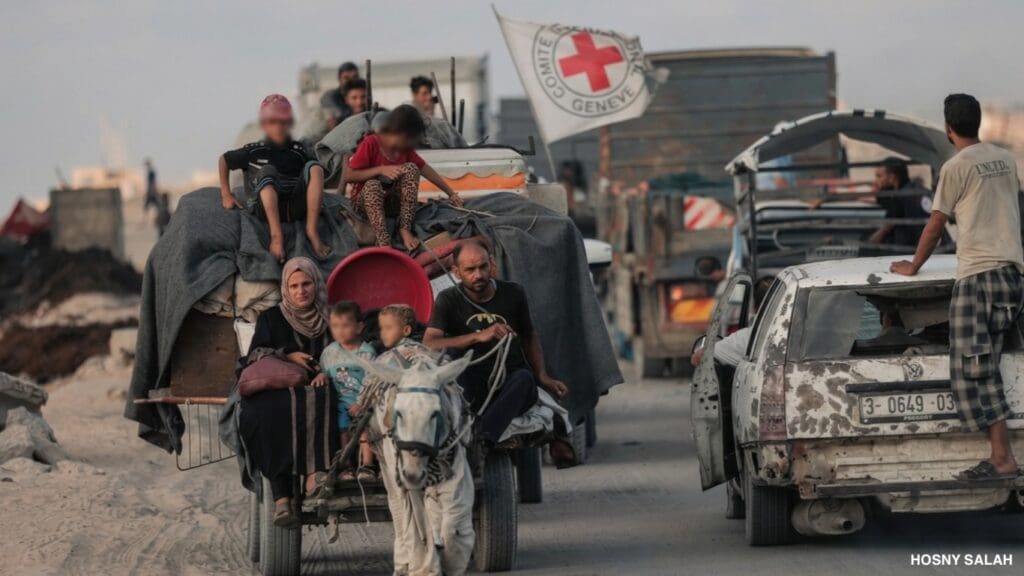
-
- Resources
- Media & Outreach
- The Network
Pope Francis, American Churches, and Palestinian Rights
This commentary is published in English only.
Pope Francis’ September 2015 visit to the US will doubtless reinforce his reach to the new audiences he has attracted beyond the Catholic Church with his strong positions on such issues as the environment, poverty, migrants – and Palestinian rights to freedom and equality.
Yet the Catholic Church is among a handful of establishment US churches – the Episcopal and Lutheran churches are two others – that has yet to endorse divesting from companies profiting from Israel’s occupation of Palestine or boycotting products made in the illegal Israeli settlements.
Pope Francis could have arranged to make the time during his US trip to find out why the US Conference of Catholic Bishops has not responded to the call that Palestinian Christians issued in 2009. Inspired by the Kairos South Africa document issued in 1985, Kairos Palestine called on Christians worldwide to make the Kairos document “a non-violent instrument, striving for peace with security and dignity for every human being in this Holy Land by bringing the occupation to an end.”
Grassroots organizers at mainline American churches responded by redoubling their efforts at the parish, regional and national levels. Decades of organizing were crowned in the past few years, when the United Methodist Church, the Presbyterian Church USA and the United Church of Christ (UCC) adopted resolutions for divestment or boycott.
And yet, despite significant progress at the diocesan level, the 2015 General Convention of the Episcopal Church failed for the second time to pass any resolutions involving boycott or divestment. In the Catholic Church, meanwhile, there has been little grassroots advocacy even though Pax Christi and the Maryknoll Office for Global Concerns have been outspoken on the issue.
There is speculation that churches with active institutions in the Holy Land are reluctant to pass resolutions for boycott or divestment because their sister institutions are vulnerable to Israeli retaliation. The Episcopal bishops who voted down the resolutions pointed to advice from Archbishop Suheil Dawani of the Diocese of Jerusalem, who subsequently claimed the bishops acted independently of him.
Others who have worked with churches for years as they debated and eventually took the decision to respond to Kairos Palestine’s call for action through boycotts, divestment and sanctions (BDS) believe that the church leadership is most worried about the reaction of Jewish religious organizations in their communities, with which they often partner in domestic projects to alleviate poverty and fight racism. But this misplaced emphasis on interfaith dialogue must not prevent churches from speaking up for the rights of a people under occupation.
Indeed, the Presiding Bishop of the Evangelical Lutheran Church in America, Rev. Elizabeth Eaton, was chastised by members within the church for promoting Jewish-Christian dialogue over the human rights of Muslim as well as Christian Palestinians in Gaza during the 2014 war.
Calling on the bishops to remember their baptismal vow to “strive for justice and peace among all people, and respect the dignity of every human being,” Rev. Naim Ateek, founder of the ecumenical Palestinian Liberation Theology Sabeel movement pointed out that the Israeli government was the only entity to benefit from the Episcopal bishops’ vote.
It is important to remember that the Presbyterians, Methodists and UCC also partner with organizations in the Holy Land. Palestinians of all faiths and backgrounds depend on these hospitals, schools, and other ministries for vital services. The fact remains that church institutions in the Holy Land do not exist in a vacuum but are made up of real people living under conditions of oppression and injustice.
It is also vital to remember that there are American Jewish voices on both sides of the issue. For instance, Jewish Voice for Peace (JVP) with 200,000 members and supporters has taken a clear stand in favor of BDS. The church leadership needs to broaden its perspective to hear the demands of the many other US-based Jewish organizations in support of actions such as boycott and divestment to end a cruel, nearly 50-year occupation and even longer violations of basic rights.
Palestinian Christian voices also need to be heard at this crucial juncture and more Palestinian Christians in the US are coming together to speak up in church forums.
Pope Francis’ voice is sure to shake up establishment churches in the US with a faith that addresses poverty, economic injustice, and the burden of climate change on the poorest of the earth.
As for Israel’s occupation and denial of rights, so far the challenge in the US has come as a response to grassroots pressure within the church. The older and deeper the institutional relationships, the greater the grassroots pressure has had to be. Pope Francis should call on American Christians to make their faith real by responding to Kairos Palestine and following “the logic of peaceful resistance…. sincerely proclaiming that their object is not revenge but rather to put an end to the existing evil, liberating both the perpetrators and the victims of injustice.”
The opinion of individual members of Al-Shabaka’s policy network do not necessarily reflect the views of the organization as a whole.
Joanna Springer
Al-Shabaka Policy Member Joanna Springer is a researcher on development policy and governance reform in the Middle East. She has carried out research and worked for local organizations in Morocco, Qatar and the West Bank. Currently, Joanna is research advisor for a rule of law advancement project in the Arab Gulf. She holds a Master’s of Public Policy and Administration from the University of Massachusetts-Amherst with a focus in economic development.
Grace Said
Grace Said is a co-founder of Al-Shabaka. She holds degrees from Duke University and Columbia University’s Teachers College, and has worked for over thirty years as a software training developer. Among her many roles, Grace serves as a board member of Friends of Sabeel North America, as a trustee of Americans for Children of the Middle East, and as an advisor to the Institute for the Study of Christian Zionism.
Latest Analysis
Health Sciences and Genocide Prevention in Gaza and Beyond
International Law After Gaza: Demise and Political Power
Animal Welfare and Hierarchies of Suffering in Gaza
We’re building a network for liberation.
As the only global Palestinian think tank, we’re working hard to respond to rapid developments affecting Palestinians, while remaining committed to shedding light on issues that may otherwise be overlooked.