






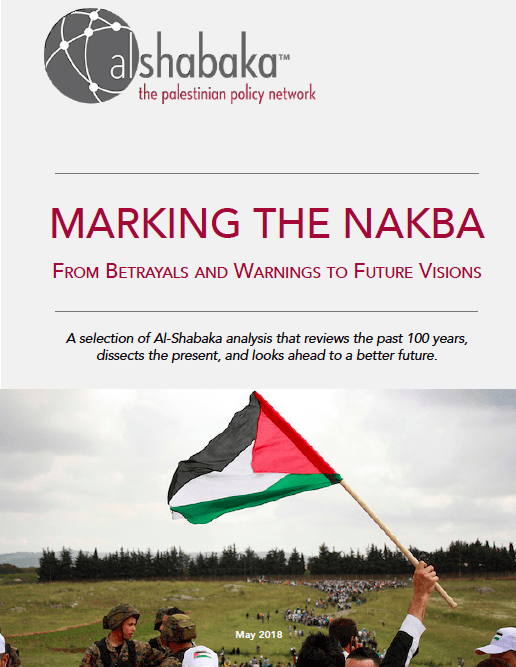
Article - Marking the Nakba: From Betrayals and Warnings to Future Visions

To mark the 72nd year of the Nakba – the catastrophe when Zionist forces evicted the majority of Palestinians from their homes and lands, occupying 78% of Palestine – Al-Shabaka reissues this insightful compilation of essays by its engaged scholars and analysts. These timely pieces dissect the betrayal of Palestine, the struggle of the refugees, the warning signs during the decades of seeking Palestinian-Israeli peace without justice, and strategies for the future. They give us strength at a time of looming annexation and the COVID-19 pandemic.

Download here, or click on the image below:
 

inline_281_https://al-shabaka.org/wp-content/uploads/2018/05/Screen-Shot-2018-05-21-at-2.45.38-PM.png

Al-Shabaka: The Palestinian Policy Network is an independent, non-partisan, and non-profit organization whose mission is to convene a multidisciplinary, global network of Palestinian analysts to produce critical policy analysis and collectively imagine a new policymaking paradigm for Palestine and Palestinians worldwide.

Latest Analysis

 Civil Society
We cannot understand Gaza’s endurance through a binary that casts Palestinians, individually or collectively, as either heroic in their resistance or passive victims. Rather, we must approach it through a decolonial conception of sumud (steadfastness): a historically situated, relational, and materially conditioned practice of collective endurance that emerges, shifts, and persists within ongoing colonial violence.
Abdalrahman Kittana· May 12, 2026
 Politics
This policy brief argues that, by maintaining the classification of such zones as provisional security arrangements rather than permanent borders, the Israeli regime exercises territorial control while limiting the immediate legal and political costs associated with declared annexation.
Ahmad Ibsais· Apr 21, 2026
 Civil Society
In February 2021, Defense for Children International–Palestine (DCIP) reported that Israeli interrogators had raped a 15-year-old Palestinian boy in detention. Rather than investigate the allegation, Israeli forces raided DCIP’s offices and later designated it—along with five other Palestinian human rights groups—as a “terrorist organization.” While such abuses and crackdowns are not new, this moment marked a decisive escalation: the shift from harassment of Palestinian civil society to its outright criminalization with the full support and participation of the US. In 2025, the Trump administration designated six Palestinian organizations under counterterrorism frameworks before advancing even further, sanctioning leading human rights groups for engaging with the International Criminal Court. These measures move beyond targeting individual actors to undermining the very infrastructure of international accountability. This policy brief argues that the campaign by the US and the Israeli regime against Palestinian civil society and international law carries global consequences, threatening mechanisms designed to hold state violence in check. It concludes with recommendations for how Palestinian organizations and their allies can adapt, defend themselves, and pursue justice in an increasingly hostile environment.
Al-Shabaka Tariq Kenney-Shawa
Tariq Kenney-Shawa· Mar 31, 2026