Article - Palestinian Elections: Essential or Harmful?

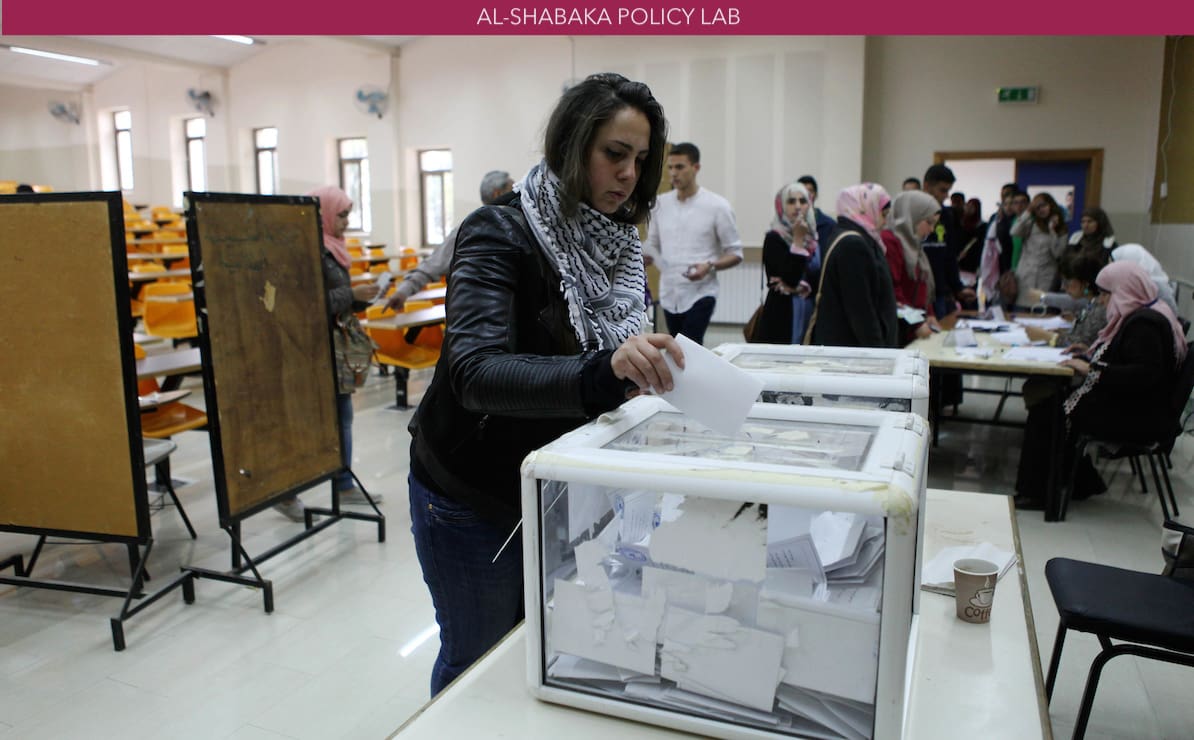
Palestinian general elections in the near future are looking more and more likely. But are they necessary?

In our final policy lab of 2019, Inès Abdel Razek joins host Marwa Fatafta to discuss the significance of elections within the current leadership crisis, foreseen challenges to the democratic process, and potential for new political players to emerge.

Marwa is a Palestinian writer, researcher and policy analyst based in Berlin. She leads Access Now’s work on digital rights in the Middle East and North Africa region as the MENA Policy Manager. She is also an advisory board member of the Palestinian digital rights organization 7amleh. Previously, she worked as the MENA Regional Advisor for Transparency International Secretariat. Marwa was a Fulbright scholar to the US, and holds an MA in International Relations from Maxwell School of Citizenship and Public Affairs, Syracuse University. She holds a second MA in Development and Governance from University of Duisburg-Essen.

Inès Abdel Razek is the Executive Director of the Palestine Institute for Public Diplomacy (PIPD) and its digital platform Rabet, an independent Palestinian organization focusing on international mobilization and digital campaigning for Justice, Freedom and Equality. From 2019 to 2022, Inès was the Advocacy Director of the PIPD, helping to develop the political networks and international advocacy pillar of the organization. Prior to joining the PIPD, Inès held policy advisor positions in the Union for the Mediterranean in Barcelona, the UN Environment Programme in Nairobi and the Palestinian Prime Minister’s Office in Ramallah, where she advised executive leadership on international aid for development policies. Inès is also a board member of the social enterprise BuildPalestine, Advisory board member of Palestine DeepDive, and policy member at Al-Shabaka, the Palestinian Policy Network. She holds a Master’s degree in Public Affairs from Sciences-Po, Paris. Twitter: @InesAbdelrazek
Latest Analysis

 Civil Society
On November 4, 2025, the UK government tabled an amendment to the Crime and Policing Bill to curtail protest rights under the pretext of “cumulative disruption.” The revised Bill is now in the House of Lords Committee, where it is scrutinized before advancing toward final approval. The amendment signals a profound shift in how the state regulates public protest. While the government presents the Bill as a neutral public order measure, it emerges directly from sustained national demonstrations for Palestinian rights and introduces new legal concepts that threaten long-established democratic freedoms. This roundtable examines the Bill’s political drivers, legal architecture, and wider implications for social movements and civil liberties in the UK. It shows that the amendment is not simply a public order measure; it is a coordinated political and legal project to narrow the space for dissent in the UK. While Palestinian solidarity is the immediate target of the crackdown on freedom of assembly, the roundtable argues that the consequences will reverberate across labor organizing, racial justice, climate activism, and broader democratic participation.
 Politics
“We’re all going to end up in Jordan,” remarked a young man from Al-Jiftlik, a Palestinian village in the Jordan Valley. His comment reflects growing despair in the West Bank countryside, where Israeli settler-colonial expansion has intensified to unprecedented levels. This is particularly true in the Jordan Valley, the agricultural heartland along the West Bank’s eastern frontier with Jordan. Once known among Palestinians as the “bride of the Jordan Valley,” Al-Jiftlik now illustrates the gravity of Israeli state-sponsored settler expansion on Palestinian land, having transformed from a prosperous agricultural community into one under siege and facing sustained displacement pressure. Since the beginning of Israel’s genocidal war on Gaza in October 2023, land seizure in the West Bank has shifted from creeping settler encroachment to a vicious military-backed campaign of territorial theft. This commentary shows how the Israeli regime’s land appropriation policy in the West Bank, once justified through bureaucratic-legal land seizure orders, has now increasingly shifted toward direct settler takeovers. This shift does not indicate a change in objectives but rather an escalation of existing settlement expansion mechanisms, signaling the growing power and influence of the settler movement over Israeli policy.
Al-Shabaka Fathi Nimer
Fathi Nimer· Feb 3, 2026
 Politics
The announcement of the National Committee for the Administration of Gaza (NCAG), a 15-member technocratic body chaired by Ali Shaath, signals a shift toward depoliticized governance in Gaza amid ongoing genocide. Shaath, a Palestinian civil engineer and former deputy minister of planning and international cooperation, will lead an interim governing structure tasked with managing reconstruction and service provision under external oversight. While presented as a neutral technocratic governing structure, the NCAG is more likely to function as a managerial apparatus that stabilizes conditions that enable genocide rather than challenging them. This policy memo argues that technocratic governance in Gaza—particularly under US oversight, given its role as a co-perpetrator in the genocide—should be understood not as a pathway to recovery or sovereignty, but as part of a broader strategy of genocide management.
Al-Shabaka Yara Hawari
Yara Hawari· Jan 26, 2026