


About This Episode
Episode Transcript
The transcript below has been lightly edited for brevity and clarity.
Yara Hawari 0:00
This ceasefire needs to be understood not as an end to violence or a violent reality for Palestinians, but rather a very different phase of the genocide. Certainly one that doesn’t come with carpet bombardments every day like we saw over the last two years, but it’s still a reality of daily killing, of daily deprivation of basic necessities.
Yara Hawari 0:27
From Al-Shabaka, the Palestinian Policy Network, I am Yara Hawari, and this is Rethinking Palestine. Earlier this month, I joined the Jacobin Longreads podcast, which features editor Daniel Finn, to discuss the ceasefire scam in Gaza. This is the conversation that we had.
Daniel Finn 0:50
Our guest today for an update on conditions in Gaza and the wider international context is Yara Hawari. Yara is the co-director of Al-Shabaka, the Palestinian Policy Network. You can read her analysis of Palestinian politics on the Al-Shabaka website, which we’ll include with the page for this episode.
Yara, thanks very much for joining us today. I want to begin by going back to the point last autumn when there was this much-trumpeted announcement of a ceasefire deal by Donald Trump and his officials with great self-satisfaction. Now, I think anyone who has been following the news from Gaza at all closely over the last three months will know that this has not been a ceasefire in any generally understood sense of the term, because fire has not ceased — certainly not from the Israeli side. Israeli forces continue to occupy large parts of Gaza and have killed hundreds of people, as well as restricting humanitarian aid to the population there.
But if we could imagine just for a moment that this really had been a ceasefire, that this really had drawn a line under more than two years of a relentless Israeli assault against the Gaza Strip — what was the level, the scale of death and destruction that had already been inflicted on the people of Gaza by that point?
Yara Hawari 2:17
Well, I think when the ceasefire was declared on the 10th of October 2025, a lot of Palestinians breathed a sigh of relief, and especially in Gaza. Palestinians in Gaza had just endured two years of constant bombardment, estimated to equal roughly six times the explosive force of the atomic bomb that was dropped on Hiroshima in 1945 and concentrated on an area less than half the size of Hiroshima.
So the devastation has been all-encompassing. This is not an exaggeration. All hospitals and universities have been bombed. Most homes and schools have been destroyed. Vital infrastructure such as sewage systems, electricity lines — all have been damaged beyond repair.
This has resulted in an estimated 68 million tons of rubble across the Strip. And devastatingly, under that rubble lie at least 10,000 bodies of Palestinians who were killed in bombardments and who have yet to be recovered.
And whilst we know that the official number of those killed in the two years of bombardments is thought to be well over 70,000, on top of them — and those that are not mentioned — are those that have been indirectly killed by the genocide. There was this article in The Lancet, one of the leading global medical journals, that explained that in typical conflict zones, the number of indirect to direct deaths is usually four to one. So indirect deaths would include those who would not have died had there been a status quo.
Because the health system in Gaza has been so brutally and systematically dismantled, people are dying from what would have been preventable deaths. People are dying from the cold, from lack of nutrition, from not having access to certain types of medication. People have also died from depression and heartbreak.
And of course, this isn’t a typical conflict zone. This is an ongoing and active genocide within the context of a decades-old colonial occupation that is essentially seeking to extinguish life in all its forms. And for those that survive, really this is to make life so unbearable.
So that was where we were at when the ceasefire was announced on the 10th of October 2025. And that’s where we continue to be in this sham of a ceasefire.
Daniel Finn 5:18
Could you talk to us in a bit more detail about what has been happening in Gaza since the declaration of this deal? I alluded to it in the opening question — the fact that there has been ongoing occupation, ongoing violence by Israeli forces. But could you tell us what that has involved on the ground? And could you also discuss perhaps some of the other aspects of what Israel has been doing in Gaza, such as its policy of continuing to foster criminal gangs, which its PR strategy has presented as a civilian alternative to Hamas in Gaza?
Yara Hawari 5:53
So almost immediately after the ceasefire was announced, the Israeli regime started attacking Gaza again, and it hasn’t really stopped since then. I think nearly every day since the ceasefire was announced, the Israeli regime has killed Palestinians in Gaza. And I think at last count, it was over 500 Palestinians that have been killed and many more injured since October 2025. Just a few days ago, there was a heavy airstrike, or multiple airstrikes, on Khan Younis that killed at least 31 people, including six children.
And in addition to that, it’s still not letting in enough aid. As per the ceasefire agreement, they’re supposed to be stopping the bombing and attacks on Palestinians, but they’re also supposed to be allowing aid into the Strip. At least 600 trucks of aid are supposed to be allowed in every day, and Israel has not fulfilled this end of the bargain. I think at the end of last year, it was reported that the Israeli regime was only allowing in 150 trucks or so a day to cross into the Strip.
And it’s not only about the number of trucks — it’s also about what’s in those trucks. They’ve been deliberately restricting the entry of nutritious food, including protein sources, meat, dairy, and fresh vegetables. And we’ve seen from reports from people on the ground that you can buy canned food, you can buy snack food, but fresh fruit and protein sources remain really difficult to get hold of — as well as much-needed medicine, tents, and other materials for shelters.
So I think people need to understand that when they hear the word “ceasefire,” it doesn’t actually mean there has been an end to the violence and it doesn’t mean that the Israeli army has withdrawn from Gaza. And actually, unfortunately, part of the ceasefire agreement was that the Israeli army would withdraw to this invisible boundary known as the yellow line. This line essentially cuts Gaza in half. The area beyond the line is about 53% of Gaza and, not coincidentally, includes most of the agricultural and industrial land — an area that has been almost totally depopulated of Palestinians.
So most Palestinians in Gaza are sheltering now on the western side of that yellow line. And a lot of people whose homes are on the other side of the yellow line have attempted to return home to see if their houses are still standing, to recover possessions. And many have been shot in the process. And there are those who’ve crossed this unmarked yellow line unknowingly, and as such they’ve been targeted by snipers or drones and killed or injured.
So again, this ceasefire needs to be understood not as an end to violence or a violent reality for Palestinians, but rather a very different phase of the genocide. Certainly one that doesn’t come with carpet bombardments every day like we saw over the last two years, but it’s still a reality of daily killing, of daily deprivation of basic necessities.
And meanwhile, the Israeli regime has, since the beginning of the genocide, been propping up criminal militias and gangs in an attempt to undermine social cohesion and to make sure that it has a constant presence, even in areas where the Israeli army is not present. And these gangs and militias are incredibly violent, incredibly disruptive, and are quite often made up of people who have been criminals. And it’s an age-old tactic. The Israeli regime has done this for a long time in Palestine, but it’s also an age-old colonial tactic that’s been used in many different contexts.
Daniel Finn 10:18
As you mentioned, Israel has continued to severely restrict the access of humanitarian aid to Gaza. And one element of that was the announcement last month that Israel was going to impose new restrictions on a number of NGOs, in addition to the embargo it was already placing on UNRWA. A number of quite prominent international NGOs — one of which had the former British Foreign Secretary, David Miliband, as its director, so hardly out of the Western political mainstream — but they were all told that they wouldn’t be allowed to operate in Gaza unless they supplied the Israeli authorities with a list of their Palestinian staff members. What was the significance of that announcement in particular?
Yara Hawari 11:06
So this announcement was made in late December 2025. Israel announced that it was suspending the work of 37 humanitarian organizations — around 15% of the total number of NGOs that work on the ground in Gaza, but also happened to be some of the largest NGOs that work on the ground in Gaza. And they include, as you mentioned, some of the most well-known across occupied Palestine but also internationally. It included Defence for Children International, the ICRC, Medical Aid for Palestinians UK, Mercy Corps, the Norwegian Refugee Council, and MSF — Médecins Sans Frontières, also known as Doctors Without Borders in English.
And I’m sure a lot of people will be aware that international NGOs have been heavily involved in the humanitarian response to the genocide in Gaza. They’ve delivered more than half of all food assistance. They support a lot of the healthcare efforts, they provide shelters, etc. So their presence in Gaza before and during the genocide has been crucial.
Now, of course, there are reasons for that — the deliberate de-development of Gaza, the kind of reliance that’s been forced upon Palestinians because of conditions of siege and blockade, conditions that have rendered them really a population heavily reliant on aid. And so there are legitimate critiques of how those organizations are part of this process of de-development and forced reliance. But undeniably, completely stopping this aid means that an entire population suffers, especially when there’s nothing to take its place.
And the Israeli regime knows that. And the reason that the Israeli regime suspended these organizations, as you briefly mentioned, is because they want them to comply with new policies that will require them to submit to the Israeli authorities all the documentation about their staff, local and international, and documentation about funding and operations. Now, as an occupying power, the Israeli regime doesn’t have the right to demand that kind of information.
But more importantly, this is a regime that has systematically targeted aid workers and their families, including those in so-called pre-authorized aid convoys. This is a regime that has bombed aid facilities. This is a regime that is in no way, shape, or form a good-faith actor.
And also according to these regulations, any organization which has called for boycotts of Israel or has expressed support for the ICC or the ICJ cases against Israel and its leaders are also going to be banned from distributing aid. So it’s a complete crackdown aimed at complete compliance. But it’s also one that comes with very legitimate fears for local staff in particular, who are the most vulnerable to Israeli violence.
And so what we did see with MSF, Médecins Sans Frontières, was that they were going to comply. In fact, they released a statement saying that they had consulted with local staff and that they were going to hand over the information that the Israeli regime requested so that they could continue their operations in Gaza. But of course, the reality was quite different.
And it came to light, as a result of a campaign from various doctors and medical staff including Dr. Ghassan Abu Sitta, that actually those staff members were being coerced and pressured by senior management in MSF into agreeing to hand over their information. Essentially, they were being guilt-tripped into it.
And so there was a huge campaign in the media and on social media against MSF and against this coercion. And it looks like now that MSF has backtracked after a lot of outrage. And the latest is that it won’t be complying with these new regulations. But that means that of course its operations will be seriously limited in Gaza, if allowed at all.
But I think what’s really clear from all of this is that the Israeli regime is trying to re-engineer the landscape of aid distribution in Gaza and in Palestine.
Yara Hawari 15:36
If you’re enjoying this podcast, please visit our website, al-shabaka.org, where you’ll find more Palestinian policy analysis, and where you can join our mailing list and donate to support our work.
Daniel Finn 16:00
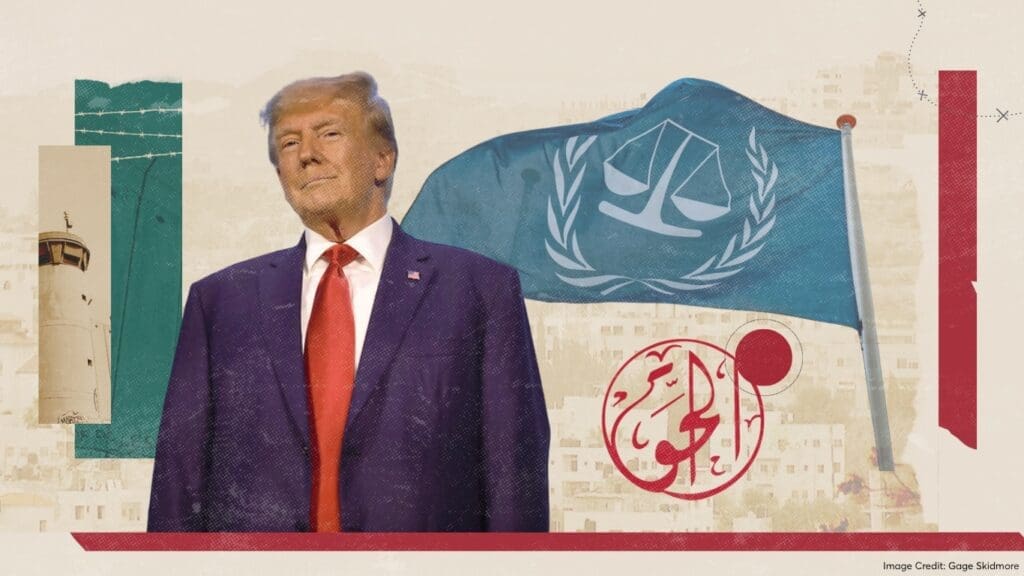
This has all been taking place in a particular international context, and you’ve written about this yourself — about the maneuvers on the international stage that have facilitated and legitimized the approach of the Trump administration. So could you talk us through that process, going from the moment when the UN Security Council, including states that have been sharply at odds with the US in recent years, either voted for or abstained on a motion that gave the Trump administration authority to go ahead with its plans for Gaza, leading from that moment up to the proclamation in the past few weeks of what Donald Trump and his officials call the “Board of Peace,” which appears to be not just relevant to Gaza but a wider attempt to marginalize and delegitimize the UN framework altogether?
Yara Hawari 17:00
Yeah. And so what’s been quite remarkable to me is that on an international level, the Israeli regime continues to enjoy unprecedented diplomatic, financial, and military cover despite a literal livestreamed genocide. And it’s remarkable to me not because I ever had any hope or faith that the international community would protect Palestinians from such violence, but I think because I thought that they would put up a bigger fight to protect the legal framework that they have set up to maintain the world order that they designed.
And indeed, I think Israel’s genocide in Gaza signals the start of a complete unraveling of that world order. And so on November 17, 2025, I think it was, when we saw the UN Security Council pass Resolution 2803, which endorsed President Trump’s twenty-point plan for Gaza — that was really, I think, the cherry on the cake. It’s a resolution which in itself contradicts international law by mandating a foreign body to rule over Palestinians in Gaza, but it also contradicts previous UN resolutions.
And from sources at the UN, we know that in the lead-up to this resolution, states and individuals saw some of the most political bullying and cajoling and coercion that they’ve ever seen at the UN. Because this resolution effectively gives Donald Trump the green light to do whatever he wants in Gaza. It creates these two bodies that are supposed to take control: the Board of Peace, which of course is chaired by Trump, and an international stabilization force, which is tasked with maintaining security and enforcing the disarmament of Palestinian groups and factions.
And then on top of all of that, it effectively bypasses all the local and international structures in the distribution of aid. So everything will have to pass through the Board of Peace. And it goes without saying that the resolution made no mention of the genocide, did not propose any kind of mechanism for accountability for war crimes.
And so essentially, this is a resolution that not only contravenes international law, but it gives the US — which is the co-perpetrator of genocide — complete control over Gaza.
And I think states thought that by giving this to Trump — effectively giving him Gaza — they would quell his appetite. But I think that was a massive miscalculation. The resolution supported the Board of Peace in the context of Gaza, but as you alluded to, the Trump administration is now making it very clear that the Board of Peace is a global project. It’s actually an attempt to replace the UN.
Now, replacing the UN wouldn’t necessarily be a bad thing if it was an attempt to create something more equitable and less biased towards the Global North. But Trump is trying to replace the UN with himself. You just have to look at the logo of the Board of Peace. It’s a UN knockoff logo except that it’s in gold, which is, I guess, Trump’s favorite color. And instead of the world, it includes only Trump’s expansionist dreams — it includes Greenland, Canada, and northern Latin America and the US.
So it’s really ridiculous and almost laughable, except for the fact that this is very real and it’s going to come with very serious consequences, not just for Gaza, but on a wider scale.
Daniel Finn 20:52
Looking at this scheme — the Board of Peace itself — in a bit more detail: what is the composition of this body? Who was offered a place on it? What inducements were they offered to join? And who turned down the offer and on what grounds, as far as we’re aware?
Yara Hawari 21:12
So we have to break this down because it is a bit confusing and all over the place. What we know so far as to the structure of the Board is as follows.
Trump has essentially designated himself as chairman for life with the ability to nominate a successor. And this is a really important point because it means that his chairmanship of the Board of Peace is not restricted to the US presidency.
And then comes the Board proper, which is comprised of national leaders. And I think about 60 countries were invited. Most European countries turned down their invitations except for, I believe, Hungary and Bulgaria. The main reason that was given for turning down these invitations was that the Board was going beyond its mandate, and also because Trump invited Russian President Putin to join. No objection to Israeli Prime Minister Netanyahu joining, who has an ICC arrest warrant and who couldn’t even travel to Davos for the inauguration of the Board because he would have been arrested by the Swiss authorities because of this arrest warrant.
And then we have the executive board, which has seven members. Nikolay Mladenov, who has the title of “High Representative for Gaza.” And I’m laughing because it’s so ridiculous, but it’s also incredibly scary.
So Mladenov is this High Representative for Gaza. Marco Rubio, who is of course the United States Secretary of State. We have Steve Witkoff, who is the US Special Envoy to the Middle East. Jared Kushner, who of course is Donald Trump’s son-in-law. Tony Blair, who needs no introduction. Marc Rowan, who is the CEO of Apollo Global Management. Ajay Banga, who is the president of the World Bank. And then Robert Gabriel Jr., who is an American political advisor.
And then we also have another body called the Gaza Executive Board, and its head is Mladenov. And basically, we have the same people as are on the executive board with a few additions, including the Minister for Foreign Affairs of Turkey, the Minister of State for International Cooperation of the UAE, an Israeli businessman, and the UN Special Coordinator for the Middle East Peace Process. And then we have the National Committee for the Administration of Gaza, which is the Palestinian technocratic committee, which reports to the Gaza Executive Board and to Mladenov.
Daniel Finn 23:55
We recently saw the announcement that phase two had begun of this process, this deal. What does that actually entail? Does it make any concrete difference on the ground? And how do you think conditions in Gaza are likely to develop over the course of 2026?
Yara Hawari 24:15
So the US announced phase two of the ceasefire in mid-January. The reality is that most of the goals that were supposed to be achieved in order to reach phase two have not been reached — namely, a halt in violence, Israeli withdrawal to the yellow line, and a full resumption of aid. In fact, the only goal that has been achieved is the return of all the Israeli hostages. So the ceasefire hasn’t delivered, definitely not for Palestinians.
But what marked this transition into phase two — and of course, these terms are very arbitrary, because as I mentioned, we’re not really in phase two and the transition is not really a transition — but nonetheless, what the US used to mark this transition was the announcement of the National Committee for the Administration of Gaza. This is the technocratic committee, the Palestinian technocratic committee. It’s a fifteen-member body which is chaired by Dr. Ali Shaath, who is an engineer who has worked for the Palestinian Authority in the West Bank in various capacities, and is originally from Gaza.
And I think in the grand scheme of things, this committee signals a shift towards depoliticized governance in Gaza amid the ongoing genocide. And it’s presented as this very neutral, technocratic governing structure. But the reality is that it’s going to function as a managerial mechanism that stabilizes conditions.
And this committee has been tasked with managing the reconstruction and service provision in Gaza, of course, under the watchful eye of Mladenov and Blair, who are going to report directly to Trump.
And there are a lot of things that still remain really unclear about the committee, about how it’s going to be able to carry out this work. The issue of Israeli withdrawal to the yellow line still remains unclear. But for now, the committee is supposed to be operating in the western part of Gaza, the part that doesn’t really have Israeli forces. But funnily enough, the committee hasn’t actually been allowed into Gaza yet by the Israeli regime.
What is very clear is that this committee is not going to have any kind of political function. They’ve been very clear about that. In fact, there’s an interview where the chair, Dr. Ali Shaath, was explicitly asked about Israeli forces, about the disarmament of Hamas, and he just deferred all of these questions to the Board of Peace. So I think it’s very important to understand the limitations of this committee. It’s not a new government. It’s not a new leadership in Gaza.
What’s very clear is that the US’s approach is to completely depoliticize the issue of Palestine and turn it into an economic one, into a real-estate issue. And so this committee creates this appearance of Palestinian involvement, but it operates totally — or will operate totally — under the subordination of the Board of Peace.
So in practice, it’s almost positioned to play a very similar role to that of the Palestinian Authority in the West Bank — a service provider operating under colonial oversight with political questions deferred indefinitely.
And as I mentioned, the big question is whether Israel will actually allow this technocratic committee to do the work that it’s mandated to do. And I think we’re already seeing it being sabotaged at every stage possible. The fact that they haven’t actually been let into Gaza yet. There was a big issue in the Israeli media the other day because the committee shared its new logo, and its logo incorporates the Palestinian Authority’s logo, and the Israelis lost their minds over it.
So I think we’ll have to wait and see if this committee is actually allowed to operate in any way, shape, or form. And obviously, Gaza is in urgent need of immediate relief and recovery and reconstruction. And the committee might be able to facilitate some of that. But speaking with Palestinians on the ground in Gaza, specifically about the committee, I think there’s a lot of mixed feelings about it. And I think the reality is its ability to deliver is completely dependent on the Israeli regime.
And the other thing that was interesting that marked phase two, in addition to the announcement of the Palestinian technocratic committee, was Kushner’s plan that he presented at Davos for Gaza. It was a very dystopian presentation of these high-rises, of this very futuristic-looking enclave. And as details of this plan have emerged, you start to realize actually what the Americans have in store for Palestinians. And it’s incredibly disturbing.
The idea is to force Palestinians into these so-called planned communities that are going to be very highly controlled and surveilled, even more so than we already are. And only approved Palestinians will be able to live in these areas, and they’ll be subjected to all these security checks, and they’ll have to give over their biodata, and they won’t have access to cash — it will be a cashless community — and the schools and curriculums will be tightly controlled.
So it’s very clear that this is the way that the American administration is thinking about this. And we’ve always talked about the Palestinian reality being very dystopian, but I think this really exceeds anything that we’ve seen or heard before.
Daniel Finn 30:14
While all of this has been happening, we’ve also seen escalating violence by Israeli forces in the West Bank. And we’ve seen quite recently an important symbolic move by Israeli forces to attack and dismantle the UNRWA headquarters in East Jerusalem. Even though the building was already unoccupied, it was ordered reportedly directly by Ben Gvir as a symbolic blow against the role of UNRWA. Could you tell us a bit more about what has been happening in the West Bank and how would you say it relates to what has been happening in Gaza at the same time?
Yara Hawari 30:52
Yeah, and I think there hasn’t been enough coverage of what’s been happening in the West Bank. And obviously, the violence in Gaza, the violence of the genocide, has been so horrific that it has taken up a lot of coverage, and rightly so. But under the cover of the genocide, over the last two years, the Israeli regime has really expanded its control over the West Bank and its settlement of the West Bank.
We’ve seen an increased use of what the Israeli authorities call counter-insurgency operations — operations such as Operation Iron Wall, Operation Summer Camps, or all these really weird names used to describe basically military operations. They’re always presented as these temporary, targeted operations in response to some kind of so-called terror act or cell, but they’re far from it. These operations are designed not only to disrupt Palestinian life, but also to create facts on the ground.
So with each new military operation comes a new permanent checkpoint, or a new permanent road closure, or demolition of Palestinian homes, or a permanent takeover of land. So Operation Summer Camps, for example, resulted in the largest mass displacement campaign since 1967. This operation saw the depopulation of the camps in the northern West Bank. Nearly 50,000 Palestinians were kicked out of their homes, and then the camps themselves were destroyed, and some of them have been effectively turned into Israeli military headquarters.
So these operations create new realities on the ground. And it’s a very coordinated effort between the army and the settlers to essentially re-engineer the spatial and social environment, to reduce the area of land that Palestinians live on, but also to create an atmosphere where there can be no dissent or resistance to occupation.
And often in the media, when we hear about settler violence, it’s very much separated from the state, or reported as something very fringe. But that’s far from the reality. The reality is that the settlers operate hand in hand with the Israeli army, and it’s very much part and parcel of Israeli government policy.
In February 2023, actually, prior to the genocide, we saw that settlement planning was transferred from COGAT, which is the Israeli occupation administration, to the Minister of Finance, a guy called Bezalel Smotrich, who is a far-right genocidal politician. And under him, what we’ve seen is unprecedented settlement growth and a massive increase of checkpoints and military gates that prevent Palestinians from accessing their land. So this has really accelerated since the start of the genocide. What we saw prior to the genocide was this sort of slow, creeping annexation and takeover of land. But the genocide has been used as a cover for the Israelis to really accelerate that takeover.
And finally, on the West Bank — although this applies to Palestinian refugees wherever they are — the Israelis are really in the final stage of ending UNRWA operations. As you mentioned, they began bulldozing a part of the UNRWA headquarters in East Jerusalem. And there are basically, as I understand it, no international UNRWA staff in Palestine. All the operations have been seriously scaled down.
And for better or worse, UNRWA plays a huge role in the lives of Palestinians. Hundreds of thousands of kids are educated in UNRWA schools. Tens of thousands of adults are employed by the agency. The mandate of UNRWA keeps the Palestinian right of return alive on an international level.
So when we say that the situation is getting worse in the West Bank, I think it really can’t be understated.
Daniel Finn 35:13
The final question that I want to put to you — as you have said, and as I’ve heard many Palestinians observe over not just the last two or three months but the last two years, it’s very difficult to think of a bleaker moment that the Palestinian people have faced in the whole period since the Nakba in the 1940s. Do you have a sense, against that backdrop, of what the state of Palestinian politics and civil society is today in the wake of the Gaza genocide? Is there any space at all for people to engage in discussion about possible strategies that might begin to challenge such a bleak scenario, such a bleak balance of forces?
Yara Hawari 36:00
I think a lot of Palestinians are talking about this moment as our post-Nakba moment. There is a shock and ongoing trauma for what has happened — not only the destruction and devastation of the genocide in Gaza, but also the violence and repression that has engulfed the West Bank, all of the things that I mentioned earlier. And the political repression, I think, is something that we haven’t seen for a long time. And maybe it is similar to what Palestinians experienced post-Nakba. But the political space inside occupied Palestine is really very, very limited.
And that’s not to say that there isn’t organizing or any kind of political movement, but it’s really limited and more repressed now than it has ever been. The number of political prisoners has increased to at least 10,000, and many of them are being held indefinitely under administrative detention. Others are taken for a few days, beaten up and threatened. People are also being arrested for social media posts. University campuses are being raided frequently.
So there is this atmosphere of fear. But I think there’s also a recognition that this is an existential moment for us as a people. We either achieve liberation and regain sovereignty over our homeland and return our people to their homes, or we’re going to be exterminated as a people and as a collective seeking self-determination.
And so the big question for me now is: how do we reconcile with the fact that over the last two years especially, the Palestine solidarity movement has grown exponentially and achieved all of this international recognition and support at unprecedented levels, and yet the situation on the ground has gotten drastically worse — and that the solidarity movement has not been able to stop the genocide?
And I think the answer is bigger than Palestine. I think Gaza has emerged as the epicenter of global politics. And I think the future of Palestine has been ultimately understood to be connected to the future of the world. The president of Colombia, Gustavo Petro, said at a conference that what we’re seeing in Gaza is a rehearsal for the future. And I think that future’s already here.
Why is it that governments are willing to oppress their own people in their own streets for protesting against a foreign state committing genocide? Why is it that so many government corruption scandals involve weapons and security companies who are complicit in the genocide in Gaza? Why is it that a politician’s downfall can be orchestrated because they stand up against genocide somewhere very far away from where they are?
People are asking these questions in a really serious way. And I think they understand that Palestine can’t be understood on its own, isolated from global dynamics. And I think it’s this reality — the fact that Palestine exists in a deeply unjust and very violent world — it’s this reality that allows the machinery of genocide in Palestine to continue.
And so I think the task at hand is to build that into political momentum, to build that understanding of Palestine into political momentum that can bring about radical change in political structures worldwide. And I’m not sure if we’ll be able to do that, but I think that’s really what has to happen.
Yara Hawari 40:04
Rethinking Palestine is brought to you by Al-Shabaka, the Palestinian Policy Network. Al-Shabaka is the only global independent Palestinian think tank whose mission is to produce critical policy analysis and collectively imagine a new policymaking paradigm for Palestine and Palestinians worldwide. For more information or to donate to support our work, visit al-shabaka.org. And importantly, don’t forget to subscribe to Rethinking Palestine wherever you listen to podcasts.
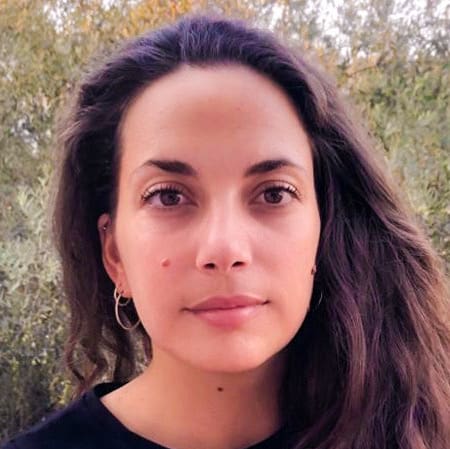
Yara Hawari is Al-Shabaka’s co-director. She previously served as the Palestine policy fellow and senior analyst. Yara completed her PhD in Middle East Politics at the University of Exeter, where she taught various undergraduate courses and continues to be an honorary research fellow. In addition to her academic work, which focused on indigenous studies and oral history, she is a frequent political commentator writing for various media outlets including The Guardian, Foreign Policy, and Al Jazeera English.