




Topics
See our analysis on civil society and how it shapes culture, politics, and policies
Read our insights on the shifting political landscape and what it means for Palestine
Learn more about the policies and practices shaping the Palestinian economy
Strengthen your understanding of the unique conditions for Palestinian refugees across the Middle East
Analysis
In-depth analysis on existing or potential policies that impact possibilities for Palestinian liberation.
Insights and perspectives on social, political, and economic questions related to Palestine and Palestinians globally.
Concise analysis into a specific policy, its background and implications.
Commentary that brings together insights from multiple analysts.
Compilations of past Al-Shabaka works surrounding a specific theme.
Longer-form, ad hoc projects that seek to confront research questions outside the scope of our regular analysis.
A policy-driven research initiative by Al-Shabaka: The Palestinian Policy Network.
Our monthly webinar series that brings together Palestinian experts.
Featured




Guest contributors are analysts who have offered their expertise to Al-Shabaka but are not members of our policy network. Contributors do not hold affiliation with Al-Shabaka beyond the specific outputs they have authored. Al-Shabaka is not responsible for, nor involved in, their other professional activities. The opinions of contributors do not necessarily reflect those of the organization as a whole.
Ali Abunimah is the author of One Country: A Bold Proposal to End the Israeli Palestinian Impasse (2006), and co-founder and director of the widely acclaimed publication The Electronic Intifada. Based in the United States, he has written hundreds of articles and been an active part of the movement for justice in Palestine for 20 years. He is the recipient of a 2013 Lannan Cultural Freedom Fellowship. His most recent book is The Battle for Justice in Palestine.
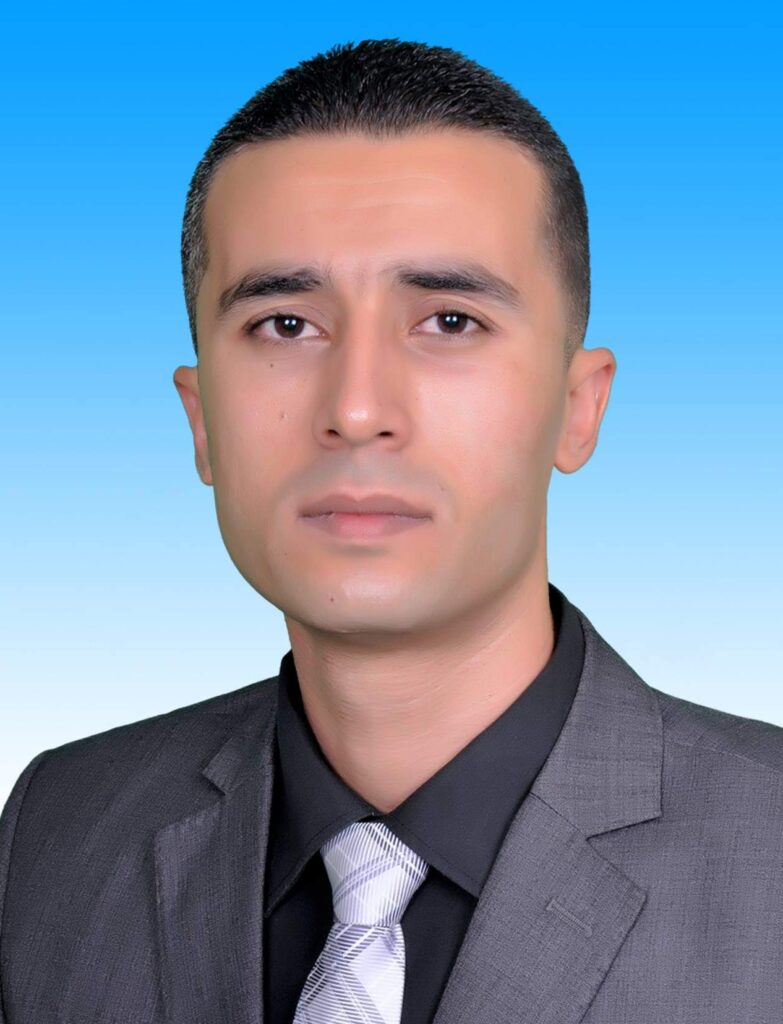
Mohammed Al-Hafi is a Palestinian academic and researcher of international politics based in Gaza. He is the director of the Studies Unit at the Palestinian Department of Labor and Planning. He earned his PhD in political philosophy from Alexandria University in 2013 and has published numerous studies and research papers.
Ahmed Alqarout is a political economy expert specialising in the Middle East and North Africa region, with a focus on great power competition and the political economy of conflicts.
Andy Clarno is assistant professor of Sociology and African American Studies and interim director of the Social Justice Institute at the University of Illinois at Chicago. His research examines racism, capitalism, colonialism, and empire in the early 21st century. Andy’s new book, Neoliberal Apartheid (University of Chicago Press 2017), analyzes the political, economic, and social changes in South Africa and Palestine/Israel since 1994. It addresses the limitations of liberation in South Africa, highlights the impact of neoliberal restructuring in Palestine/Israel, and argues that a new form of neoliberal apartheid has emerged in both regions.
Khaled Elgindy is a senior fellow at the Middle East Institute, where he also directs MEI’s Program on Palestine and Israeli-Palestinian Affairs. He is the author of the newly-released book, Blind Spot: America and the Palestinians, from Balfour to Trump, published by Brookings Institution Press in April 2019.
Nada Elia teaches ethnic and cultural Studies at Western Washington University. She is the author of Greater Than the Sum of Our Parts: Feminism, Inter/Nationalism, and Palestine (Pluto, 2023), and has contributed chapters to numerous anthologies, including The Case for Sanctions Against Israel (Haymarket, 2020).
Lamees Farraj is a researcher in economic and developmental policies. She received her MA in economics from Birzeit University in 2016, and her BA in economics from Birzeit University in 2010.
Nell Gabiam is Assistant Professor of Anthropology and Political Science at Iowa State University. She received her Ph.D. in anthropology in 2008 from the University of California, Berkeley. From 2004 to 2006, she conducted ethnographic fieldwork in the Palestinian Refugee Camps of Ein el Tal, Neirab, and Yarmouk in Syria. More recently she has conducted fieldwork in Lebanon, Jordan,Turkey, the United Arab Emirates, France, and Sweden on Palestinians who have been displaced by the ongoing war in Syria.
Adam Hanieh is a Palestinian political economist and professor at the University of London’s School of Oriental and African Studies. His research focuses on global capitalism and the political economy of oil. His latest book is titled Crude Capitalism: Oil, Corporate Power, and the Making of the World Market (2024).
Celie Hanson is a Campaigns Officer at the Palestine Solidarity Campaign, Europe’s largest solidarity organization dedicated to securing Palestinian rights.
Ahmad Ibsais is a Palestinian American immigrant and law student pursuing a Juris Doctor at the University of Michigan. He is the author of the newsletter State of Siege, and his writing has appeared in The Guardian, Al Jazeera, Time, and other international outlets. Through his work, he seeks to preserve Palestinian memory in the face of ongoing erasure. His legal research has focused on humanitarian aid in Gaza and the history of Israel’s systematic constriction of Palestinian development.
Dr. Ardi Imseis is Assistant Professor of Law, Queen’s University, where he specializes in public international law. Between 2002 and 2014, he served in senior legal and policy capacities with UNRWA in the occupied Palestinian territory. He has provided expert testimony to the UN Security Council, members of the UK House of Lords and the French Senat. His scholarship has appeared in a wide array of international journals, including the American Journal of International Law, the Harvard International Law Journal, and the Oxford Journal of Legal Studies. He is outgoing Editor-in-Chief of the Palestine Yearbook of International Law (2008-2019), and former Harlan Fiske Stone Scholar and Human Rights Fellow, Columbia Law School.
Sarah Kanbar earned her J.D. in 2016 from the University of the Pacific, McGeorge School of Law, with a concentration in international legal studies. While at law school, Sarah interned at the California Office of Legislative Counsel and the Federal Public Defender’s Office. She received her B.A. in history from the University of California, Berkeley, focusing on the relationship between the United States and the Middle East. Sarah previously published “Rooted in Our Homeland: The Construction of Syrian American Identity” in American Multicultural Studies (Sage, 2012) and articles in Muftah and Kalimat Magazine.
Layla Kattermann is the Monitor Team Manager at the European Legal Support Center (ELSC). Layla studied International Studies at Leiden University and specialized in the region of the Middle East, where she focused on the politics of law, the media discourse on Palestine and Israeli disinformation. She is also a co-founder of the Student Coalition for Palestine in the Netherlands.
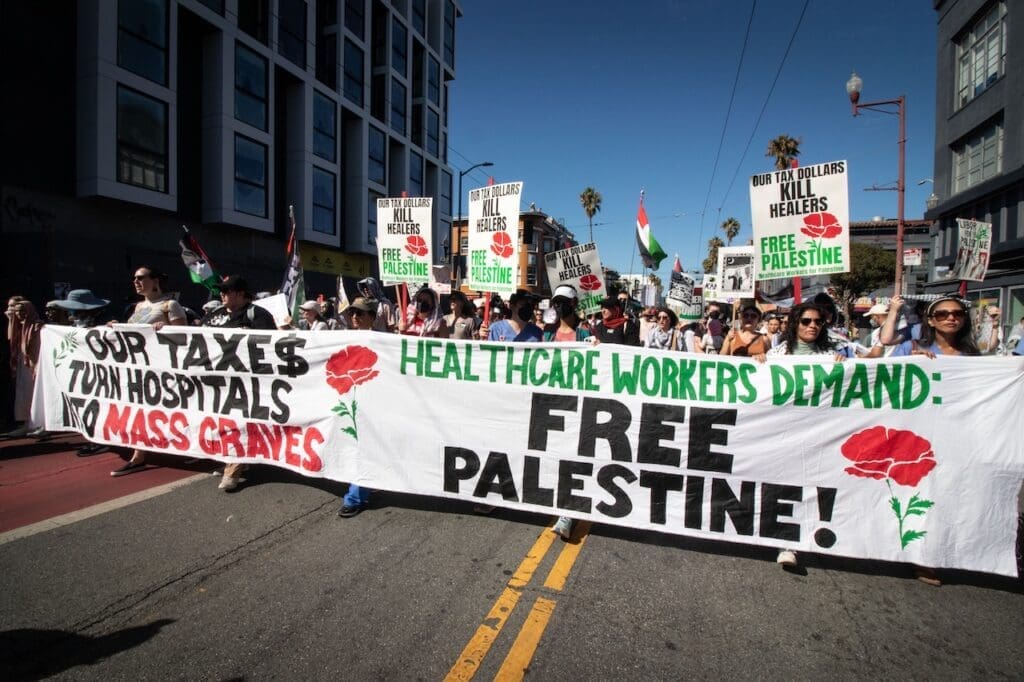
Layth Malhis is a graduate student at Georgetown University’s Center for Contemporary Arab Studies, where his work focuses on settler colonialism and Palestinian health. His research advances the concept of “de-healthification” as an analytical framework for understanding the systematic dismantling and weaponization of healthcare in Palestine under successive regimes of colonial control. He is also a researcher at the Institute for Palestine Studies, where he contributes to the Healthcare Destruction Database and scholarship on medical violence and colonial governance. Previously, he managed North American operations for the House of Jerusalem (Bayt al-Maqdis), a Palestinian food import initiative, examining how Palestinian businesses navigate occupation, global supply chains, and the political economy of dispossession.
Al-Shabaka Guest Author Maren Mantovani is the international relations coordinator for the Stop the Wall Campaign and the international outreach coordinator for the Land Defense Coalition, a network of Palestinian social movements. She serves on the secretariat of the Palestinian Boycott, Divestment and Sanctions (BDS) National Committee, the umbrella organization promoting the call for BDS. She has published several studies on Israeli military relations and corporate complicity.
David Mills is a pediatric emergency medicine physician and public health practitioner. He is co-director of the Palestine Program for Human Rights at the FXB Center for Health and Human Rights at Harvard University and an Assistant in Pediatrics in the Division of Emergency Medicine at Boston Children’s Hospital. His research, educational, and academic interests focus on the intersections between health and human rights, utilizing critical frameworks to elucidate the social and structural determinants of health and health program implementation to improve access to health education, improve clinical care, and promote health equity.
David Musleh (he/him/his) is a Palestinian-German economic advisor. He holds an MSc in Global Economic Governance and Policy from SOAS, University of London, where he researched Palestinian economic development, as well as the integration of West Asian economies into global value chains.
Khalil Nakhleh is a Palestinian anthropologist from the Galilee, Israel/Palestine, with a Ph.D. from Indiana University, US. His main academic and applied preoccupations focused on how to transform Palestinian society and people from an occupied, colonized, and fragmented society to a liberated, productive, free, and self-generating society, not dependent on external financial aid. Dr. Nakhleh has authored a number of academic books and articles on Palestinian society, development, NGOs, and education, in English and Arabic. The Red Sea Press published his latest book, Globalized Palestine: The National Sell-out of a Homeland, in 2012. He may be reached at [email protected].
We are a global network of Palestinian experts, collectively challenging prevailing structures of oppression through critical policy analysis.
Join Al-Shabaka’s mailing list and find the latest Palestinian policy analysis in your inbox: