



Executive Summary
This policy brief introduces de-healthification as a framework for understanding Israel’s systematic destruction of Palestinian healthcare infrastructure, particularly in Gaza. Rather than viewing the collapse of Gaza’s health system as a secondary outcome of the genocide, the brief argues that it is the product of long-standing policies of blockade, occupation, and structural neglect intended to render Palestinian life unhealable and perishable.
From the post-1967 military occupation to the Oslo-era permit regime and the blockade imposed in 2007, the Israeli occupation has progressively eroded Palestinian health sovereignty. This strategy has reached its apex during the ongoing genocide, as the Israeli occupation forces destroyed hospitals and systematically targeted healthcare workers. Gaza’s healthcare system has, in effect, transitioned from underdeveloped to unviable to non-existent.
By tracing the historical evolution of de-healthification, this brief argues that naming the process is essential for accountability. Because intent is revealed through patterns of destruction rather than explicit declarations, the framework of de-healthification equips policymakers, legal bodies, and advocates to identify healthcare destruction and denial as a core mechanism of settler-colonial control.
Recommendations
Without an international reckoning that centers the destruction of health as core to this genocide, ceasefire diplomacy remains insufficient. To end de-healthification, action must extend beyond humanitarian relief and reconstruction. The following priorities are directed toward states, UN bodies, international courts, donors, and Palestinian health institutions, each responsible for preventing and reversing the destruction of Palestinian health sovereignty.
- Recognize De-healthification as a Crime
International legal bodies and human rights mechanisms must formally adopt the term de-healthification to acknowledge the intentional destruction of health systems as a tool of collective punishment and group erasure. Naming this crime strengthens monitoring, documentation, and legal accountability.
- Make Historical Violence Legally Actionable
Courts and investigative bodies must assess Israeli violations through a longitudinal lens that includes decades of siege, de-development, and structural degradation of Palestinian health. Prolonged system collapse should be treated as structural violence, and all complicit actors—including states providing political or military support—must be held accountable.
- Pursue Structural Recovery Rooted in Liberation
Reconstruction and recovery efforts must be Palestinian-led and grounded in sovereignty. This requires ending Israeli control over borders, airspace, fuel, and medical supply chains; abolishing the medical permit regime; guaranteeing free movement for patients and providers; and embedding legal protections against future siege tactics.
- Build Knowledge Infrastructure for Liberation Medicine
Academic institutions and global health networks should establish a Palestinian-led platform for liberation medicine to study health under occupation and produce knowledge accountable to affected communities. Research must prioritize justice rather than charity.
- Establish Absolute Protections for Medical Units
International humanitarian law reform processes must eliminate loopholes that enable attacks on medical facilities. States should adopt absolute legal safeguards for healthcare infrastructure and personnel, recognizing the protection of medical units as a jus cogens norm that cannot be overridden.
Introduction
Since October 2023, Israel’s genocidal military campaign in Gaza has led to the collapse of nearly every pillar of the territory’s healthcare system. The Israeli occupation forces bombed hospitals, killed medical personnel, obstructed humanitarian convoys, and decimated critical infrastructure. Major human rights organizations have documented that the destruction of healthcare in Gaza is systematic and deliberate; even so, they often stop short of naming what this truly represents: not an isolated wartime tactic but the culmination of a long-standing policy. Indeed, the erasure of Gaza’s health system began long before this latest episode of the genocide against the Palestinian people. It is the result of a sustained, calculated strategy aimed at rendering Palestinians unhealable, unhelpable, and ultimately perishable.
This policy brief introduces de-healthification as the governing logic of health under settler colonialism: the systematic degradation, obstruction, and weaponization of the very conditions that make health of the Indigenous population possible. In Palestine, Israeli de-healthification does not simply “attack healthcare;” it restructures health itself into a domain of domination, where illness and vulnerability are deliberately produced and administered. Within this colonial regime, unhealth becomes both a condition for rule and an instrument of control. De-healthification thus functions as the health-specific manifestation of the logic of elimination, through which the settler colonial state sustains itself by manufacturing illness, dependency, and the degradation of the conditions of life among the colonized Palestinian population.
De-healthification Defined
De-healthification can be defined as a systematized regime that transforms health from a protected public good into a field of coercion. It operates through coordinated mechanisms of administrative strangulation, infrastructural attrition, clinical criminalization, dependency engineering, epistemic erasure, ecological sabotage, and programmed disablement—each designed to produce predictable deficits in survival, repair, and futurity for a targeted population. Under settler-colonial rule, these mechanisms unfold through both slow administrative violence and punctuated military destruction, ensuring that the capacity to heal is continually withdrawn.
Under settler-colonial rule, de-healthification unfolds through both slow administrative violence and punctuated military destruction, ensuring that the capacity to heal is continually withdrawn Share on XFor decades, this Israeli colonial logic governing Palestinian health has proceeded through phases of neglect, weaponization, dependency, siege, and genocide. These phases have repeatedly reshaped the colonial structures that organize health and survival in Palestine, culminating in Gaza’s present collapse. This architecture can be traced across time: from the neglect of the 1970s, to the overt weaponization of care during the First Intifada, to the administrative entrapment of the Oslo era, to the ecological throttling imposed by the blockade, and now to the genocidal annihilation of Gaza’s health system. Understanding these shifts reveals that Israel’s current campaign is not an aberration but the latest iteration in a decades-long refinement of control over the very possibility of health. This regime renders Palestinian health perpetually conditional and survival structurally untenable.
Occupation and Neglect of Health (1967–1986)
The Israeli regime severely neglected the Palestinian healthcare system following its 1967 occupation of Gaza and the West Bank. Indeed, it institutionalized a policy of containment, treating Palestinian health not as a right to be upheld but as a burden to be managed.
Throughout the 1970s, the Israeli military administration oversaw a fragmented, under-resourced health system in Gaza. Data compiled by Palestinian medical practitioners and later confirmed by the Union of Palestinian Medical Relief Committees (UPMRC) show that clinics operated under severe institutional deprivation: most lacked basic supplies, diagnostic tools, and referral capacity. Rather than investing in infrastructure, the Zionist regime enforced bureaucratic impasse, making the procurement of equipment, medication, and even ambulances contingent on Israeli military permits.
By the late 1970s, Gaza’s doctor-to-patient ratio was about one per 1,666 people, and in some areas as low as one per 2,200—compared with one per 350–450 in land occupied in 1948 and Jordan. Clinics were equally overwhelmed: with only 25 facilities—each staffed by a single doctor, no dentists, and no ambulances—physicians saw nearly 200 patients daily, spending mere minutes with each.
This pattern of managed neglect also appeared in broader health indicators. Israel’s Central Bureau of Statistics estimated infant mortality in Gaza and the West Bank at roughly 70 per 1,000 in 1985. Data from Palestinian medical networks revealed an even grimmer picture: 49 per 1,000 in Biddu (a Palestinian village near Jerusalem), 91 per 1,000 in villages around Ramallah, and up to 100 per 1,000 in poorer districts such as Hebron and the Jordan Valley. In the same year, infant mortality in Israel stood at 14 per 1,000, Jordan at 55, and Syria at 60. These stark disparities indicate that stagnation in Palestinian health indicators reflects politically driven structural neglect.
The Israeli-imposed siege on Gaza was not merely a restriction on goods and movement but a direct constraint on the basic conditions required for human life and health Share on XThe same pattern was evident in infrastructure. Between 1974 and 1985, the West Bank’s population increased by 21%, yet hospital beds declined from 1,393 to 1,308, reducing the ratio from 2.1 to 1.6 beds per 1,000 people. In Gaza, the population grew by 26% while beds dropped from 1,004 to 872, collapsing the ratio from 2.4 to 1.6 per 1,000. Over this same period, Israel maintained approximately 6.1 beds per 1,000 people.
At a structural level, the Israeli regime’s colonial health governance strategy relied on a politics of de-development that produced and sustained Palestinian dependency. All major decisions regarding medical infrastructure—whether importing syringes or expanding hospitals—were centrally controlled by Israeli military authorities. This control was consolidated through the establishment of the colonial permit regime, a system that placed Palestinian movement and access to care under military approval. Through this regime, the settler colonial state can, with bureaucratic indifference, decide who lives and who dies.
First Intifada and Weaponization of Health (1987–1993)
The First Intifada marked the moment when years of bureaucratic erosion of the Palestinian health system escalated into overt colonial violence. The neglect that had defined the preceding decades was now weaponized openly and systematically. The Palestinian uprising of 1987 triggered an Israeli regime response that fused military repression with medical coercion, extending its logic of control into every hospital corridor and clinic hallway.
One of the most revealing accounts of this period came from Physicians for Human Rights (PHR), whose delegation visited the West Bank and Gaza during the first 100 days of the Intifada. Dr. H. Jack Geiger described their findings as an “uncontrolled epidemic of violence” perpetrated by Israeli forces. Interviews with Palestinian medical staff made clear that what PHR witnessed was not a breakdown or deviation from policy but the norm: hospitals were overwhelmed, under-equipped, and stretched far beyond capacity by the volume of trauma cases. At Alia Government Hospital in Hebron, for example, only two functioning blood pressure cuffs were available.
PHR noted that the beatings inflicted on Palestinian protestors by Israeli occupation forces during this period went far beyond crowd control. They were systematic and targeted, aimed at shattering limbs—particularly mid-shaft fractures—to disable and punish. Victims frequently arrived in emergency rooms with multiple broken bones, severe trauma, and complications such as subcutaneous emphysema from rib fractures. These injuries were not incidental but inflicted with intent, reflecting what was widely reported at the time as former Israeli Prime Minister Yitzhak Rabin’s “break their legs” doctrine—a policy whose legacy persists today in Gaza’s amputee crisis.
Indeed, medical experts documented that much of the violence was designed to disable Palestinian bodies. As many as half of all gunshot wounds were directed at the legs, while high-velocity bullets generated a “lead snow” effect in which internal shrapnel maximized tissue damage. Hospitals also reported kidney failure from muscle breakdown caused by severe beatings and frequent brain hemorrhages from head trauma that stopped just short of fracturing the skull. Thousands were wounded in the first two months of the uprising—far surpassing the official figures reported by the Israeli authorities—pushing an already weakened health system to the brink of collapse. After years of neglect, hospitals could not absorb the surge in trauma patients and operated in conditions that observers described as falling far below any acceptable standard.
In addition, the Israeli regime routinely violated “medical neutrality,” the international law principle meant to protect medical staff, patients, and facilities. The Israeli forces commandeered ambulances and used them as disguised entry points for conducting arrests and beatings in refugee camps. They blocked, assaulted, detained, and expelled health workers, destroyed medical equipment, and seized patients from their beds. Palestinian health services collapsed: prenatal care deteriorated, immunization programs halted, and water cuts in refugee camps forced women to give birth without clean water.
Meanwhile, the Israeli Medical Association refused to meet the PHR delegation, and officials dismissed documented abuses as fabricated. This denial of suffering is itself a mechanism of de-healthification: it erases the harm while enabling its continuation. As the delegation concluded, had these practices occurred in the context of a “recognized war,” much of what they observed would have been considered atrocities.
The violence of the First Intifada exposed the depth of the Israeli regime’s destruction of healthcare in Gaza and the West Bank. Hospitals ceased to function as sanctuaries and instead became sites of fear and military control. The public weaponization of care during the Intifada did not end; it became institutionalized.
Oslo and Deepening Dependency (1994–2008)
The Oslo Accords of the 1990s did not usher in Palestinian self-determination. Instead, they shifted Israel’s occupation from direct rule to a more entrenched form of remote management. Although Oslo resulted in the creation of the Palestinian Ministry of Health (PMoH), it did so within a context of military occupation and donor dependency that made the development of a sovereign and integrated health system impossible. Healthcare provision remained divided among the PMoH, UNRWA, nongovernmental organizations, and private providers. At the same time, the Israeli regime continued to control the movement of people and goods, which left access to care dependent on the restrictive and arbitrary permit regime.
Israel’s de-healthification policy is…manifested in its calculated assault on the very possibility of Palestinian life, erasing Indigenous bodies through the annihilation of care Share on XOslo did not reduce Israeli control over Palestinian health systems; it repackaged that control into bureaucratic mechanisms that resembled Palestinian self-rule but in practice maintained—and deepened—Israeli de-healthification. What was presented as a transfer of power excluded sovereignty over resources, mobility, and the basic medical lifelines that constitute a functioning health system. With authority over borders remaining exclusively in Israeli hands, every generator component, every antibiotic shipment, and every ambulance tire required military approval.
Palestinians in Gaza and the West Bank who needed specialized treatment in occupied East Jerusalem or beyond depended on permits from the Israeli Civil Administration. In 2011 alone, over 33,000 patients had been referred by the PMoH for permit-requiring care. Among them, at least six patients died while waiting for approval. Other patients were subjected to so-called “security interviews” before receiving permission—an extrajudicial process lacking transparency or medical oversight. By 2013, more than 1,500 patients experienced delays, and over 250 received no reply at all.
Meanwhile, the arbitrary rejection of designated companions, including in pediatric cases, further undermined access to essential treatment. Ambulances were denied direct entry into East Jerusalem in over 90% of cases, forcing emergency patients to undergo multiple transfers at checkpoints. In the West Bank, of nearly 250,000 permit applications, more than 20% were denied or delayed. Across Gaza and the West Bank, many patients missed appointments, were reduced to substandard treatment abroad, or died waiting for care.
Bureaucratic control over access to care became the defining logic of the post-Oslo health governance. Through permit delays and denials that kept patients waiting for weeks or months, the Israeli regime retained authority over Palestinian survival, subjecting doctors, patients, ambulances, and medical supplies to military approval. Israeli colonial violence unfolded through paperwork, military checkpoints, and access to energy sources essential to operating medical facilities. In Gaza, fuel restrictions left hospitals generator-dependent and acutely vulnerable to collapse under siege.
Healthcare Under Gaza Siege (2008-2023)
In 2007, after Hamas’s electoral victory and its political rupture with Fatah, Israel imposed a full land, air, and sea blockade on Gaza that inaugurated an explicit policy of infrastructural strangulation. Healthcare entered a state of permanent siege. That same year, Israeli officials devised a framework to restrict food access by calculating the minimum caloric intake needed to avoid malnutrition and reducing imports to keep Palestinian life suspended at the edge of catastrophe.
By 2008, the Israeli regime denied or delayed more than 40% of medical referrals, including urgent cases involving cancer, kidney failure, and trauma. Essential medical equipment and spare parts were restricted as “dual-use” items, and fuel shortages repeatedly shut down hospital generators. After 18 months of blockade, the World Health Organization (WHO) warned that Gaza’s health system was incapable of mounting an organized emergency response.
This engineered fragility laid the groundwork for further catastrophe. When the 22-day assault of Operation Cast Lead began in December 2008, the weakened health infrastructure imploded under pressure. With no reliable power, supplies, or functional hospitals, treatment for the wounded and ill became nearly impossible—many died waiting for care that never arrived. What might have appeared at first glance as energy or infrastructure failure was, in actuality, a systematic deprivation of critical lifelines that rendered Palestinian health and survival dependent on political and military control
Accordingly, Operation Cast Lead exposed the consequences of this manufactured vulnerability. Israeli forces killed more than 1,400 Palestinians and forced hospitals facing mass casualties to operate without sufficient electricity, supplies, or functional facilities. They likewise damaged 34 health centers, leaving many wounded without access to lifesaving treatment. By 2010, the combined pressure of blockade and systematic de-development led observers to openly question whether Israel’s actions in Gaza reflected genocidal intent.
In 2017, when Gaza’s only power plant shut down after fuel supplies ran out, the WHO warned that 14 public hospitals and 16 primary-care clinics faced imminent closure due to acute fuel shortages. Fuel restrictions under the blockade rendered surgery rooms, neonatal incubators, dialysis units, and vaccine refrigeration largely inoperable. Hospitals were forced to ration electricity to only a few hours per day, while reports of chronic childhood malnutrition and micronutrient deficiencies increased sharply.
By 2018, the Great March of Return revealed a new stage of the siege. Israel’s deliberate targeting of protestors with live rounds caused more than 35,000 injuries between March 2018 and December 2019, overwhelming surgeons who lacked the supplies to prevent hundreds of amputations, exemplifying what Ghada Majadli describes as the “fragmentation of the nation through the fragmentation of the body.”
Thus, Gaza had already been biologically throttled by Israeli policy long before the current genocide. The Israeli-imposed siege was not merely a restriction on goods and movement but a direct constraint on the basic conditions required for human life and health.
The Ongoing Gaza Genocide
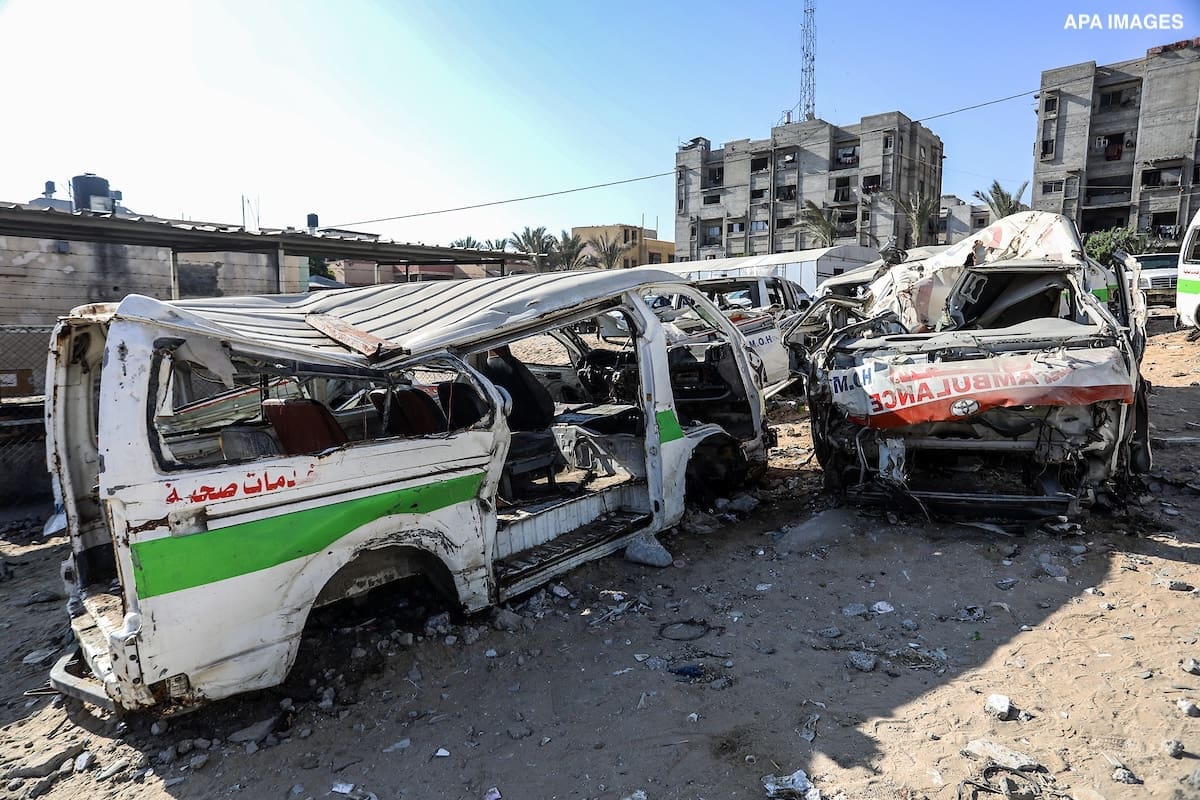
The genocide today marks the final stage of de-healthification. Israeli forces have turned Gaza’s hospitals from sanctuaries into execution sites. Human rights organizations reported that they repeatedly surround, besiege, bomb, and raid medical facilities before forcing evacuation. Between October 2023 and May 2025, Israeli forces killed more than 1,400 healthcare workers and carried out over 700 attacks on health institutions, systematically dismantling Gaza’s medical system.
After Israeli forces bombed Al-Ahli hospital in October 2023, killing 471 and injuring over 370, targeting medical facilities became normalized. This paved the way for the siege of Al-Shifa Hospital—once Gaza’s largest trauma center. By April 2024, Israeli encirclement, shelling, and invasion had rendered it non-functional.
Israeli forces escalated their assault on Gaza’s health sector with complete impunity. They besieged Al-Awda, Kamal Adwan, the Indonesian, Al-Rantisi, and Nasser Medical Complex, forcing evacuations, firing on wards, detaining medical staff, and blocking food and medical supplies. These actions aligned with a broader Israeli military plan to shut down all medical facilities in northern Gaza. In January 2024, Israeli troops raided Al-Amal Hospital, fired directly at its façade, detained doctors, and displaced more than 7,000 people seeking refuge there. They maintained a siege for over 40 days and effectively closed the hospital by March 2024.
Since October 7, 2023, Israel has advanced the final stage of de-healthification by eliminating Gaza’s capacity to sustain life. Fewer than 1,800 hospital beds remain for more than two million Palestinians in Gaza. Surgeries, dialysis, cancer treatment, and neonatal care are essentially impossible. Medical staff—those still alive and not detained or tortured—work under fire with almost no electricity, antibiotics, or anesthesia. Wounds rot into necrosis, and amputations proceed without pain relief. Malnutrition and once-preventable diseases spread rapidly, as the WHO warns of outbreaks of hepatitis A, polio, and jaundice.
What we have been witnessing in Gaza is biological warfare through starvation, infection, and untreated injury—what Ghassan Abu Sittah calls a “biosphere of genocide.” The impact of the Israeli assault is devastating, causing environmental, social, and biological destruction. The Israeli regime weaponized air, water, and soil by destroying sewage plants and desalination stations, flooding neighborhoods with waste, contaminating aquifers, and burning croplands. Bombing of orchards, greenhouses, and irrigation networks has erased food production itself. Drinking water, breathing, and planting food now involve mortal risk.
Israel’s de-healthification policy is central to this “biosphere of genocide,” manifested in its calculated assault on the very possibility of Palestinian life, erasing Indigenous bodies through the annihilation of care. Even if Palestinians were to survive bombardment, siege, and bureaucratic control, they are consigned to untreated agony—denied the right to heal, to recover, or to resist. Israel’s genocide uses bullets, but more decisively, sepsis, stillbirth, and suffocation through pain. The aim is to dismantle the systems that sustain life, depriving the Palestinian population of its doctors, clinics, and hospitals. This is not the collapse of a health system but the realization of a colonial logic designed to extinguish the conditions of life itself.
Recommendations
Without an international reckoning that centers the destruction of health as core to genocide, ceasefire diplomacy remains insufficient. To end de-healthification, action must extend beyond humanitarian relief and reconstruction. The following priorities are directed toward states, UN bodies, international courts, donors, and Palestinian health institutions, each responsible for preventing and reversing the destruction of Palestinian health sovereignty.
- Recognize De-healthification as a Crime
International legal bodies and human rights mechanisms must formally adopt the term de-healthification to acknowledge the intentional destruction of health systems as a tool of collective punishment and group erasure. Naming this crime strengthens monitoring, documentation, and legal accountability.
- Make Historical Violence Legally Actionable
Courts and investigative bodies must assess Israeli violations through a longitudinal lens that includes decades of siege, de-development, and structural degradation of Palestinian health. Prolonged system collapse should be treated as structural violence, and all complicit actors—including states providing political or military support—must be held accountable.
- Pursue Structural Recovery Rooted in Liberation
Reconstruction and recovery efforts must be Palestinian-led and grounded in sovereignty. This requires ending Israeli control over borders, airspace, fuel, and medical supply chains; abolishing the medical permit regime; guaranteeing free movement for patients and providers; and embedding legal protections against future siege tactics.
- Build Knowledge Infrastructure for Liberation Medicine
Academic institutions and global health networks should establish a Palestinian-led platform for liberation medicine to study health under occupation and produce knowledge accountable to affected communities. Research must prioritize justice rather than charity.
- Establish Absolute Protections for Medical Units
International humanitarian law reform processes must eliminate loopholes that enable attacks on medical facilities. States should adopt absolute legal safeguards for healthcare infrastructure and personnel, recognizing the protection of medical units as a jus cogens norm that cannot be overridden.
Acknowledgments:
The author thanks Laura Albast, Hareem Qureshy, Layth Hanbali, and Al-Shabaka’s editors and reviewers for their thoughtful comments and critical suggestions, which strengthened the clarity and framing of this brief. He also extends his deep gratitude to Palestinian healthcare workers—past and present—patients, and international physicians who continue to bear witness to the genocide.

Layth Malhis is a graduate student at Georgetown University’s Center for Contemporary Arab Studies, where his work focuses on settler colonialism and Palestinian health. His research advances the concept of “de-healthification” as an analytical framework for understanding the systematic dismantling and weaponization of healthcare in Palestine under successive regimes of colonial control. He is also a researcher at the Institute for Palestine Studies, where he contributes to the Healthcare Destruction Database and scholarship on medical violence and colonial governance. Previously, he managed North American operations for the House of Jerusalem (Bayt al-Maqdis), a Palestinian food import initiative, examining how Palestinian businesses navigate occupation, global supply chains, and the political economy of dispossession.