






Executive Summary
Christian Zionism has become a key vehicle of Israeli influence across the Global South, and South Africa has emerged as a central battleground. Once rooted in nineteenth-century imperial theology, Christian Zionism today functions as a political project that seeks to legitimize Israeli colonialism through religious narratives. In South Africa—long a stronghold of Black-Palestinian solidarity—its rapid spread threatens to erode public support for Palestinian liberation and strengthen pro-Israel lobbying efforts.
Israel’s alliances with Christian Zionist networks have expanded alongside the growth of South Africa’s Pentecostal and prosperity-gospel movements over the past several decades. These theological currents frame support for Israel as a divine obligation and have helped cultivate both an active pro-Israel lobby and a broader devotional base that discourages engagement with Palestinian rights. Together, these forces risk reshaping South Africa’s political landscape at a moment of increasing coalition politics, where even small pro-Israel parties can exert disproportionate influence.
To counter this trend and reinforce South Africa’s historic commitment to Palestinian liberation, this brief offers the following recommendations to the various actors identified:
Grassroots and Youth Movements
- Reframe Palestine as part of the Global South’s unfinished decolonization, linking it to South Africa’s anti-apartheid history.
- Expose Christian Zionism as a vehicle for neocolonial interests and highlight Israel’s role in global repression, including arms sales, spyware exports, and partnerships with authoritarian regimes.
- Build alliances among BDS organizers, youth formations, and grassroots movements to counter Zionist narratives and connect Palestinian liberation with broader African struggles.
Policy and Media Oversight
- Investigate and expose Christian Zionist networks, funding streams, and collaborations with Israeli propaganda infrastructure.
- Strengthen oversight of NGOs and charities complicit in rights violations; revoke charity status where applicable.
- Close legal loopholes that allow financial support for illegal Israeli activities and increase transparency in tax-exempt reporting.
Religious Leadership and Theological Institutions
- Promote liberation theology as an alternative to Christian Zionism, encouraging churches to adopt justice-centered forms of solidarity.
- Use international forums—including the World Council of Churches—to advance Palestinian perspectives.
Strengthen and internationalize Kairos Palestine, including through deeper coordination with Kairos South Africa.
In the nineteenth century, European empires used Christian missions to legitimize their conquest of African lands, seize resources, and entrench cultural domination. Mission schools and churches spread Western values, undermined African traditions, and framed service to the empire as service to God. Within this broader imperial landscape, British evangelicals began advancing a political vision for Jewish resettlement in Palestine. Although theological calls for Jewish restoration had circulated in Europe for centuries, it was Lord Shaftesbury—Victorian England’s leading Christian Zionist—who pressed Foreign Secretary Lord Palmerston to support Jewish resettlement as a means of strengthening British influence against rival French and Russian ambitions. In the process, evangelicals helped transform Christian Zionism from a theological belief into a political ideology aligned with imperial interests.1
Rooted in the belief that a Jewish state in Palestine is necessary for the return of Jesus and the end times, contemporary Christian Zionists often equate modern Israel with the biblical kingdom and frame its policies as divine will, casting Palestinian presence as an obstacle to God’s plan. In this view, the forced displacement of Palestinians is not only justified but reframed as a religious obligation. This policy brief examines the spread of pro-Israel Christian Zionism in the Global South, focusing on South Africa, which has been a stronghold of Palestinian solidarity. It shows how the Israeli regime has sought to undermine this support by leveraging Christian Zionism to lobby for the settler colonial state and weaken solidarity with Palestinians.
Christian Zionism in the Global South
The Israeli regime has long sought to overcome resistance to normalizing relations with Israel in the Global South, which itself is rooted in anti-colonial solidarity and support for the Palestine Liberation Organization (PLO). One of Israel’s most effective entry points has been the growing influence of Christian Zionism, which has expanded alongside Pentecostal and premillennial dispensationalist movements in Africa and Latin America over the past three decades. Israeli policymakers formalized this approach in 2004 by establishing the Christian Allies Caucus in the Knesset to “build direct lines of communication, cooperation, and coordination” with Christian leaders worldwide.
If Christian Zionism and pro-Israel mobilization can take hold in South Africa, a major center of Palestinian solidarity, the implications for the wider Global South are significant Share on XChristian Zionism has been gaining traction outside the Global North, as indicated by shifts at the Feast of Tabernacles, an annual evangelical gathering held in Jerusalem since 1980 to demonstrate support for Israel. At the first feast, Americans accounted for roughly half of the 3,000 participants. By 2008, however, Brazil sent the largest delegation, comprising an estimated 1,300–1,500 attendees. Building on the expanding base of Christian support for Israel in the Global South, the International Christian Embassy Jerusalem (ICEJ)—one of the world’s most influential Christian Zionist institutions—opened an office in Rio de Janeiro in 2023.
In South Africa, the growing influence of Christian Zionism has been closely intertwined with the rapid spread of theological currents aligned with its core beliefs. Pentecostals, for example, who made up just 0.2% of South African Christians in 1950, now account for roughly 10%. Surveys indicate that support for Israel is, on average, twice as high among Pentecostal congregations as among other Christian groups. Although not uniformly pro-Israel, Pentecostals tend to interpret biblical prophecy literally, making them more receptive to the idea that the modern Israeli state fulfills scripture. This orientation often aligns Pentecostal communities with Christian Zionist narratives and contributes to higher levels of support for Israel than those found in other denominations.
The rise of Christian Zionism in South Africa carries significant implications for the Palestine solidarity movement. Palestinians and Black South Africans share a long history of joint struggle against colonialism and apartheid, grounded in reciprocal support for each other’s liberation. The PLO has maintained close ties with the African National Congress (ANC) for decades, including providing training to South African freedom fighters during the anti-apartheid struggle. This Black–Palestinian solidarity stands in sharp contrast to Israel’s historic support for the white supremacist apartheid regime, which included military assistance and efforts to suppress South Africa’s liberation movement as well as anti-colonial struggles across the continent.
Accordingly, South Africa became a central hub of support for Palestinian liberation, most recently demonstrated by its case before the International Court of Justice (ICJ), accusing Israel of genocide. In response, the Israeli regime has intensified its public diplomacy efforts—and meddling—in South Africa, seeking to weaken this solidarity. If Christian Zionism and pro-Israel mobilization can take hold in South Africa, a major center of Palestinian solidarity, the implications for the wider Global South are significant.
Pro-Israel Groups: The South African Matrix
There is no single, universally accepted definition or form of Christian Zionism, and support for the Israeli regime ranges widely—from perfunctory prayers during mass to financial backing for settlers seizing Palestinian land and homes. In South Africa, Christian Zionism can be understood as comprising two broad strands: an active pro-Israel lobby and a wider “passive” devotional current, made up of congregations and individuals who embrace the theology that valorizes the Israeli state but do not actively campaign on its behalf.
Active Christian Zionist groups translate their beliefs into direct support for the Israeli regime and its geopolitical objectives. While these groups engage in a variety of political initiatives, Zionism remains a core element of their theology and advocacy. As a result, they maintain close ties with Israeli and Zionist networks that work to expand support for the regime both locally and internationally.
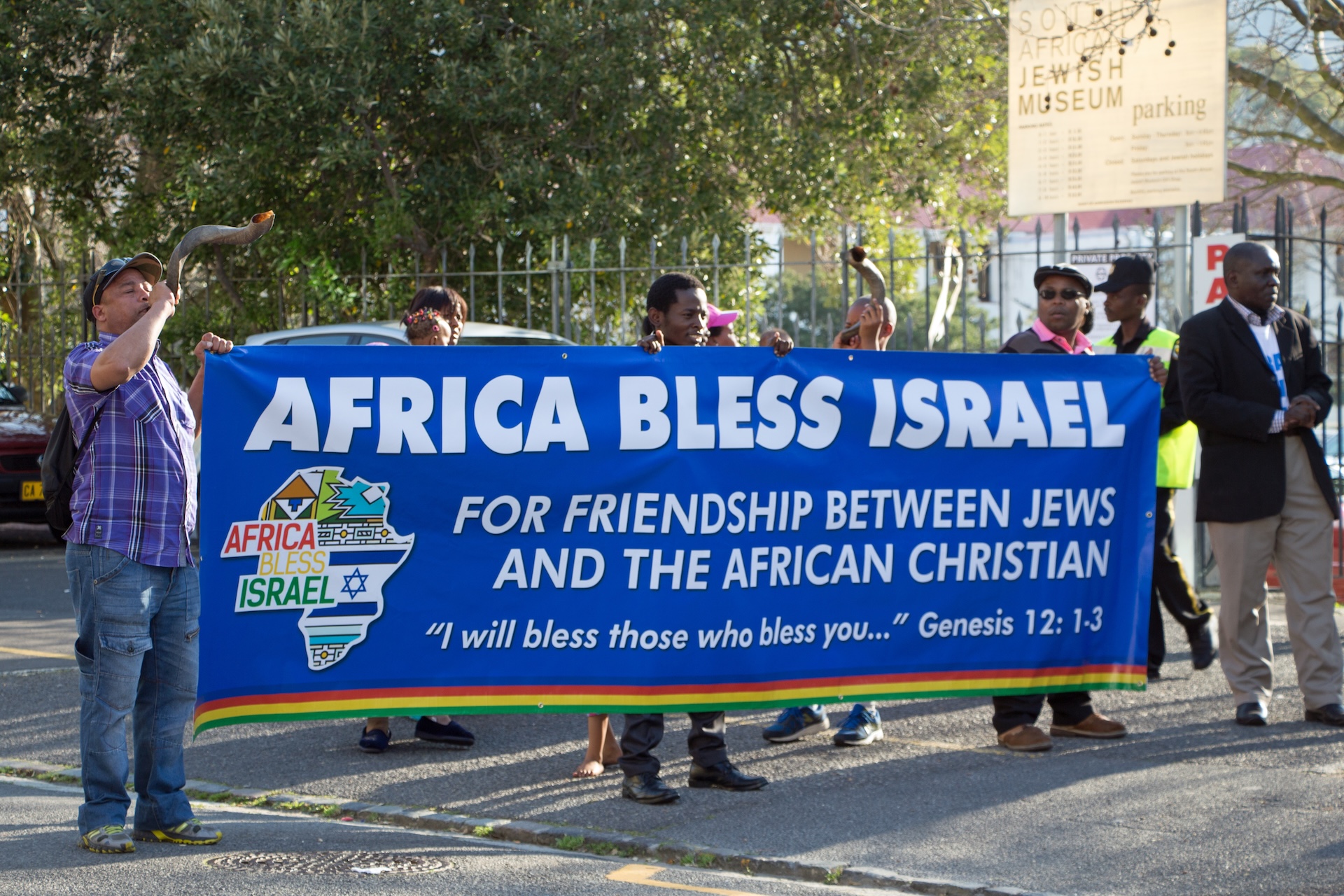
South Africa’s Christian Zionist groups and Israel advocacy networks are closely intertwined, with leaders often moving between organizations to reinforce pro-Israel agendas Share on XThe ICEJ and Bridges for Peace (BP) are among the most influential Christian Zionist groups in South Africa. As branches of global movements dedicated to “supporting Israel,” they maintain offices worldwide and work closely with the South African Friends of Israel (SAFI), which collaborates directly with Israel’s Ministry of Strategic Affairs, particularly on efforts to quash the Boycott, Divestment, and Sanctions Movement (BDS). While ICEJ and BP are rooted mainly in white South African communities, SAFI has cultivated strong ties with Black congregations, helping to spread pro-Israel theology across racial lines.2
In addition, the African Christian Democratic Party (ACDP), an explicitly Christian party represented in South Africa’s parliament, pledged in its 2024 manifesto to “re-establish full diplomatic relations with Israel” and move the South African embassy to Jerusalem. Its founder, Kenneth Meshoe, is also a member of the Israel Allies Foundation, a global network that promotes pro-Israel legislation in more than 40 national legislatures, including South Africa.
South Africa’s Christian Zionist groups and Israel advocacy networks are closely intertwined, with leaders often moving between organizations to reinforce pro-Israel agendas. Meshoe, for example, also established an initiative to counter BDS campaigns, called Defend Embrace Invest Support Israel. Malcolm Hedding, a prominent South African theologian, served as the head of Christian Action for Israel (South Africa) before moving to Jerusalem to become ICEJ’s executive director. Cassandra Mayekiso co-founded the Africa for Israel Christian Coalition, later worked with the South African Friends of Israel, and now leads the StandWithUs South African chapter. By leveraging this overlap among leaders of Christian Zionist and Israel advocacy groups, the Israeli Ministry of Strategic Affairs frequently channels its activities through local organizations to avoid the appearance of foreign interference.
In the absence of audited financial statements for pro-Israel Zionist groups, their funding sources remain opaque, though indications of Israeli government support exist. For example, Proclaiming Justice to the Nations—a US Christian Zionist organization classified as an anti-Muslim hate group—received direct funding from the Israeli regime to host events in Johannesburg and Cape Town alongside local partners, such as the South African Zionist Federation and ICEJ. This information only came to light after a Freedom of Information Act request revealed payments approved by Israel’s Ministry of Strategic Affairs to groups around the world. The organization in question has continued to deny receiving these funds.
This matrix of pro-Israel Zionist groups constitutes a coordinated lobbying network, with leaders moving fluidly between local and global roles and aligning their messaging and advocacy efforts across borders. As a result, Christian Zionist organizing in South Africa is closely intertwined with the broader international Zionist advocacy infrastructure.
Beyond this organized lobby, Christian Zionism also thrives in prosperity gospel congregations, where support for Israel is framed as a spiritual obligation linked to divine favor, health, wealth, and success. These theological interpretations lead many Christian Zionists—particularly among marginalized communities—to align reflexively with Israel by equating the biblical Israelites with the modern state and portraying the contemporary Zionist regime as “the nation of God.”3 These ideas circulate widely in churches and through major Christian media networks, which reach vast audiences and explicitly promote Zionist messaging. Pilgrimage tours to occupied Palestine and faithwashing-style dialogue initiatives further reinforce this worldview, helping Christian Zionism spread rapidly across Pentecostal and Charismatic communities throughout the Global South.
In South Africa, this broader devotional current—far less active than formal lobbying networks—constitutes the majority of Christian Zionists and plays a critical role in sustaining pro-Israel sentiment. Its primary impact is not overt advocacy for Israel but rather encouraging disengagement from Palestinian solidarity and fostering silence on Palestinian rights. Together, South Africa’s devotional current and lobbying network anchor a durable Zionist base, extending its reach from churches into parliament.
Political Impact of a Zionist Base
The ANC, South Africa’s dominant governing party, has been steadily losing its parliamentary majority. Its decline signals a growing reliance on coalition politics, in which smaller parties can wield disproportionate influence. As the ANC’s dominance weakens, pro-Israel groups among these smaller parties are gaining greater leverage.
South Africa’s pro-Israel parties, including the Patriotic Alliance, Freedom Front Plus, and African Christian Democratic Party, hold nine, six, and three parliamentary seats, respectively. Alone, their influence is limited compared to the ANC or the Democratic Alliance. Yet in coalition negotiations or on contentious bills, their votes could prove decisive, giving them leverage to extract concessions in exchange for support. However, even ostensibly “neutral” parties, such as the Inkatha Freedom Party, with 17 seats, could obstruct pro-Palestine legislation by narrowing the ANC’s margin for political maneuvering in parliament. These parties do not have to oppose such legislation outright; simply not backing it can weaken the ANC’s position.
As South Africa’s political landscape becomes increasingly fragmented, the rise of a Christian Zionist voting bloc is reinforcing small pro-Israel parties and intensifying lobbying efforts that challenge the country’s long-standing solidarity with Palestine. Bishop Lekganyane of the Zionist Christian Church joined a propaganda tour to colonized Palestine under the guise of a “peace mission” and later appealed directly to South African President Cyril Ramaphosa to soften the ANC’s stance toward Israel. Inkosi Shembe, leader of South Africa’s Nazareth Baptist Church, travelled to Jerusalem during Israel’s genocide to express solidarity with the colonial regime, declaring: “Our task is how we convert this support to something tangible to show the political leadership does not support the voice of the people.”4 Other church leaders have undertaken similar visits, often financed by the Israeli regime and its proxies in South Africa. Ironically, these carefully orchestrated propaganda tours mirror the same tactics once deployed by apartheid South Africa in its futile bid to rehabilitate its global image.
Challenging Christian Zionism
The long history of Black-Palestinian solidarity, set against Israel’s ongoing genocide in Gaza, has reinvigorated anti-colonial networks across Africa and Palestine after years of relative neglect. South Africa is no exception, where confronting Christian Zionism has become another front in the broader struggle for Palestinian liberation.
The battle against Christian Zionism in the Global South extends beyond theology; it's a struggle against material colonial interests Share on XThe South African Council of Churches (SACC) has played a central role in this fight, organizing workshops and conferences in support of Palestine while also challenging Christian Zionism and the prosperity gospel. SACC’s work extends beyond domestic politics, advancing Palestinian advocacy within the World Council of Churches through the Kairos Palestine Document. This document, released by Christian Palestinian theologians in Bethlehem in 2009, urges Christians worldwide to support Palestinians in resisting the occupation. It echoes the 1985 Kairos Document released by theologians in South Africa, calling on Christians globally to help South Africans oppose apartheid. Meanwhile, the Anglican Church of Southern Africa has issued strong condemnations of Israeli apartheid. At its June 2025 meeting in Johannesburg, the World Council of Churches Central Committee issued a statement that not only affirmed Palestinian rights and condemned Israeli apartheid, but also called for targeted sanctions, divestment, and arms embargoes against Israel for violations of international law.
Yet many churches still avoid confronting the passive forms of Zionism embedded in their own traditions, often perpetuated by the inertia of past teachings. Even so, meaningful engagement remains possible. Exposing the direct harm that Christian Zionist doctrines inflict on Palestinians may compel congregations to reconsider their stance. Ncamisile Pamela Ngubane—once a prominent Christian Zionist activist—embodied this shift when she resigned as SAFI’s spokesperson after learning the realities of Palestinian subjugation.
To curb the threat to the Palestinian solidarity movement, the Mandela Foundation issued a call for proposals for its Solidarity in Action Awards, with a special focus on challenging Christian Zionism in South Africa. As the foundation notes, “the misuse of religious scripture to justify domination and discrimination is something we know all too well in South Africa.” This statement draws a deliberate connection between how religion was once used to legitimize apartheid in South Africa and how similar theological arguments are now deployed to defend the Israeli regime.
Ultimately, the struggle against Christian Zionism cannot rest solely on theological debate. Challenging the ideology requires exposing the material consequences it obscures—namely, Israel’s long-standing role as a subjugator across the Global South. For decades, Israel has aligned itself with authoritarian and settler-colonial regimes, acting against Black and Indigenous communities through military support and political partnerships. This record includes its backing of Apartheid South Africa, complicity in genocide in Guatemala, and the provision of arms and training to Brazil’s military dictatorship.
Conclusion
The rise of Christian Zionism in South Africa, driven by literalist theology, international coordination, and political opportunism, presents a growing challenge to the country’s long-standing support for the Palestinian liberation struggle. Through both active and passive means, Christian Zionism has become embedded in parts of South African society, especially among Pentecostal and theological streams practicing the prosperity gospel. This religious backing, which is often presented as apolitical faith-based initiatives, ultimately advances the Israeli regime’s geopolitical aims by fostering a loyal base that remains disconnected from the realities of Zionist colonialism. As these beliefs influence politics, particularly in a coalition-based era, there is an increasing risk that South Africa’s official stance on Palestine could be weakened.
For Palestinians, the growing influence of Christian Zionism in South Africa and throughout the Global South highlights the urgent need to strengthen relationships and rebuild old alliances strategically. Instead of letting Zionist narratives dominate, activists must work to demystify the reality of Christian Zionism, challenge its justifications, and expose its connections to colonial and apartheid regimes, both historical and current. Building genuine solidarity and educating African communities about Palestinian oppression, while drawing clear parallels with their own histories of resistance, can help reclaim these spaces. The battle against Christian Zionism in the Global South extends beyond theology; it’s a struggle against material colonial interests. It requires a renewed, grassroots approach that focuses on shared histories of resistance against imperialism.
Recommendations
Confronting Christian Zionism as a vehicle of Israeli influence in Africa and beyond demands coordinated strategies across movements, policy spaces, and faith communities to expose its role in advancing expansionism and neocolonial domination. The following recommendations outline concrete actions for activists, advocates, and religious leaders to foster solidarity, counter disinformation, and bolster global resistance.
Activists, Youth Groups, and Solidarity Movements:
- Reframe Palestine as part of the Global South’s unfinished decolonization, directly linking it to South Africa’s anti-apartheid struggle.
- Expose Christian Zionism as serving neocolonial interests and highlight Israel’s role in global repression through arms, spyware, and authoritarian training.
- Engage veteran anti-apartheid activists and theologians to reinforce historical solidarity.
- Build alliances between BDS, youth, and grassroots movements to counter Zionist narratives and connect Palestinian liberation with African struggles against neocolonialism and capitalism.
- Develop digital toolkits, workshops, and cultural programs to demystify Christian Zionism and mobilize youth.
- Coordinate campaigns and direct actions targeting businesses complicit in Israeli crimes and opposing resource transfers like coal.
Policy Advocates, Journalists, and Watchdogs:
- Investigate and expose Christian Zionist networks, funding sources, and ties to the Israeli government and its propaganda apparatus.
- Push for oversight of NGOs and charities complicit in rights violations; revoke charity status where applicable.
- Close legal loopholes that enable funding of illegal Israeli activities and increase transparency in tax-exempt reporting.
Religious Leaders and Theologians:
- Promote liberation theology as an alternative to Christian Zionism and engage churches in grassroots solidarity.
- Amplify the voices of Palestinian theologians and foster global alliances with churches that resist imperial theologies.
- Use international fora (e.g., the World Council of Churches) to amplify Palestinian perspectives.
- Expand the Kairos Palestine initiative into an international coalition uniting liberation movements in the Global South.
- Deepen strategic collaboration with Kairos South Africa for joint theological and political advocacy.
- Curtin, P.D. (1971). The “Civilizing Mission”. In: Curtin, P.D. (eds) Imperialism. The Documentary History of Western Civilization. Palgrave Macmillan, London.
- Author’s interview with Ncamisile Ngubane, August 20, 2025.
- Gamedze, T. (2025). Christian Zionism in South Africa: An Initial Mapping [Manuscript submitted for publication]. Desmond Tutu Centre for Religion and Social Justice, University of the Western Cape.
- Gidron, Yotam. Israel in Africa: Security, migration, interstate politics. Bloomsbury Publishing, 2020.

Fathi Nimer is Al-Shabaka’s Palestine policy fellow. He previously worked as a research associate with the Arab World for Research and Development, a teaching fellow at Birzeit University, and a program officer with the Ramallah Center for Human Rights Studies. Fathi holds a master’s degree in political science from Heidelberg University and is the co-founder of DecolonizePalestine.com, a knowledge repository for the Palestinian question. Fathi’s research revolves around political economy and contentious politics. His current focus is on food sovereignty, agroecology, and the resistance economy in Palestine.