- Topics
-
Topics
See our analysis on civil society and how it shapes culture, politics, and policies
Read our insights on the shifting political landscape and what it means for Palestine
Learn more about the policies and practices shaping the Palestinian economy
Strengthen your understanding of the unique conditions for Palestinian refugees across the Middle East
-
- Analysis
-
Analysis
In-depth analysis on existing or potential policies that impact possibilities for Palestinian liberation.
Insights and perspectives on social, political, and economic questions related to Palestine and Palestinians globally.
Concise analysis into a specific policy, its background and implications.
Commentary that brings together insights from multiple analysts.
Compilations of past Al-Shabaka works surrounding a specific theme.
Longer-form, ad hoc projects that seek to confront research questions outside the scope of our regular analysis.
A policy-driven research initiative by Al-Shabaka: The Palestinian Policy Network.
Our monthly webinar series that brings together Palestinian experts.
Featured
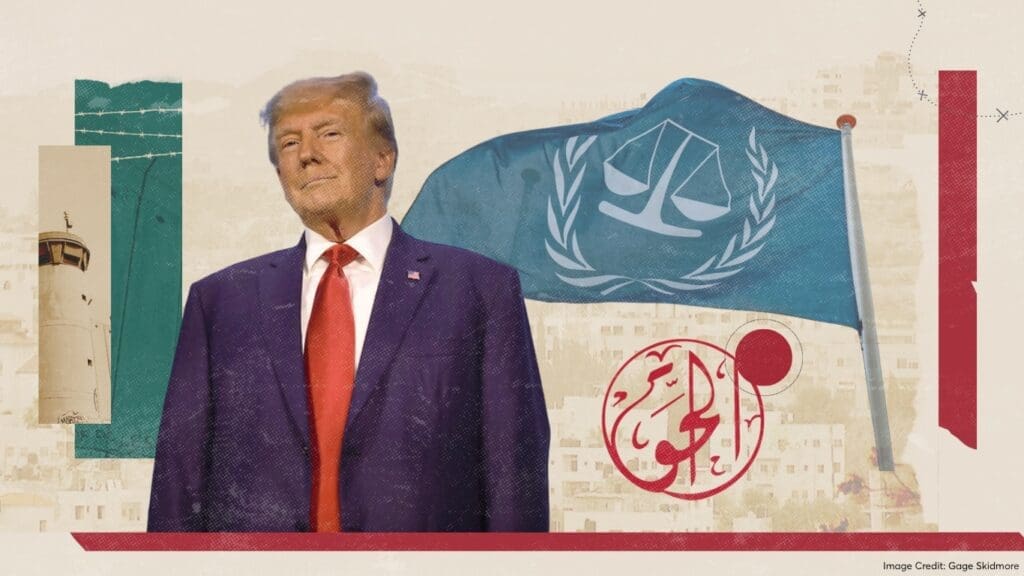
In February 2021, Defense for Children International–Palestine (DCIP) reported that Israeli interrogators had raped a 15-year-old Palestinian boy in detention. Rather than investigate the allegation, Israeli forces raided DCIP’s offices and later designated it—along with five other Palestinian human rights groups—as a “terrorist organization.” While such abuses and crackdowns are not new, this moment marked a decisive escalation: the shift from harassment of Palestinian civil society to its outright criminalization with the full support and participation of the US. In 2025, the Trump administration designated six Palestinian organizations under counterterrorism frameworks before advancing even further, sanctioning leading human rights groups for engaging with the International Criminal Court. These measures move beyond targeting individual actors to undermining the very infrastructure of international accountability. This policy brief argues that the campaign by the US and the Israeli regime against Palestinian civil society and international law carries global consequences, threatening mechanisms designed to hold state violence in check. It concludes with recommendations for how Palestinian organizations and their allies can adapt, defend themselves, and pursue justice in an increasingly hostile environment. Tariq Kenney-Shawa· Mar 31, 2026
 As the US and Israel escalate their assault on Iran, the Israeli regime has been constructing a war economy to sustain prolonged military campaigns while evading accountability. In September 2025, Prime Minister Benjamin Netanyahu urged Israelis to transform the country into a “Super Sparta” of the Middle East—more militarized, economically self-reliant, and capable of sustaining protracted conflict despite mounting external pressure. This policy brief argues that this rhetoric reflects an emerging doctrine: a political-economic project structured around permanent national mobilization, preventative warfare, and accelerated defense-industrial expansion. Yet the Israeli regime’s shift toward self-reliance is not producing full autarky. Instead, the war economy is consolidating into a hybrid model that combines domestic substitution in critical defense sectors with deeper integration into transnational supply networks, thereby dispersing sanctions risk. This configuration blunts the impact of conventional accountability tools, such as fragmented or weakly enforced arms embargoes. As a result, effective international responses must move beyond traditional sanctions frameworks and instead target the material infrastructure and dependency nodes that sustain Israel’s war economy.
 Ahmed Alqarout· Mar 11, 2026
 Noura Erakat and Jake Romm joined us for a policy lab episode on how Gaza helped shatter the old status quo and what that break reveals about the world being built in its wake.
-
- Resources
- Media & Outreach
- The Network
The Future of the West Bank: Settler Takeover and Annexation
Introduction
“We’re all going to end up in Jordan,” remarked a young man from Al-Jiftlik, a Palestinian village in the Jordan Valley. His comment reflects growing despair in the West Bank countryside, where Israeli settler-colonial expansion has intensified to unprecedented levels. This is particularly true in the Jordan Valley, the agricultural heartland along the West Bank’s eastern frontier with Jordan. Once known among Palestinians as the “bride of the Jordan Valley,” Al-Jiftlik now illustrates the gravity of Israeli state-sponsored settler expansion on Palestinian land, having transformed from a prosperous agricultural community into one under siege and facing sustained displacement pressure.
Since the beginning of Israel’s genocidal war on Gaza in October 2023, land seizure in the West Bank has shifted from creeping settler encroachment to a vicious military-backed campaign of territorial theft. This commentary shows how the Israeli regime’s land appropriation policy in the West Bank, once justified through bureaucratic-legal land seizure orders, has now increasingly shifted toward direct settler takeovers. This shift does not indicate a change in objectives but rather an escalation of existing settlement expansion mechanisms, signaling the growing power and influence of the settler movement over Israeli policy.
The Rise of Settler Regional Councils
In the aftermath of the 1967 war and Israel’s occupation of the remainder of Palestine and the Syrian Golan Heights, former Israeli minister Yigal Allon drafted a plan for the colonization of the West Bank. The plan proposed constructing settlements to enable the annexation of Jerusalem and the Jordan Valley while fragmenting the West Bank into enclaves under Jordanian rule or limited Palestinian autonomy. Although never formally adopted, the plan has nonetheless served as a guiding framework for the placement and expansion of settlements.
Today, six settler regional councils preside over the occupied West Bank, openly calling to bring in one million settlers and impose 'Israeli sovereignty' over the territory Share on XBetween 1967 and 1979, the Israeli regime established 79 settlements in the West Bank. As the settler population grew to nearly 100,000, governing bodies were created to oversee and administer these illegal communities. These took the form of local, municipal, and regional councils responsible for managing settlers’ “civil” affairs, including planning and administrative functions within settlement areas. The Israeli military established the first settler regional council in the Jordan Valley in early 1979, followed later that year by the Mateh Binyamin council. Soon after, the Yesha Council was formed as an umbrella organization coordinating the activities of settler councils.
Although the Israeli Coordination of Government Activities in the Territories (COGAT) is the Israeli military unit tasked with administering the occupation of the West Bank, settler regional councils have gained increasing influence over Palestinian affairs in recent years. These councils exercise quasi-governmental authority, plan and administer infrastructure, and provide services. They embody a system of settler self-rule that further fragments Palestinian geography and governance, bypassing international law with the backing of the Israeli regime. In practice, settler councils function as parallel administrative authorities, operating outside formal state channels while wielding de facto state power. Their integration into Israel’s broader bureaucratic apparatus has blurred the distinction between official governance and informal settler enforcement.
In February 2023, Israeli Minister of Finance Bezalel Smotrich was granted broad authority over settlement planning, construction, and civilian affairs in the West Bank. This arrangement effectively transferred key powers previously held by COGAT and its operational arm, the Civil Administration, to Smotrich and his settler allies. This transfer of authority has enabled unprecedented settlement growth while severely constraining Palestinian life and development across much of the West Bank.
Today, six settler regional councils preside over the occupied West Bank, openly calling to bring in one million settlers and impose “Israeli sovereignty” over the territory. Their representatives have increasingly become the public face of the occupation, exemplified by figures such as Shai Eigner. Identified as the land inspector for the Jordan Valley’s settler regional council, Eigner has become a notorious figure among Palestinian residents of the Al-Jiftlik area. Local reports describe repeated incidents in which he has threatened Palestinians and used drones to monitor and intimidate them on agricultural land. Although media outlets often distinguish between settler and army violence—framing the former as “wildcards” acting independently of the latter—in practice, state and settler violence are indistinguishable, operating as mutually reinforcing arms of the same settler-colonial system.
In 2024, the Palestinian Authority (PA) distributed supplies and water tanks to support communities whose cattle had been stolen; among them was Al-Farisia, which had endured years of settler attacks. Shortly after the PA visit concluded, Eigner—accompanied by Israeli soldiers—arrived to inspect the aid and intimidate residents. In the months that followed, settlers repeatedly raided and robbed the same rural community.
Despite these attacks, Palestinians in the Jordan Valley remain determined to stay on their land and resist ongoing colonization. Initiatives such as the Jordan Valley Solidarity Movement have supported community steadfastness by rebuilding demolished homes, constructing clinics, repairing damaged structures, and securing temporary access to water. Yet as the settler movement grows increasingly emboldened, assaults on Palestinian communities have intensified, leaving residents facing an ever more uneven struggle. Grassroots volunteers are stretched thin in confronting a well-resourced, state-backed apparatus of settler-colonial expansion.
A Unified System of Dispossession
It is important to understand that Eigner’s actions, and those of other settler council representatives, are carried out in coordination with Israeli security forces and state authorities. Israeli settlers and state institutions thus operate as an integrated apparatus advancing Palestinian dispossession and displacement. In one documented case in the Jordan Valley, Palestinian villagers reported that armed settlers seized their livestock and removed the animals in the presence of Israeli security forces. Residents stated that the forces failed to intervene, questioning Palestinian ownership claims rather than preventing the transfer of the animals to settlers. Such incidents reflect broader patterns in which settler violence and state enforcement function in tandem.
Israeli settlers and state institutions operate as a unified system to enforce Palestinian dispossession and displacement Share on XIsraeli state-imposed restrictions on movement and access to resources operate alongside settler seizures, together undermining Palestinian livelihoods and driving displacement. Trucks transporting animal feed are routinely stopped, searched, and confiscated by Israeli authorities under allegations of smuggling without evidence. Israeli occupation forces regularly subject Palestinians to arbitrary delays and harassment at checkpoints, where movement and daily life depend on soldiers’ discretion. These practices collectively reinforce a regime of coercive displacement.
Since October 7, 2023, the situation has deteriorated. Occupation authorities have installed new metal gates at the entrances of many Palestinian communities to exert comprehensive control over movement. This practice is especially pronounced in the Jordan Valley, where an activist from Al-Zbeidat, a village neighboring Al-Jiftlik, has described the current period as the “age of gates.” These barriers confine Palestinians to urban enclaves and sever them from land and livelihoods. Although Palestinians constitute more than 80% of the Jordan Valley’s population, they are restricted to roughly 5% of the territory, facilitating settlement expansion. This restriction is the culmination of decades of displacement: the Jordan Valley has witnessed a steep decline in its Palestinian population since 1967, from approximately 275,000 to about 60,000 today.
Meanwhile, the Israeli military safeguards settlement housing on occupied Palestinian land and connects settlements to state infrastructure. The Israeli regime designates settlements as “national priority areas,” granting them access to subsidies, state-backed mortgages, agricultural grants, and salary incentives, particularly in education. This designation functions as a policy instrument to expand and sustain settlements as part of Israel’s broader territorial strategy in the West Bank. Israeli state institutions, working in coordination with the settler movement, also select settlement sites to control water, farmland, and strategic corridors, preventing the emergence of a contiguous Palestinian polity.
This approach is characteristic of settler-colonial governance, in which an indigenous population is fragmented, economically constrained, and politically marginalized to secure demographic dominance. These conditions are not incidental byproducts of occupation but engineered outcomes of a coherent, long-term strategy.
De Facto Annexation Without Consequences
What experts once described as a “creeping annexation” has become an accelerated drive toward formal annexation. Regional settler councils openly frame Palestinian community initiatives as threats to the “Zionist enterprise,” revealing the fundamental contradiction between Palestinian survival and settler-colonial objectives. While some settler organizations articulate this explicitly, it reflects the underlying aim of Israel’s colonization of Palestine.
For decades, the international community has paid lip service to negotiations over land even as it was actively seized, without exerting meaningful pressure to halt expropriation. Israeli ministers and political representatives across both governing and opposition parties have openly vowed to annex additional territory and prevent the establishment of a Palestinian state. Yet, these declarations—along with unchecked settler aggression—have met no material repercussions.
A system that sanctions a handful of Israeli settlers while ignoring the state institutions that enable them sends a clear message: structural impunity remains firmly intact Share on XInstead, some states have imposed targeted sanctions on individual settler leaders deemed particularly abusive toward Palestinians. There is little evidence that these measures have alleviated Palestinian suffering or curtailed settlement expansion. They also raise further questions: what threshold of rights violations is deemed sanctionable, and why are specific individuals targeted while the broader settler population—now exceeding 700,000—remains unaffected? Such policies expose the tension between addressing individual acts of violence and confronting the systemic, state-supported structures that enable them.
In practice, these measures—alongside symbolic recognition of a Palestinian state—function as gestures that allow states to avoid the diplomatic cost of applying meaningful pressure on the Israeli regime. Meanwhile, the Israeli regime’s policy of providing state subsidies and material support to individuals relocating to illegal settlements remains untouched by individual sanction frameworks.
This inconsistent approach has produced a tiered system of accountability and, alongside Israeli impunity in Gaza, has eroded international legal norms and the post–World War II international order. A system that sanctions a handful of Israeli settlers while ignoring the state institutions that enable them sends a clear message: structural impunity remains firmly intact.
Conclusion
The Palestinian community of Arab al-Kaabneh foreshadows the future that awaits Palestinian communities should settler regional councils achieve their objectives. For years, the rural community faced systematic harassment, including repeated attacks, livestock theft, and settler intimidation. Its school was deliberately targeted: teachers were assaulted, children threatened, and fear was instilled through tactics such as the digging of child-sized graves outside its grounds. Persistent threats at checkpoints and a pervasive climate of fear disrupted education and daily life. While Arab al-Kaabneh’s experience reflects that of many villages across the region, its outcome is especially stark. As of July 2025, the community has been entirely depopulated, and settler outposts have been established in its place.
The fate of Arab al-Kaabneh exemplifies the broader pattern of Palestinian displacement unfolding across the West Bank. Absent meaningful intervention, similar outcomes are likely to follow elsewhere.
The objectives of Israeli policy in the West Bank have become increasingly explicit and remain fundamentally incompatible with any future in which Palestinians are free and sovereign. The long-standing approach of “managing the conflict” without addressing its root causes has become untenable. While Palestinians continue to assert their right to remain on their land amid an expanding territorial regime, the question now is whether third states will act—or once again leave Palestinians to confront these intensifying assaults on their land and rights alone.
Fathi Nimer
Fathi Nimer is Al-Shabaka’s Palestine policy fellow. He previously worked as a research associate with the Arab World for Research and Development, a teaching fellow at Birzeit University, and a program officer with the Ramallah Center for Human Rights Studies. Fathi holds a master’s degree in political science from Heidelberg University and is the co-founder of DecolonizePalestine.com, a knowledge repository for the Palestinian question. Fathi’s research revolves around political economy and contentious politics. His current focus is on food sovereignty, agroecology, and the resistance economy in Palestine.
Latest Analysis
US Sanctions: Criminalizing Palestinian and Global Justice Work
Insulation Not Isolation: Israel’s Super-Sparta War Economy
After Gaza’s Genocide: What World Order?
We’re building a network for liberation.
As the only global Palestinian think tank, we’re working hard to respond to rapid developments affecting Palestinians, while remaining committed to shedding light on issues that may otherwise be overlooked.