



About This Episode
Episode Transcript
The transcript below has been lightly edited for brevity and clarity.
Engy Sarhan 0:00
I think when we say Gaza is our moral compass, it’s not really an empty slogan. And I think one can always ask, is the action that I’m doing centering the dignity of the Palestinians? I think there’s a responsibility in how we have to act and how we have to relate to Palestinians. And I think that the question of dignity has become centered on this, and I think secondary to this, or also next to this, would be, will my action put someone else in danger if they don’t have the same privileges as me?
Yara Hawari 0:34
From Al-Shabaka, the Palestinian Policy Network, I am Yara Hawari, and this is Rethinking Palestine.
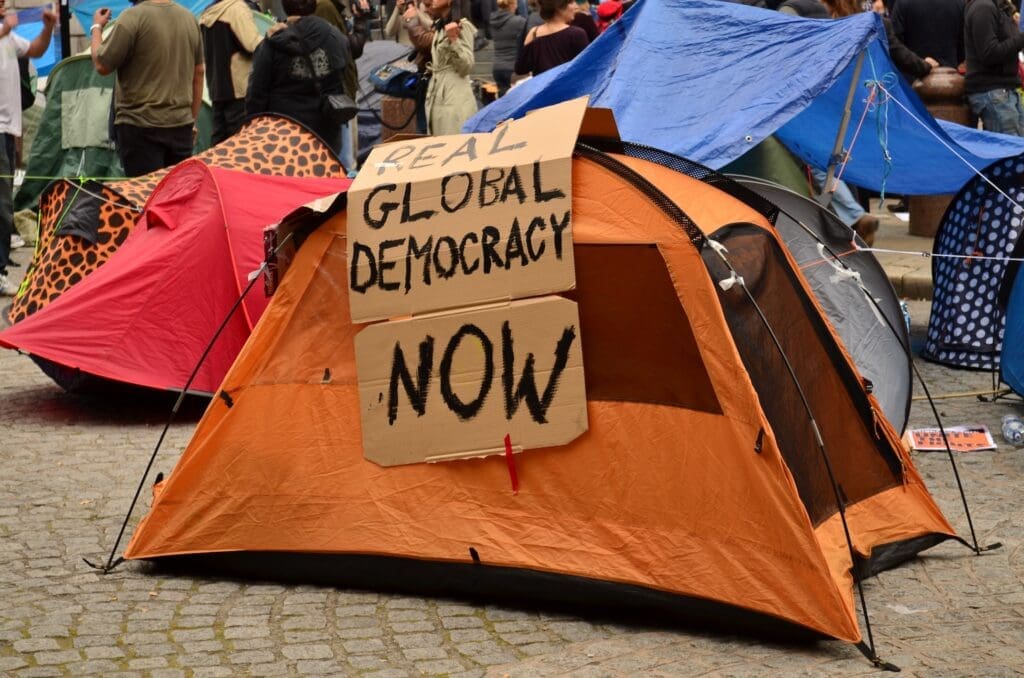
In mid-June 2025, thousands of international solidarity activists planned to march from Arish in the Egyptian Sinai to the Rafah border in what was dubbed the Global March to Gaza. The participants came from over 80 countries, many from Europe, and they included individual activists, solidarity groups, and trade unions.
As expected, the participants barely made it out of Cairo before they were stopped by the Egyptian authorities. They were sent back to the Egyptian capital. Some were detained, and others forcibly deported. It’s clear that the organizers of the march knew they wouldn’t reach Rafah, and many activists have since stressed that the aim was to highlight the complicity of the Egyptian regime in the blockade and to put some kind of international pressure on it.
Now this is not the first attempt to breach the blockade on Gaza. Over the last nearly 18 years, there have been various attempts by sea and land, and with them have come many discussions about the effectiveness and importance of such actions.
Indeed, though these actions often capture some media attention, especially if public figures are involved, like the recent case with Greta Thunberg, and provide symbolic support, they rarely make changes to the material reality on the ground. Is this what is expected of international solidarity—to only participate in actions that have a real-life effect, or is there room for symbolic support?
To discuss this with me on this episode of Rethinking Palestine is Engy Sarhan. Engy Sarhan is a researcher pursuing a master’s degree in modern Middle Eastern studies at the University of Oxford. She’s also one of the five founding members of Collective, a platform for resource sharing among artists, writers, and curators in Egypt and the Arab world. Engy, thank you for joining me on this episode of Rethinking Palestine.
Engy Sarhan 2:34
Thank you for having me, and thank you for opening the space to discuss this at this point.
Yara Hawari 2:39
Engy, you recently published an article with the Egyptian media platform, Mada Masr, that raises some critical questions about mobilizations, such as the Global March to Gaza. Perhaps you can start off by telling us a bit about what unfolded and contextualize it in the history of international attempts at solidarity with Gaza in Egypt.
Engy Sarhan 2:59
I want to start by saying that the text is kind of a piece of reflection on recent events that happened through discussions with other people. At the same time, many people around me were having these discussions, but there was not one space in which we could funnel down these ideas. And I think this is where the push to write came.
The other thing that might be important to mention here is that I’ve seen a lot of people tweet around the time, I think it’s something to the effect of what you said in your introduction, that it was crushed as expected. People were drawing a lot of parallels between this March to Gaza and a similar march that took place in 2009.
Back in 2009, I was very young, so I don’t have a vivid memory of what that meant. So I had to turn into a researcher and try to read this moment backwards from the position of today. And I found a very comprehensive article on the Electronic Intifada that was published in early January 2010. So it was shortly after the events of this attempt that happened.
And what I could tell from this article is also something that I discussed with a friend, is that history is a distorted mirror. So much of what was in that article could be applied to today’s context if you just swap some dates. And I think it made me think, since we have a precedent, since we have this in recent memory, 2009 is not that far away from today.
It made me question a lot about what was happening in 2025 and how it relates to 2009, and how we can see both as a continuity, not as moments of rupture, actually. And I think I mentioned this in the article, but I think from both instances, what’s happening today and what I read in the 2009 article, you can see similar tactics.
You can see soft detention, you can see the focus on media attention, the focus on it becoming a spectacle of protest and containment, whereas visibility is prioritized over strategic planning. It also raised a lot of concerns about performative activism and the privilege of mobility. Like you really start to think, who has the privilege to just drop everything, get a ticket to Cairo, and then just go not knowing what is the end goal of this action, and whether directly or indirectly, I think it ended up distracting media and public discourse from the ongoing genocidal violence inside Gaza to what was actually happening with protesters on the other side of the border, or like slightly outside.
I think people don’t understand the context in Egypt. People were sometimes texting me just because I’m Egyptian. It was really random; they would be saying something like, “Have you heard of this?” And again, I was also very, not hesitant, but doubtful that this would ever go through.
I remember sometimes I would just screenshot the map of Egypt and draw a line over the Suez Canal, and I could tell them this would be as far as one can go if you try to attempt a similar type of protest, just because of my experience of traveling into Sinai. You know, how many checkpoints one has to go through if you’re just going to Sharm El-Sheikh or Dahab or somewhere else for vacation, let alone, we’re talking about Northern Sinai when you have a direct border with Gaza.
I think people lack this basic understanding just because they look at a map and they think they can understand how to get there from point A to B, not knowing what sorts of obstacles are between points A and B. I think this is what I can say to that first point—that it was really helpful for me to read the events of today through the lens of what happened in 2009.
See how it was probably similar intent, probably similar scale. The only difference is that back then, there was a lot of support from the French Embassy, for example, which is absent today. Even though the embassy tactic was invoked at some points, people were like, “Call your embassies, ask them to come and defend you.”
But we all know the position of those embassies today. We all know how complicit they are, and we all know that they really don’t care. And the second thing is to look at what happened in 2009 and apply to today, and then understand when the initial intention of protest fails, how those groups resort to symbolic actions, probably in Cairo, not knowing what this leads to, and by this I mean hunger strike vigils and flash mobs and all sorts of these actions.
Yara Hawari 7:26
Engy, something you said really struck me—that visibility was prioritized over strategic planning. Can you unpack that a little bit more?
Engy Sarhan 7:35
If you go to their social media channels, official social media channels, which at this point in time act as an official means of understanding what this campaign is about, what you would see is hyper-visible.
I think we can speak only to what we see. I cannot speak to what’s happening internally. What you see is a lot of quasi-influencers that are being brought to Cairo to launch what would be called, in that instance, awareness campaigns. They want to draw international attention to what’s happening in Gaza, and then by being in Cairo and trying to break the siege, they are redirecting this international awareness or international media attention.
But I think there needs to be a pushback on the lack of awareness. Gaza is not absent from the news lines. It’s been present in the news lines for the last two years. So this technique applies to other struggles, other causes where the media stops reporting on them, where the media avoids reporting on them.
I don’t think this is the case with Gaza, and I think there’s something very flattening in applying this blanket claim that there hasn’t been enough media coverage or there’s no media coverage, so we need to use the media tactic. So there was this, and I think also the idea of gathering masses, focusing on numbers, where 1,400 activists from 80 countries and all, and whatnot, it becomes a currency in which you can basically present something. So I would say the focus was on this rather than material aid. We don’t know if any aid was involved. As far as I know, I’ve seen tweets of people stuck on the first or the second checkpoint to Ismailia with no water and sending out emergency appeals for people to bring water and food trucks from Cairo.
So what is your role in that situation? I thought you were going there to deliver aid. I thought you were going there to help break the siege. There’s also something in that when you read the official statements on the website of the march, it feels like a safari program. We are going to arrive in Cairo on June 12th or 13th, and then we’re going to go by bus to Arish, and then from that point onwards we’re going to march for three days.
There was even a program of marching between 7:00 and 10:00 AM, and then a break because I don’t think anyone can tolerate walking in the sun, in the heat, and then continue marching again between 5:00 and 9:00. And then after that, there’s a sit-in staged outside the border on the Egyptian side. The sit-in was supposed to last three days, and then there was like the last line in the program, “Return to Cairo and leave.”
So I think something about this was for me very disturbing to read because it reads like a recreational program or something that I would sign up to if I want to go on tourism or something. And for me, something didn’t sit right with this, and it made me just question what the point is. What is the actual goal?
What is behind all of this? What are we going to do if we gather a lot of people and we sit outside for three days? What is this going to do to people on the other side? Also, thinking of the ethics and weight of what it means when I’m sitting outside the borders of a place that has been actively bombed by Israel for the last almost two years.
Yara Hawari 10:53
If you’re enjoying this podcast, please visit our website, al-shabaka.org, where you’ll find more Palestinian policy analysis and where you can join our mailing list and donate to support our work.
I think at best it kind of highlights the sort of naivety of a lot of these activists, but I think that also takes away—assuming that this is just naivety—takes away agency from these people, because as you said, this isn’t about raising awareness.
The genocide in Gaza has been live-streamed and covered by the people who are facing the genocide themselves for the last nearly two years. And so it’s no longer a question about narrative. I think the Palestinians and their liberation struggle have won the narrative in this moment. I think there is no question about genocide and the mass horror that is being inflicted upon the Palestinian people.
We have the literal proof of that on our phones every day, every minute, every second. The last thing you said about sort of the lack of forward thinking in terms of basic logistics, it just strikes me that this put a lot of undue stress on local activists, people who would rightly be concerned about international comrades and people coming to their country and being placed in unsafe situations.
Engy Sarhan 12:19
I’m just going to answer the second part of your question first. I would agree that this happened, but again, when I read the 2009 article, something very striking—one of the last paragraphs was talking about the absence of Egyptian representation.
It said, and I’m quoting here, “In previous incidents during the Gaza Freedom March, except for the syndicate of journalists, the relative absence of Egyptian participation and solidarity with the Gaza Freedom March could have been interpreted by detractors as the result of either severe political repression or political indifference.
Anti-government Egyptian activists pointed out that the Gaza Freedom organizers failed to reach out to them and establish coordination. In fact, Egyptian labor unions, students, and organizations of civil society have a long history of struggle in the streets of Cairo and other towns for democratic rights in the face of the overwhelming force of the state apparatus.
Six full days of political demonstrations in Cairo by a large group of visiting internationals is without historical precedent.” I think it’s really important to understand that this moment in 2009, you had active labor unions, you had active student unions, you had active political organizations, and even then, it’s mentioned in the article, even then, no one was contacted.
No one was reached out to. So I think there’s a little bit of arrogance in kind of thinking, you can just go to this new terrain, new context, without really doing any basic reading, basic research, trying to understand, thinking that you can just survive there. And I think the other thing is that similarly, this time around, people sounded the alarm.
I’ve seen reports online or articles online asking activists, so at this point, they’re not even trying to stop them, but they’re trying to kind of do damage control. It said when you come to Cairo, try to stay away from mutual aid networks because if you try to approach them, you risk exposing them.
So I think there was a lot of advice or a lot of crucial context being provided in advance that was dismissed. Was dismissed because people thought they could do better or that they were taking action for the sake of action without really thinking of consequences. And because there’s also the privilege of exit.
Basically, I can go and leave. Or that they really don’t have an understanding of what it means to engage with the police in Egypt, for example. Maybe their experience with engaging with the police is one of, for example, the UK or Germany, where basically you have some sort of police clash. They escort you to a police station, and then maybe they do fingerprints.
Maybe someone is sent, and they do police station support, and then you spend the evening in a police station, and then you’re released with no consequences or no major consequences, more or less. So I think there’s a discrepancy here that might not have been taken into account in that instance. I also agree that it’s not really about changing the narrative.
I saw once in a protest a banner that was very silly, but it said so many things. It said, “No one can say they didn’t know.” So by this point, it’s not really about bringing to light something that is off the table. It’s more or less about using similar tactics to what people have been used to before, without really realizing how the situation on the ground has changed.
And I think a lot of the critique that was directed at people asking international activists not to descend on Egypt was like, “What do you want us to do? Do nothing?” And the response to this was not “Do nothing,” but at the same time, you have to maybe think of what you should target that has the most efficient material change for people on the ground.
So basically, if you live in a country that directly finances the genocide, you have to aim at directing a change in policy, not in changing the narrative. If you live somewhere close to a weapons factory, then you might have to do something in relation to that weapons factory as opposed to thinking of a symbolic action that might bring into light the suffering of the Palestinian people. I think, just to sum it up in short, people sometimes invoke sensational parts of the reality of the genocide to have some sort of urgency. So they would say, “We need to do this because the children of Gaza are starving.”
But my response to this is, if you really care about the starving children of Gaza, start engaging more seriously with mutual aid. Fundraise so that they can have access to flour. People sometimes say, “We’re hearing the calls of the Palestinians.” Yes. But the Palestinians, when they call on people, they ask that you surround embassies, Zionist embassies, US embassies, buildings or institutions of true political power that actually have the authority and the possibility to overturn something, the possibility to change the material conditions on the ground with the speed that matches the scale of the carnage.
So I think, again, people tend to conflate a lot of what they invoke to achieve what, without really that being questioned.
Yara Hawari 17:29
And I think part of this is an outcome of social media, where people prioritize these symbolic, flashy, Instagrammable protests over real political work, which, to be honest, is more often than not very tedious, very monotonous, very thankless, not Instagrammable at all, but is necessary and vital in building a movement. And the fact that many of these activists and figures came from the global North and came from Europe is really significant. There was some research published the other day that contrary to what a lot of people think, the EU is actually the biggest investor in Israel, not America, the EU.
And so there is actually a lot of work for these people to be doing at home. And in many cases, I think it’s more important to be engaged in that kind of work rather than the symbolic protest. But I want to bring us to one of the talking points that a lot of the organizers or the people involved used as a sort of acknowledgment of the passport privilege and the white privilege of participants, and insisting that it can be used as a mechanism for leverage.
So, in other words, the logic was that they could do things that local activists or Arab activists could not do, or at least they would be afforded more safety than local activists. So what do you think about that kind of defense or argument?
Engy Sarhan 18:53
In the article, I mentioned white privilege a couple of times, but I think in that specific instance, I would prefer to stick more to passport privilege. Whiteness here is more a construct in relation to the proximity of power structures rather than race or skin complexion.
I think it’s also important because maybe this is something that I missed while writing that article, that some of the participants in the march were also organizers who are coming from either Arab countries or from Western countries. So it means that they have a certain passport privilege.
I think one feedback that I got was that I put everyone in the same basket. This is something that I kind of acknowledge doing, whether willingly or not, but I think in the same way that I demand a differentiated approach when I write in the article that we should have the clear-eyed distinction between state policy and popular will, I think I would like to use the same framework and allow it to lend itself to separate organizers from participants.
I think this is really important in any kind of organizing structure, where the question of accountability kind of comes forward. So again, what I wrote about was mostly that which was hyper-visible. And then going into that, I think there was a lot of, like you said, a lot of people thought that their privilege would afford them safety to do certain actions where their Arab, Egyptian or Palestinian counterparts could not be afforded the same privileges.
But I think it’s also important to think about what’s at stake. A lot of the people who would engage in similar acts of protest are probably acting on white guilt, are probably acting with a certain level of white fragility and are probably acting with a certain level of white saviorism. And I think there’s something to be said about going into solidarity movements for identity building.
There’s a lot of privilege in choosing which struggles do you want to support. And also in turn, which struggles you can just decide to walk away from. I’ve met a lot of people in my life who will say something like, “I think I will prioritize working on the climate struggle for the next period.” But for others, this is a part of the reality.
This is not something that they can afford to walk away from, even if they wanted to. I think this is what sets apart a lot of considerations in that people would take in that position. Also, how can one act while being principled?
I understand that the response is a lot of outrage, and it’s very understandable to be outraged by the helplessness. At the same time, taking any action in that specific context, taking any action because you want to break the siege or stop the genocide, and all of these things, should be understood within the larger struggle for liberation.
Then the second thing is that it shouldn’t be so that you feel good, so that you’re able to ease your conscience. So again, the outrage itself is not enough. And doing action for the sake of action is not enough because at the end of the day, it’s not going to be able to change anything.
It’s not going to be able, for one, to become closer to the end goal of liberation. At the same time, it ends up being something that takes so much space. It actually takes so much media attention and probably redirects it from what is actually happening in Gaza. And I don’t think it ends up benefiting anyone.
And with that said, and I think with what we discussed on the march that took place in 2009, I still don’t quite understand why people are acting surprised. I don’t think there is anything to be surprised about. Does that mean we stop trying? I’m not sure, but I think it requires that one tries with a little bit of humility, with understanding, with strategizing.
Yara Hawari 22:39
Engy, I want to just quickly, if you allow me, to read out a quote from the article that I thought was really impactful and sort of encapsulates what you have just been talking about. You wrote, “There’s something deeply seductive about collective movement, about being part of a movement that feels historic, but that feeling, too, can be a kind of privilege—to experience solidarity as a high without having to live its aftermath. What does it mean to hold that emotion alongside politics or responsibility?”
I think that really sums up what you have just been saying, that inevitably there will be tensions in any solidarity movement. And I think that applies not only to white allies in the movement, but to those who also have passport privilege.
And I think it’s something to reflect on. But one of the things, and you really hit the nail on the head, is that this has been happening before that. We have had these kinds of issues come up over many years, and there seems to be a sort of a lack of reflectivity, a lack of strategic thinking, and really a lack of learning from history.
The year 2009 was not so long ago; I probably remember it a bit better than you do, but it was a time when there could have been a lot of lessons learned.
Engy Sarhan 23:58
I really agree with the kind of lessons learned. What are the precedents? What can we do differently? How can we approach things in a way that would actually work?
Because at the end of the day, like I would’ve loved to see this happen in reality. It would’ve been great, but what I saw was a lot of probably misplaced excitement, you know? There is again, like I said, there’s something deeply seductive about not only a collective movement, but also a proximity to an event that might seem historic; everyone will remember the Gaza genocide 10 years from now.
So in that moment, I might think that I want to be one of those activists who went there, put my body on the line, and tried to break the siege, even if I ended up not being able to do that. But I would’ve liked to be part of that. So I think there is something in, at this point, of proximity, but then also the attempt to do something against the backdrop of helplessness, without really kind of knowing for sure that this is going to bear fruit.
Yara Hawari 24:57
So this week, there’s another flotilla on its way to Gaza carrying a group of international activists. And of course, Freedom Flotillas have been a long part of the struggle in attempting to break the siege on Gaza. Do you have any thoughts about this particular action?
Engy Sarhan 25:15
When I wrote the article, I remember opening the article by saying that there are three different international protest actions and that each has its own calculus of strategy and visibility and privilege. I think there’s a lot to be said about the Freedom Flotilla, specifically the Madeleine, which relied mostly on high-profile figures more than any of the other older missions.
But I think there’s something of value, maybe when you think of it as a form of sustained protest over a large number of years. I think I read somewhere that this is the 37th mission so far. So I think there’s a lot of learning from past mistakes. It relies on redoing; when one of those missions fails, it doesn’t mean that it’s a fail, a definite fail. It means that it’s a new space opened up for the next one and so on. And I think something can be of value in this attempt or this strategy, basically.
The other thing is that I think they also rely so much on the aspect of raising awareness, which I don’t think is needed at this point. But on the other hand, they also deliver aid, and I think there is, historically speaking, the Flotilla has reached Gaza a couple of times, as far as I understand, delivering aid at different points in time. And also the 2010 Freedom Flotilla, it was called the Mavi Marmara. I think it ended up with direct confrontations and violent clashes with the Israeli military.
I think the type of confrontation that it invokes is completely different from the march. I think people go there also knowing what’s at stake. So I might not agree with the framing per se, or maybe smaller tactics, but I think there is something of value or something that could be learned from understanding how something can work as a sustained form of protest as opposed to a one-off.
And if it doesn’t play out the way it was planned, then we move on with our lives and don’t revisit it.
Yara Hawari 27:15
I think in all fairness as well, like we are living in an unprecedented moment. I mean, the genocide is, for all of us, a moment of unprecedented horror. It’s something that I think none of us could have quite imagined or expected this level of violence.
So I think it’s, on the one hand, it is understandable that people are trying to do anything and everything, but it is precisely because this moment in the Palestinian struggle for liberation is so horrific that necessitates us to slow down and to think more collectively and to think about what we have learned, to think about strategy over sort of these very flashy feel-good tactics.
That’s not, we’ve said this time and time again throughout this podcast, it’s not to say that people come with bad intentions, but I think people don’t acknowledge how much work goes into liberation movements, into revolutions. There’s a lot of tedious political work that is necessary and crucial for the movement that is often built on, and built up over years and years and years.
The various revolutions of the Arab Spring weren’t one moment in time. It wasn’t one protest that led to the Arab Spring. It was years and years of organizing and work. And the same is the case for Palestine when there have been moments of uprising. These haven’t been sort of just random moments where protests suddenly become the uprising itself. It’s actually a lot of work that goes into it.
Engy Sarhan 28:44
I can maybe jump in and say I agree with you that I don’t think any of this is ill intention, but I think it’s a little bit misplaced and a little bit inconsiderate of the context. And I think what could be asked here is just to make sure that the framing is correct, the intention is in the right place.
This is going to do something that, in the long run or in the grand scheme of things, can have an impact and change something. I think when we say Gaza is our moral compass, it’s not really an empty slogan, and I think one can always ask, is the action that I’m doing centering the dignity of the Palestinians?
If you don’t have a clear answer to this, then I think you would require revisiting what you’re doing, and you keep revisiting until you have a clear answer on how this actually centers the dignity of the Palestinians, not the Palestinians in general, but I think there’s a responsibility in how we have to act and how we have to relate to Palestinians.
I think that the question of dignity becomes centered on this. I think secondary to this, or also next to this, would be, will my action put someone else in danger if they don’t have the same privileges as I? Again, thinking of the ramifications. If I step foot in that square, what happens?
Who else is affected? Are they affected positively or negatively? And it ends up being like a simple calculation of what’s your input? What is the output? And then you start to see if it’s worth it or not worth it.
Yara Hawari 30:12
Engy, I think we’ll leave it there. Thank you so much for joining me on this episode of Rethinking Palestine.
Yara Hawari 30:20
Rethinking Palestine is brought to you by Al-Shabaka, the Palestinian Policy Network. Al-Shabaka is the only global, independent Palestinian think tank whose mission is to produce critical policy analysis and collectively imagine a new policymaking paradigm for Palestine and Palestinians worldwide. For more information or to donate to support our work, visit al-shabaka.org and, importantly, don’t forget to subscribe to Rethinking Palestine wherever you listen to podcasts.

Al-Shabaka: The Palestinian Policy Network is an independent, non-partisan, and non-profit organization whose mission is to convene a multidisciplinary, global network of Palestinian analysts to produce critical policy analysis and collectively imagine a new policymaking paradigm for Palestine and Palestinians worldwide.