






About This Episode
Episode Transcript
The transcript below has been lightly edited for brevity and clarity.
Yara Hawari 0:00
All the advocacy efforts that haven’t happened randomly. This has happened as a result of Palestinian-led organizing in Palestine and in the diaspora. So I think it’s really important to take stock of that and to remember that we’re seeing massive solidarity, but we’re seeing it in such an organized way because Palestinians refuse to be beaten. We refuse to be erased from our land, but also from the world’s consciousness. And I think that’s really a testament to that.
The following podcast was recorded in collaboration with the Makdisi Street podcast, co-hosted by Saree, Ussama, and Karim Makdisi. In it, we discuss the ongoing genocide in Gaza, intra-Palestinian and Israeli politics, and more.
Karim Makdisi 0:50
There are major demonstrations taking place today in Israel and labor union strikes, and this follows of course the deaths of six — or the uncovering of six — hostages, captives that were taken and discovered. And I’m wondering, how do you see this? How is it being covered? Is there something new in Israeli politics with all these major demonstrations, or is this just a continuation of something that we’ve been seeing over the past several months, where it’s not so much about what’s going on in Gaza, about the genocide, about anything else, but purely a very intra-Israeli kind of politics — anti-Netanyahu, pro-deal, that type of thing?
So how do you see what’s going on today?
Yara Hawari 1:40
I think before I go into that, the demonstrations and the sort of intra-Israeli politics, I think it’s really important that we take stock of what’s happened over the last 12 months of the ongoing genocide in Gaza. The death toll — and those figures are only the bodies that have been confirmed and identified — we’re looking at 42,000 people. There are many more under the rubble, unlikely to be found until the bombing stops, and many actually won’t be found at all. Those have been killed directly in bombings or shootings.
Many others have died from other causes, the other symptoms related to the genocide. I’m sure you all remember that Lancet article that came out — the Lancet being of course one of the most prestigious medical journals in the world — it estimated that the figure is more like at least 180,000 killed. And that includes people who’ve died from starvation, lack of medical treatment, contaminated water, et cetera. And now we have a polio outbreak confirmed in Gaza. So the numbers will only rise.
And beyond the human cost of this genocide, the infrastructure in Gaza has been completely obliterated. Something like 90 percent of homes have been destroyed or deemed uninhabitable. Most of the roads have been destroyed, all the hospitals, schools, and universities. It’s the first time since the Nakba that schools and universities will not open this month in Gaza.
And I think all of this really speaks to the longevity of this genocide. Even when there’s a ceasefire, if there’s a ceasefire, it’s going to take years to clear away the rubble, to rebuild. I think modest estimates are at least a decade just for the rubble, just to get rid of the rubble. So we’re looking at an entire generation of young people who will have their education and their dreams stalled and possibly destroyed, people who’ve had their businesses and homes destroyed that they built with their life savings.
So this is something, as you all know, that’s going to have really long-lasting effects into the future. And I think that’s a crucial part of the story and something that’s sometimes lost in the call for a ceasefire. Certainly a ceasefire is needed to stop the immediate death and destruction, but the death and destruction will continue long after this ceasefire is achieved.
The reason I’m talking about that is that it provides the background to what has been happening the last few days in Tel Aviv and within the Israeli regime. We’ve seen massive protests, perhaps the largest since the genocide started. And this was of course following the discovery of the bodies of six Israeli hostages in a tunnel in Gaza. There are Israeli analysts who are suggesting that this indicates that we’re either going to have a ceasefire by the end of the week or the Israeli government will fall by the end of the week.
And to be honest, I’m not sure about either of those. And I think we have to be really clear about something: the hundreds of thousands of people marching in Tel Aviv right now, they’re demanding a ceasefire deal and the resignation of Netanyahu, their prime minister — not in protest of the genocide, not in protest of the destruction that I just outlined. They’re doing so in protest of how the genocide has been carried out. In other words, they haven’t achieved the military victory that they set out to achieve, which is eliminating Hamas and returning the hostages. Many of the hostages have not been returned home. The tens of thousands of murdered Palestinians don’t even register on their radar.
And I think certainly for me, that’s not surprising. I don’t have high expectations from the Israeli public. We saw there were quite a few polls over the last 11 months, but one in particular stood out to me. I think it was published at the end of last year — it asked Jewish Israelis about the war, about the genocide. And the vast majority said that the Israeli army was not doing enough in Gaza. So what we see really is that there is bipartisan support for the genocide. The question within Israeli society is about how that genocide is conducted and who leads them. That’s really the central tenet of these demonstrations.
Saree Makdisi 6:14
Yeah. Thank you for that. One of the things that’s striking about the genocide now, as you’re saying, is that insofar as there’s dissent inside the Israeli state or the Israeli polity, it’s very clear that there’s no dissent about the genocide itself. As you’re saying, there’s almost — if not unanimity — certainly broad solidarity among Israelis about either the need for the genocide or total indifference to what’s happening in Gaza itself. The concern is more about the Israeli prisoners being held in Gaza and internal Israeli political differences.
So one thing that’s striking about this genocide compared to other episodes going back — well, if not to 1948, then at least in our collective memory. 1982, for example, during the Israeli invasion of Lebanon, there were protests inside Tel Aviv against the war — not against the conduct of the war per se, but really against the war altogether, right? In previous Israeli bombardments of Gaza, for example, I remember — it was either 2008-2009 or maybe 2014 — there was that letter published by Israeli pilots who said we’re not going to be doing this anymore. So there has in the past been a certain degree — not much, but a certain degree — of Israeli dissent about violence against Palestinians. This time, that’s all gone.
It seems that the Israeli polity has shifted to a far more genocidal mindset than even 2008-2009, 2014, 1982, 2006 — name the episode you want. So something seems to have shifted in their mindset that has made Israelis much more murderous as a kind of state project.
So I want to just pause on that question. When there’s an argument among Israelis themselves between Labor and Likud, between the so-called opposition — it’s not like the opposition is any better from a Palestinian perspective than the ruling party. They’re all basically in agreement about what to do with Palestinians.
So let’s think through it a little bit more. What does it mean that there is such unanimity among them with respect to Palestine and Palestinians, which is different from previous such moments — although there’s really no comparable moment, even in whatever terms we could compare this particular moment to 2014 or 2008-2009? What do you make of this increasing murderousness of the Israeli collective?
Yara Hawari 8:47
I know I wasn’t alive in 1982, but I’m not sure that I fully subscribe to that assessment of the Israeli psyche, that they’ve become more of a murderous society. This was a regime that was founded on the murder and the looting of an entire society.
I think it comes in ebbs and flows. I don’t think it’s a straight line going up, with Israelis becoming more and more violent in their attitudes toward Palestinians. And I think when you talk about dissent with violence, or how Israelis have sometimes in the past dissented, I think the question is never about whether violence should be used. It’s the extent of the violence used. I think it’s fair to say that across the Israeli political spectrum, there is agreement that violence should be used against Palestinians. It’s about where that violence is used, which communities will suffer, which tactics and tools of oppression.
And I think we see this even with the so-called liberal Israelis. We’ve seen certain points in history where certain groups of liberal Israelis have had a turning point. We saw this during the Second Intifada, where many in the Israeli so-called peace camp suddenly turned away from it because they thought that Palestinians, for resorting to armed resistance, were ungrateful and undeserving of human rights. And they became even more ardent in their support for the oppression of Palestinians.
And we’re seeing that again — so-called liberal Israelis once again saying, how dare Gazans resist their oppression? This is what they deserve. I think a settler colonial society that’s founded on the ashes of another society — in this case, Palestine — will always inevitably be violent.
Ussama Makdisi 10:50
We agree that this is a settler colonial society and there’s a sort of logic of elimination in a settler colonial society. It’s indexed to and in a relationship with resistance. Every time native populations or indigenous populations resist their oppression, they’re met with extraordinary violence. So 2006, for example, was a prelude to what happened in Gaza. The Dahiya doctrine is a prelude to what happened to Gaza. Gaza then shows us what the future is in terms of how much violence and killing and mass murder and genocide is going to be acceptable to that society.
And the question really is, are you surprised, Yara, by the way Western societies — liberal societies and governments in particular — have not only tolerated but have actually condoned and accepted and enabled this genocide, which is just so shocking to so many people around the world? Or do you see a shift, or is it more shocking or more appalling than previous episodes?
And just to link this to another level: Israeli society, you’re saying, is totally on board in terms of the violence directed at the natives, which is true. But what about Western societies more generally? Do you see there’s a shift or not a shift? Is it more shocking or more appalling than previous episodes?
Yara Hawari 12:19
By the British and the US, not so much. I think the notable aspect of this genocide — something perhaps unprecedented — is that it has been live-streamed, that it has been covered so extensively by the very people this genocide is being perpetrated against. And so I think for many people, the hundreds of thousands or even millions of images, and hours of footage, and the live-streaming are all testament to the horrors that are occurring in Gaza.
I think for many people, the shock is that with all of this, how can we not have more state opposition? I’m talking right now about state opposition, third-party opposition — how can we not have countries hold their hands up and say, we don’t condone this? And it looks really bad, at least for them. Even if they don’t value Palestinian lives, which we know they don’t, they could say: this looks really bad on us to have an ally doing this so brazenly.
And I think for many of these politicians — I’m not giving them the benefit of the doubt — but I think it’s also uncharted territory for them. They have an ally that they have supported for decades, since the very existence of the state of Israel. They have really premised their foreign policies, certainly in the Middle East, on this state. For them to come out and condemn what Israel is doing, to challenge those policies — it has serious repercussions. It’s not just coming out and saying, Israel, you’re doing a bad thing. It has much more serious repercussions on foreign policy for decades to come.
I think that really hammers home the point that whatever happens in Palestine and Gaza doesn’t happen in a vacuum. This is connected to so much more — connected to the wider foreign policies in the Middle East, connected to the arms trade. So there’s a lot riding on this. It’s not easy for them to come out and say it, because it undermines their own democracies as well, and undermines their own politics.
Ussama Makdisi 14:50
Yeah, right. Can you specify what repercussions you’re talking about? What do you mean?
Yara Hawari 14:56
Well, I think one of the serious repercussions this genocide is going to have in the future is on the international legal regime. What does it mean to have an international legal regime when people are not held accountable?
There are plenty of mechanisms within international law that actually could have brought about a ceasefire in the first week of the genocide, but third states are actively choosing not to invoke those mechanisms. They’re choosing to ignore their third-state responsibilities. So that’s going to have a serious repercussion on the international legal regime moving forward. What does it mean when we only apply this regime — which so many Western countries have held so dear to their hearts — to one group of people and not to another?
I think also in terms of the region: this is going to have repercussions, maybe not in the short term, but certainly in the medium to long term. The populations of the Middle East have seen how these countries have behaved towards the Palestinian people who are facing genocide, and I don’t think they’re going to stay quiet for a long time.
Karim Makdisi 16:02
Yeah, I have a couple of questions. The first: since you’re based in Palestine, I assume that you’re meeting with a lot of NGOs, potentially a lot of delegations that come or not. Do you get an impression from at least some of the Westerners that they are aware of what’s going on — the ones that are kind of coming to the area as opposed to operating from capitals — and do they acknowledge, behind the scenes, a difference from their official statements?
It’s not just, well, we need to do it, we have domestic concerns, we have to — but we actually know what’s going on. I’m curious about that because we often get this when people come to Lebanon and have some discussions with them. Sometimes there’s a difference — they come and say, we know what’s going on, but we can’t do anything about it.
During the genocide now, is this something that’s taking place? And also, I think it’s connected as well: we hear from the United States and from European capitals that there seems to be a distinction between the West Bank and Gaza. So it’s like, okay, we’re turning a blind eye to genocide — go ahead, do what you want. But when something happens in the West Bank, there’s at least this kind of formal note or formal protest, or they say something. The Americans even do these symbolic sanctions on individual settler types. Do you see that there is a distinction in this sense, and why?
Yara Hawari 17:33
Perhaps I’ll address your question in reverse.
There is a distinction between how the international community — including NGOs, diplomats, and politicians — responds to Gaza as opposed to how they respond to the West Bank. We know that there is deep dehumanization of the Palestinian people, and it’s not like the responses to the West Bank are particularly strong. But when it comes to Gaza, it seems like it’s a different playbook entirely. The dehumanization is so deep that we don’t see even an ounce of humanity afforded to them by this community. And I’m speaking in general terms, but this is from my experience.
And then to your second point: I have not been meeting with that many people over the last 11 months. A lot of internationals have not been coming to Palestine. It’s also a choice of mine not to meet with them. But just from past experience, it’s incredibly infuriating. Internationals — and again, I’m talking about people who work for NGOs — they will admit in private that the occupation is horrific. They will talk about Israel with disdain. They will say how awful it is to have to deal with them and how terrible the situation is for Palestinians. But in public, they won’t say these things because they’re concerned — either for their organizations, their funding, or their own personal positions.
And that’s been the case for decades. People who’ve been working in the field much longer than me will tell you the same — that they’ll have a great meeting with someone in private and come out of that meeting feeling elated, and then it’s a different story when they see the public statements or public actions from these internationals. So there is certainly that disconnect between what is said in private and what’s said in public.
Ussama Makdisi 19:25
So, Yara, on this point then — a couple of questions come out from what you’ve just said about the NGOs and the liberal NGOs and also Israeli society more broadly that you described. Is there any point in appealing to, depending on, or engaging with these kinds of NGOs or Israeli society more broadly — Israeli Jewish society specifically? What is the efficacy or point of appealing to them if what you’re saying holds true? Can you flesh that out for us a little bit more?
Yara Hawari 20:15
I’ll separate those two out. So I think with the international community — and it’s such a broad term, but I think many of the listeners will know broadly speaking who we’re referring to — we will always have allies in that community. There will always be people coming to Palestine because they genuinely support the struggle and the right for Palestinians to have their freedom and sovereignty. And so I think it’s always worth engaging with well-intentioned people who have the right politics.
I think it’s not a question of whether we give up entirely in that arena. I think it’s more a question of how much energy we spend. And I think for so long, especially since the Oslo Accords and the NGO-ization of Palestinian civil society, we’ve put too many eggs in that basket. We have spent time and energy on these people, on these organizations, and we haven’t seen tangible outcomes from it. And I think we have neglected, for example, our allies and our brothers and sisters in the Global South. There has been such a large focus on these Western groups and entities. And that’s not to say that we should abandon them, because there are allies in these spaces. But it’s really about shifting our energies and doing a reassessment of where we spend our time, our advocacy efforts, and our time in building alliances.
As for Israeli society — the poll I stated earlier, where the majority of Israeli society thinks that the Israeli army hasn’t gone far enough in Gaza, I think really sums it up. I think it’s really difficult to advocate or to appeal to such an audience. And I think there are people better suited to do it than Palestinians. I don’t think it should be the responsibility of Palestinians to engage in that kind of work. I think it should be the responsibility of Jewish allies to engage with those people.
Also importantly, there is a consensus among Palestinian civil society at the grassroots against normalization with Israelis and Israeli entities that refuse to recognize Palestinian fundamental rights. And I very much support that consensus, and so do many Palestinian organizations and individuals.
Saree Makdisi 22:37
On this point — I mean, I think we’re largely in agreement with you in the sense that no matter what we say about Israeli society in the past, I think that there were cracks of dissent at different moments that are just gone now. There’s no question about that, and in that sense, I think you’re right that what we’re talking about here at a collective social level shows that there’s very little to be gained in trying to negotiate with these people or to try to explain to them that genocide is wrong.
It seems kind of hopeless to me, right? A society in which 90 percent of the people support the genocide in effect — which is what those polls pretty consistently show. A society that has also leveled calls for the destruction of Lebanon and things like that. That’s a society that needs to feel not just international attempts at dialogue, but also international isolation, collectively. Which is of course the whole point of the BDS — Boycotts, Divestment, and Sanctions — campaign: to isolate Israeli society in the way that South African apartheid society was once isolated, to make them feel, if this is how you’re going to behave, this will be the result. Not trying to appeal to your conscience, because I don’t know what vestiges of conscience remain collectively in that society, but rather saying: you do this, this is going to be the consequence. You will be cut off from international events, international sporting events, the UN, international organizations, and so on.
So it seems to me that the necessity of a boycott campaign and a sanctions campaign has only been made clearer than ever before by what we’re seeing now.
Karim Makdisi 24:45
I want to go back a little bit to the question of intra-Israeli politics. I think this question of overwhelming Jewish Israeli support for the genocide — for me, if there was any shred of doubt about things before, this is now very clear: you have to consider that the whole society there — individuals aside, of course, there are always some individuals — but this is a war by the entire society against the Palestinians. There’s no longer, for me at least, this question of trying to find allies within Israeli society. It’s very difficult to even conceive of that conceptually at this point.
And then you have on top of that, the US Secretary of State showing up a few days after October 7th and saying, I’m here as a Jewish person, rather than as the US Secretary of State.
There must be a sense among Palestinians of what resistance looks like. So you’ve got the resistance — Hamas as the military resistance, which has its role. Then you have other forms of resistance through civil society, through policy networks, through what’s called nonviolent movements.
Where are we now with this? Where is Palestinian society in trying to imagine a post-genocide society? I’m not talking about the Palestinian Authority or the PLO. I would like to talk about it a little bit. But is something going on in the society itself? Does that space still exist? Will politics be renewed and taken up much more viscerally? Or is this a major setback to all those initiatives, all those networks that were built, all those kinds of allies that were being counted upon?
What’s the sense inside Palestine on this?
Yara Hawari 26:56
I can’t speak to or about Gaza as someone who is not in Gaza and has never been to Gaza. But I think elsewhere in Palestine, all of Palestinian civil society at the grassroots has always had this phenomenal ability to rebuild, to bounce back in the face of massive adversity.
I know what we’re seeing today is unprecedented in many ways, but if you look at what happened during the Nakba in 1948 — our entire society, all our institutions, all our communities, all our various different groups and political parties — were obliterated from the land of Palestine, or from the majority of the land of Palestine. And quite phenomenally, it was able to bounce back.
And so I do believe that we will come back from this as a people. I think it’s very difficult to say this amidst the genocide, which is ongoing, and from a position of immense privilege as someone who is not currently under Israeli bombardment. But I do believe in that.
I do think Palestinian civil society and the grassroots and activists are continuing to mobilize. And I think sometimes it’s a bit difficult to see amidst all the horrors. But they haven’t gone away. And we’re seeing all the advocacy efforts, all the mobilization efforts around the world — that hasn’t happened randomly. This has happened as a result of Palestinian-led organizing in Palestine and in the diaspora. So I think it’s really important to take stock of that and to remember that we’re seeing massive solidarity, and we’re seeing it in such an organized way, because Palestinians refuse to be beaten. We refuse to be erased from our land, but also from the world’s consciousness. And I think that’s a testament to that.
And I don’t say this to romanticize the current moment we’re in, because of course, at the same time, many Palestinian political organizing efforts have taken a huge hit — not just since the beginning of the genocide, but also since the 2021 unity Intifada. There was a concerted effort to disrupt and destroy the leadership of that moment, and the disruption was successful in many ways. The results of that disruption were played out in the West Bank, where there has been an inability to mass mobilize against the genocide.
I don’t want to romanticize the situation, but I also don’t want to be defeatist about it, because I do really believe in the ability of the Palestinian people to come back from such horrible catastrophes.
Saree Makdisi 29:56
Yara, even though all of our attention has been focused on Gaza because of the genocide there, there have been a lot of things going on in the West Bank as well. At a somewhat slower pace than in Gaza, but it’s been ticking along. At this point, the Israelis have killed 900 or a thousand people so far in the West Bank. It’s a smaller scale than Gaza, but nevertheless it’s there, it’s been present, and it’s ticking up.
But in the past two weeks or so, there’s been a pretty marked acceleration in terms of the violence Israelis are inflicting in the West Bank — the increasing use, for example, of helicopter gunships or drones or fighter aircraft to bomb people in Jenin and other parts of the north, especially the northern part of the West Bank. The use of what they call evacuation orders in parts of the West Bank, which are of course similar to the ones they’ve used in Gaza. And the ramping up of the genocidal rhetoric from Smotrich and Ben Gvir and so forth.
From a West Bank perspective, what do you think the sense is? If the genocide now turns in a full way to the West Bank, where does that leave Palestinian society in the West Bank?
For example, among other things, you made the point that the genocide in Gaza doesn’t just involve killing people, it also involves massive and lasting — maybe even permanent — damage to infrastructure. So when we see those videos of the Israeli army entering Jenin or Tulkarem, those horrible Caterpillar bulldozers with those incredible hooks at the back, which they use just to dig up and churn up the asphalt in the streets — which serves zero military function, it’s gratuitous damage to sewer networks and roads — what do people think about this escalation in the West Bank and the possibility that this could be the next phase of the genocide?
Yara Hawari 31:56
Do you know what the Israeli army is calling this operation in the West Bank? They’re calling it Operation Summer Camps. The reason they’re calling it Operation Summer Camps is of course because the focus is on the refugee camps in the northern West Bank, where there tends to be more armed resistance.
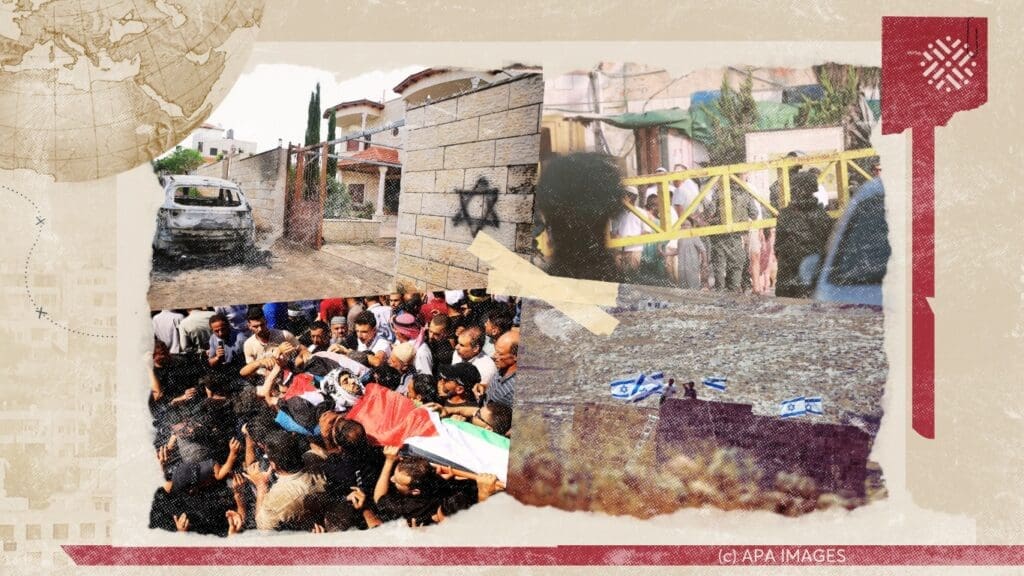
This is the largest invasion of the West Bank since 2002. A lot of what we’re seeing in Jenin is very reminiscent of what happened at least in the early days of the genocide in Gaza. The cities have been placed under blockade, and the entrances and exits are being blocked. There are checkpoints everywhere, limited food and medical supplies. The Israelis are going into people’s homes, kicking them out, and in some cases blowing up the houses. They’ve invaded medical facilities and been preventing ambulances from reaching the injured. We’ve even seen footage of Palestinians leaving their homes waving white flags. And we’ve heard from journalists on the ground that they’re being shot at and threatened. I don’t think there’s any international journalist presence on the ground in these areas. And Jenin, of course, is a place where the Palestinian journalist Shireen Abu Akleh was killed in 2022.
Jenin and these places are no strangers to invasion, to military raids. The whole of the West Bank is under occupation, but in particular the northern parts of the West Bank have been really subjected to a lot of brutality over the last few decades. And the pretext is always the same — the same everywhere that the Israelis are going after the armed resistance. It’s a pretext that we saw, and continue to see, the Israeli regime use in Gaza.
So it’s an escalation in sheer scale — the number of soldiers deployed, the use of airstrikes as you mentioned. And it’s been even more worrying to see how the Israelis are talking about this, how Israeli officials are talking about this. We heard the Israeli foreign minister, Israel Katz, say that this would be a war for everything. And that it would include, as you mentioned, the so-called temporary evacuation of Palestinian residents from the West Bank. And we know that that language is code for ethnic cleansing. It’s not particularly good code, but that’s what they mean when they say it.
And Palestinians know that this is not separate from what’s happening in Gaza. Israelis use different tactics for different communities, but the end goal is always the same. In Gaza, they’re committing genocide. In the West Bank, we’ve seen over decades this incremental use of forced displacement, of incarceration, of colonization. And the end goal is to squeeze as many Palestinians into even less and less land. Fewer Palestinians for more land.
And I think the scary thing is that the Israeli army, the Israeli regime, now sees this as an opportunity. They see that they’ve gotten away with killing tens of thousands of Palestinians in Gaza and obliterating Gaza, and they have yet to face any consequences from the international community. We had the ICJ come out and say that there are plausible acts of genocide, but it hasn’t resulted in any kind of sanctions. And on the contrary, they’ve been rewarded — rewarded for their actions in Gaza with continuing diplomatic relations, with increased arms sales.
This is a prime opportunity for them to launch something a lot more serious in the West Bank because they’ll get away with it. And I think it’s something that a lot of Palestinians are fearing, but it’s also something that we’ve always known. We’ve always known that they’re not going to stop at Tel Aviv, they’re not going to stop at Ashkelon, they’re not going to stop at Yafa and Haifa. The end goal has always been the whole of Palestine, and we’ve known that all along. And I think we’ve been gaslit for so long by the international community with the promotion of the facade of the two-state solution and the respect for international law. That’s what it’s been — consistent gaslighting for over seven and a half decades.
Ussama Makdisi 36:23
On that point of gaslighting, you raised several really important points. There are two questions there. One is the West Bank specifically and the PA, the Palestinian Authority. One of the most striking aspects of the genocide over the last year has been the total absence of any effective statements — let alone actions — by the PA, which of course acts as a collaborating authority to the Israeli occupation of the West Bank.
How do you explain the endurance of the PA in the West Bank, given the genocide and given what the Israelis are doing in the West Bank — which, as you’re suggesting, is ethnic cleansing? That’s what the plan has always been and that’s what it will continue to be. So that’s one question: what about the PA? How do you read the PA’s response? Why do people still put up with the PA given how overt the collaboration is? Is it that they have no choice? Is it that people are so fragmented that they don’t have the ability to mobilize against the PA?
Question number two takes us back to a point you raised earlier: given the official Western support for the genocide, or the inaction of the international community in preventing the genocide, how does one isolate Israel without appealing to Western society, since Israel depends on Western societies and Western governments? How do you put leverage on them?
Yara Hawari 37:58
I think if there were a global nuclear war, the last people standing would be the PA. That’s how it feels at this point.
I think the PA has, since the beginning of the genocide, been functioning — at least on an operational level — as it is supposed to. And by that I mean it continues to oppress and suppress Palestinian political opposition and resistance to occupation. There has been some rhetoric about standing with our people, but there hasn’t been any action. And there are things that they can do, even if limited. But worse than inaction, they’ve been suppressing Palestinian solidarity with Gaza.
And I think not many people are aware of this, but since the beginning of the genocide, there have been demonstrations in support of our brothers and sisters in Gaza and Jenin and many other areas — in Haifa, in Nazareth, but talking about the West Bank specifically — these have often been repressed by PA security forces.
So just to give you an example: the night of the bombing of the hospital, which I think was in mid-October — I think this was the first time the Israeli army bombed a hospital in Gaza; of course, we’re now at a stage where they’ve bombed every hospital in Gaza — there was a spontaneous demonstration in Ramallah, and the PA security forces brutally shut down this protest. They killed a protester. They ran him over with one of their armored jeeps, funded with thanks, of course, to the international community.
Another example: just a few days ago, during the invasion of the northern West Bank, during that horribly named Operation Summer Camps, the PA security forces went into the old city of Nablus and took down the tarpaulins, the plastic covers that residents had put up to avoid Israeli surveillance drones.
They continue to work hand in hand on security coordination, and there’s always this rhetoric about Abbas or other PA ministers threatening to end the security coordination, but it never actually happens. They never go through with it. And that’s because the PA’s existence is premised on that security coordination.
I don’t know if you saw when Abbas and a delegation of PA officials were invited to Turkey to address the parliament in Ankara. In his speech, Abbas made this grand statement that he’d be going to Gaza in the near future, even if it cost him his life. This was met with a standing ovation from Erdoğan and his cronies. From most Palestinians, it was met with ridicule. I mean, there was a whole series of memes and jokes online, because how exactly is Abbas — 90 years old next year — going to go to Gaza? A besieged territory under massive bombardment, facing an ongoing genocide.
It was revealed shortly after that the man in charge of the security coordination between the PA and the Israeli regime had submitted a written request to the Israelis to allow Abbas and various others to go to Gaza. And apparently they also appealed to the Americans to facilitate this. I don’t think there’s been a response, but we know realistically this won’t and can’t happen. He is not going to get a warm welcome in Gaza, and I think probably the Americans and the Israelis would have been concerned about his safety there.
I think it tells you everything you need to know about who’s calling the shots. Abbas not only has to apply for permission from the Israelis to leave the West Bank, but he also has to coordinate with them when he travels between cities — which doesn’t happen much anyway these days. But I think it highlights some crucial things, such as that the PA has become redundant. It doesn’t have any power and it’s not playing any kind of role in working towards stopping the genocide.
There have been some lip-service efforts at national unity — the national unity agreement signed between Fatah, the ruling party of the PA, and Hamas counterparts in Beijing, brokered by the Chinese. But this national unity agreement was only about very broad principles, and it was a win for Fatah. They could say, oh, you know, we did something.
Ussama Makdisi 42:34
Well, my question then is, given your knowledge of the situation in the West Bank, why do people put up with this? Maybe it’s a naive question, but why, given all of this — given how overt the collaboration is — how disgraceful what’s going on is, with this systematic genocide taking place in Gaza in full view, live-streamed, every Palestinian in the West Bank and outside the West Bank and around the world can see what’s going on. No filters. How can it be that Abbas and company are still there, even pretending to call the shots? Why isn’t there more resistance to this absolutely naked collaborationist authority?
Yara Hawari 43:30
I think there are several facets to this. The PA has worked hard for a couple of decades now at suppressing Palestinian political opposition on all different levels. They have worked hand in hand with the Israeli regime to imprison hundreds, if not thousands, of potential and actual political leaders across the Palestinian political spectrum.
Just as a fact: it’s nearly impossible to register a new Palestinian political party with the interior ministry. It’s a very stifled space that Palestinians have to operate in politically. But I think importantly, the world’s powers — the Israelis, the Americans, the EU to a large extent — don’t have an interest in seeing the Palestinian Authority toppled. Their interest is to keep the Palestinian Authority in place because the PA is what stabilizes the situation in the West Bank. It prevents an uprising from occurring. It prevents any kind of opposition to the status quo. So the PA has these massive backers.
And I want to clarify as well: the PA is also the largest employer in the West Bank. It employs something like a third of people in the West Bank — civil servants and so on. So when I’m talking about the PA in broad terms, I’m talking about the structure and the people at the top. I’m not talking about the average employee.
It’s a very complex situation where you have essentially what is a native enforcer of a colonial entity, propped up by the world’s powers, and a people who in many ways are held hostage to this entity because they rely on it for their livelihood. So it’s a very complex situation, but it’s something that Palestinians are deeply aware of. The average Palestinian will tell you: if we want to see an end to occupation, we have to deal with the PA first. We have to clean up our own house first. And that’s something that Palestinians are deeply, deeply cognizant of.
Karim Makdisi 45:45
Just following on this, as we begin to wrap up: we’ve seen a couple of polls that showed Hamas has increased in popularity even in the West Bank. This brings up the question of what liberation means now in Palestine for Palestinians. On the one hand, we have armed resistance and what’s been going on as an option — as it is in Lebanon, as it has been in various countries in the region. And on the other hand, we have all of this. We’ve talked about the Palestinian Authority. I’m not sure there’s much more to discuss there, because I think we all agree that it’s simply a collaborationist institution.
We’ve talked to people like Hanan Ashrawi and Diana Buttu and others about the possibilities of PLO reform — the PLO being, in theory at least, the only organization that represents all the different constituents of all Palestinians, inside and outside, refugee camps, diaspora, everywhere. Is that option finished?
Realistically, is there still a way out of this in terms of intra-Palestinian politics? Is it to reform the PLO, maybe bring Hamas into it, go from there? Or does liberation now look like fighting against the Palestinian Authority and moving towards a different form of resistance — either the form that Hamas has pushed for or some other kind of hybrid? Something where it’s no longer a question of negotiating and institutional things but some other form? What does it look like?
Yara Hawari 47:22
That’s a really good question and I’m not sure that I’ll be able to fully answer it. I’m from a generation of Palestinians that’s often referred to as the Oslo generation. We grew up under the consequences of Oslo. I was in Palestine when the PLO returned to Palestine and suffered the consequences of the signing of those accords.
I think people of my generation, and perhaps those younger, are less wedded to the PLO as an entity, less committed to the PLO as an entity to represent the Palestinian people, as an entity that will lead us to liberation. At the same time, I don’t dismiss the importance that the PLO still has for a lot of people of other generations.
So it’s a difficult one. I’m not a reformist. I generally don’t believe in reform, but I also recognize the significance of the PLO as an entity for so many people — though I’m not personally holding on to it. For me on a personal level, it’s not something that I necessarily hold on to.
I think it’s very unlikely that we will see the kind of PLO reform that is needed for full liberation, to be very honest with you. I don’t think that’s necessarily a bad thing. We can have new entities, we can have new leadership structures and models. And I think that’s okay. I don’t think we’re in that position right now, though, to think about that.
It’s a big question. I don’t know if Palestinians are in the place to think about that right now. I know lots of Palestinians are talking about leadership. There are lots of behind-the-scenes discussions about not only the day after in Gaza but also about what Palestinian leadership looks like moving forward. But unfortunately, from my experience and what I’ve heard of these conversations, there’s nothing new in them. It’s a recycling of old leadership models and old leaders. So it’s a big question — maybe one that I’ll need to think on some more before I provide a more extensive answer.
Saree Makdisi 49:33
Yeah, of course, that’s fair. And you’re right that the question of the PLO is partly a generational question. So people in our generation, there’s a certain kind of nostalgia to it, and we want to be wary of that nostalgia, not fall into the trap of it. But the PLO does have something that the PA doesn’t have, which is — as Karim alluded to earlier — its international presence. It has a seat in the UN, it has embassies around the world, and it has more recognition around the world than the Israeli state does. So there’s a lot there that at least in theory could be mobilized for — not necessarily to do what it used to do, but rather, for example, as part of what I see as an important part of the next phase towards liberation: the massive ramping up of the BDS program. An international network such as the one the PLO still possesses and international leverage would be a useful component to the struggle, although I’m aware that we shouldn’t fall for misplaced nostalgia for how things used to be.
I’m not saying we should go back. If anything, maybe we should look forward, to anticipate the ways in which the PLO could at least theoretically be reformed in order to use its international presence, its international networks, its presence in various international organizations, including the UN. Yes, as you said earlier, those haven’t yielded very much yet. But nevertheless, that’s one area where surely we need to focus the struggle as well.
Yara Hawari 51:27
I think perhaps I wasn’t thinking so much about the international dimension, which I should have been. It is undeniable that the PLO is the one that maintains our presence in all these institutions. But there is another international dimension, and that’s the grassroots diaspora. All of the massive mobilizations we’ve seen around the world haven’t been a result of the PLO. They’ve been a result of various different Palestinian groups and communities who’ve been working for decades.
And I’m not saying this to pit one against the other. I do think the generational issue is a big one. I think also, in terms of Palestinians in Palestine, the PLO is largely irrelevant to them. If you ask the average person on the street under the age of 30 what the PLO is, they might not know how to respond to that. I think that’s really critical when we’re talking about the issue of the PLO — we do need to factor that in.
And as I said before, I don’t have a clear answer on this. I think it’s such an unprecedented moment in our story and our struggle that it’s difficult to think clearly about these issues. I do recognize what you said, and I think it’s something we’re going to have to grapple with.
Saree Makdisi 53:00
Just as a quick follow up on that — just imagine, hypothetically or theoretically, I know we’re not in a place right now to imagine much beyond the immediate present, but we do need to at some point.
Imagine the PLO throwing its weight behind a global BDS program. The PLO has assiduously avoided — and Fatah and so forth have assiduously avoided — engaging with the question of BDS. They just don’t, or if anything, they don’t approve of it or they don’t talk about it. Imagine PLO ambassadors going to the Olympic Committee or FIFA or using the leverage that they have, at least in theory — in other words, a common cause being made between grassroots civil organizing, all the civil society organizations that issued the BDS call in 2005, working with the PLO.
Theoretically, yes, and you’re right, of course, there are these generational things that we have to ask about. And of course the PLO lost its way as of Oslo. But there are ways to imagine, at least theoretically, where the PLO could be reformed in order to use its international presence, its international networks, its presence in various international organizations including the UN. Not to go back, but to look forward and see how it could contribute to leverage.
Yara Hawari 54:05
Just to add to that, there is a difference — again, between PLO official statements and individuals in the PLO, entities within the PLO. There is such a broad spectrum of opinions, and ultimately the one that wins out in terms of what’s put down on paper and what’s said in official statements is the one that’s supported by Abbas and his faction. That just speaks to how much the PLO has been subsumed by the PA, Abbas, and Fatah.
We all know that the PLO has a very broad spectrum of opinions. I wouldn’t say that the PLO is necessarily against BDS. But what I would say is that in terms of the official line, they are beholden to the PA. If the PLO comes out and supports the BDS movement in its official statements, that will have repercussions on the PA — on the funding and the donors who might decide to cut money to certain ministries. So the problem is that it has been subsumed, and it’s beyond time for that entanglement between the PA and PLO to be untangled. The question is whether that can happen. And whilst the PA exists, I don’t think it can. And whilst the PA exists, I don’t think we’re going to see a return to a revolutionary PLO — one that truly represents its people in their entirety.
Ussama Makdisi 55:45
I think there’s no other organization that has represented or can represent the entirety other than the PLO, and you’re right, it has been subsumed by the PA in the Oslo phase and in what we’re living now. But that doesn’t mean that there isn’t a possible future. There has to be thinking about other futures.
And also just as a note of caution — although I agree with almost everything you’ve said — is this idea of grassroots organization alone. You can have grassroots mobilization that rises in an extraordinary moment of genuine passion, genuine conviction, and courage, but then dissipates once the moment is over. That’s why there’s ultimately something called leadership.
Unfortunately, right now, the leadership is completely co-opted and fragmented. The question is, can we imagine — is there an imagination for — something different in the future that can actually represent the reality of the Palestinian people in all its diversity, in all its fragmentations, and unify it? Other than the PA, something — whatever it is — that can speak to the Palestinian reality in its entirety, not just in the West Bank, which is what the PA does, but across the world.
Yara Hawari 57:06
I agree with you. I think there has to be political leadership. I think one of the problems for the Palestinian people is that there isn’t that space in Palestine for that leadership, and so it has in many ways retreated from civil society spaces to grassroots spaces. So we do need that political leadership. I hundred percent agree with you on that.
I think just on that point about grassroots movements rising up and then dissipating — I think that’s the very nature of grassroots groups, but I would say, speaking from my experience in Palestine, a lot of these movements and moments and spaces amongst the grassroots are not new people. They’re the same leaders, the same people organizing, trying to carve out and forge new spaces in an incredibly politically repressive environment.
So the question — as you pointed out — is how do we imagine a new political landscape for Palestinians, one that includes leadership? I think people are beginning to do that. They have done it in the past. I do think now is the time to do it. I recognize that for a lot of people, just surviving the ever-deteriorating present is taking priority. But that means that for Palestinians who are in positions where they can do that, that’s the work that we have to do.
Karim Makdisi 58:33
I think, to wrap up — it’s not necessarily leadership, it’s institutions. These are connected, but it’s the institutions themselves that normally create sustainability. You take certain moments of crisis, but then you build institutions from them.
This is why one of the most insidious parts of Oslo was the creation of the PA — because you are creating an institution that is beholden to the Oslo process and therefore, by definition, to the occupation, to the Americans, to the Israelis, and to all of that. And once you create an institution, it’s extremely difficult to move it aside, because you have a bureaucracy, which means you create jobs, which means you create services. And then, because nothing else is going on, you have a large number of people working and therefore whole families dependent on this, and then donors come in, and if you don’t do this, the donors withdraw their money from other kinds of projects.
So the institution is one of the most insidious parts of the whole Oslo process.
What I’m left thinking here, Yara — and really this is for all of us — is this issue of the unbelievable genocide that’s taking place in Gaza, rendering Gaza uninhabitable, at least as of now. We see in the West Bank this beginning of a continuation or intensification of invasion and annexation. I think we should remember that Netanyahu came in on a platform of wanting to annex the West Bank or large parts of it. So this kind of invasion, annexation, and ethnic cleansing — we are all agreeing that this is not going to stop.
The genocide in Gaza may or may not stop at a certain point. There may or may not be a ceasefire today, tomorrow, next week, next month. But the ethnic cleansing there in the post-genocide phase will continue in the guise of humanitarianism. On the other hand, we’re seeing it now in the West Bank and Jerusalem and other places.
So if this is going to be the way it is for years — then in these extraordinary moments, how can we think about building institutions? How can we think about mobilizing politically? How does one move on from this, where you’re not constantly simply reacting?
On the one hand, you have resistance movements that come up, responding to particular moments, and then building those into political gains. This is where there seems to have been an absence for a very long time. Even pre-genocide, even in moments when there was at least a little bit of time to build something, it didn’t seem to happen — because the Palestinian Authority was so effective at suppressing it within the West Bank, while Gaza was so effectively isolated from the West Bank, let alone from the diaspora and other areas.
So it’s not a question per se, but I think it’s something we need to be thinking about: how to think about liberation politics that is both resistance on the one hand, but at the same time trying to come up with something that unifies the various elements within the Palestinian polity itself — the various constituents of which BDS is a part, but it has to be part of a larger political strategy. The BDS is one thing as something that mobilizes people in the West within a certain kind of politics that makes sense in the West. But connecting it to the material movements, the resistance movements, the liberation movements on the ground and the institution building — this is where the big disconnect has been for obvious reasons. It’s not easy. The occupation has been extraordinarily successful at that level, with the Palestinian Authority at the head of it.
So yeah, it’s not really a question, just something to think about. Anyway, I think we need to wrap here. Thank you so much, Yara, for joining us in this discussion, and for opening up all these questions that we’re all going to try to grapple with in the days and weeks and years ahead. Thank you very much.
Yara Hawari 1:03:26
Thanks for having me. Bye.
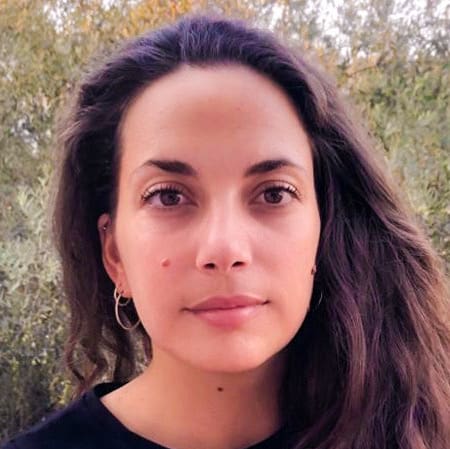
Yara Hawari is Al-Shabaka’s co-director. She previously served as the Palestine policy fellow and senior analyst. Yara completed her PhD in Middle East Politics at the University of Exeter, where she taught various undergraduate courses and continues to be an honorary research fellow. In addition to her academic work, which focused on indigenous studies and oral history, she is a frequent political commentator writing for various media outlets including The Guardian, Foreign Policy, and Al Jazeera English.