






About This Episode
Episode Transcript
The transcript below has been lightly edited for brevity and clarity.
Alys Estape 0:00
Unfortunately, spoiler alert, it is not an arms embargo on Israel. This is the main criticism we have as Spanish civil society. It is an important move, but what Spanish civil society has been saying is that words do not stop a genocide. We need concrete action to end the complicity that enables this genocide.
Yara Hawari 0:21
From Al-Shabaka, the Palestinian Policy Network. I am Yara Hawari, and this is Rethinking Palestine.
One of the most vocal critics of Israel in Europe since the genocide in Gaza began has been the Spanish government. And indeed, over the last two years, they have announced various measures ranging from an arms embargo to sanctions against Israeli officials. The Spanish prime minister, Pedro Sanchez, has also been incredibly vocal in his condemnation and has recognized Israel’s actions and Gaza as genocide.
But some argue that many of these measures have been symbolic, without follow-up, and even contain loopholes that allow for weapon sales to continue. Moreover, Spain maintains trade and diplomatic relations with the Israeli regime. To unpack the Spanish government’s measures a bit deeper and provide some analysis behind the headlines.
I’m joined by Alys Samson Etape, one of the spokespeople for RESCOP, the Solidarity Network against the occupation of Palestine in Barcelona. Alys, thank you for joining me on this episode of Rethinking Palestine.
Alys Estape 1:23
Thank you for having me.
Yara Hawari 1:25
Perhaps you can start by outlining some of the measures that the Spanish government has taken against the Israeli regime since the start of the genocide.
Alys Estape 1:33
I think, as you very rightly said, at the international level, Spain has been one of the most vocal critics of Israel’s genocide in Gaza. But for a long time, unfortunately, these have just been words. What Spanish civil society has been saying is that words do not stop a genocide. We need concrete action to end the complicity that enables this genocide.
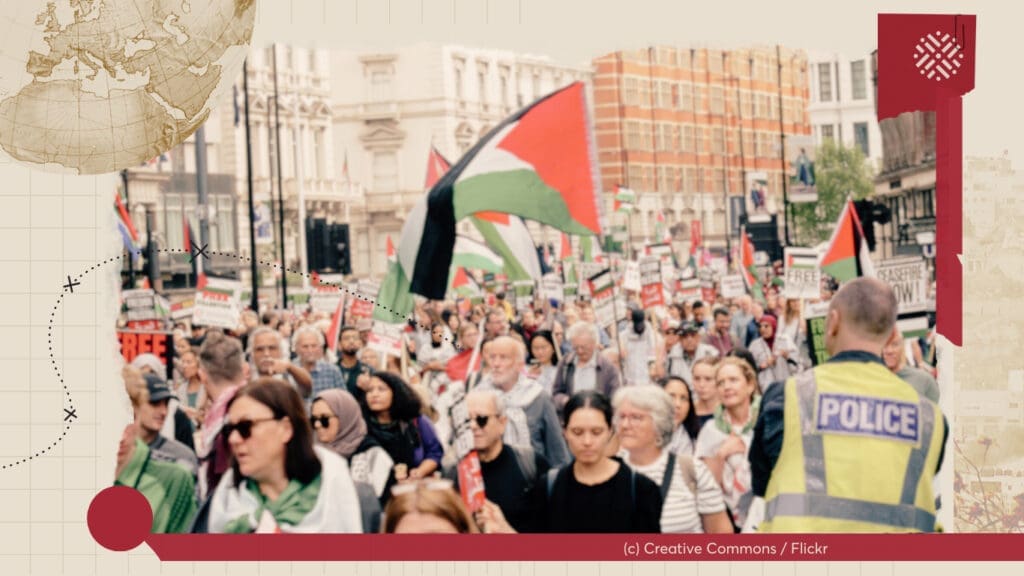
But Spanish civil society, we have proven time and time again that not only Spain was lying, but in fact, there have been months where Spain has been the country in the EU that has been buying or selling more weapons from Israel. So, since there have been some important developments over the last two years, I think it’s important to say that these have happened thanks to very organized, consistent action by civil society. Just last weekend, which was October 4th and October 5th, we saw the biggest mobilizations for Palestine in the history of the Spanish state.
And through RESCOP, which we are a coalition, the Solidarity Network Against the Occupation of Palestine, we’ve been organizing monthly protests in over 80 cities and villages at the same time throughout the Spanish state. So we’ve created a climate where it was very difficult for the Spanish government, which was saying the right words at the international level, to condemn the Israeli genocide against the Palestinian people. It was very difficult for them to keep on being complicit.
So things that are important to highlight is last month of July when we organized and got over 1,200 artists asking the Finnish Prime Minister and the government to pass a royal decree law that implemented an arms embargo in Spain in the month of July, the Spanish government responded saying that it would indeed implement this.
And right now, as we’re speaking, on October 8th, it is being voted on in the Spanish Congress. Now, it’s important to say that this Royal Decree law is not a military embargo. There are many loopholes. We can talk about this more later, but it is a first step in limiting military trade between Israel and Spain.
Before this, there have been times when, thanks to the pressure from civil society, the Spanish government has denied ships that were involved in the arms trade with Israel from stopping in Spanish ports. For example, Israel was banned from the biggest arms fair in Spain some months ago, and there have been small incidents, but many of these have been on a one-on-one basis.
There haven’t been structural changes until this royal decree law was passed. So we have this situation where the Spanish government has been saying the right words, which I don’t think that’s to be taken for granted, considering that we live in a world right now governed by fascist and extreme right.
But it’s only because the bar is so low that people internationally have this wrong impression of the Spanish government. And we must remember that Spain is still failing in its obligation to prevent genocide against the Palestinian people. To this day, Spain is still complicit. Spain still has diplomatic, economic, and military ties with Israel, which is absolutely horrendous.
Spain also joined the International Court of Justice. The case was opened by South Africa in May 2024, but it did not support South Africa. It just said that it was supporting the case—which is, again, the bare minimum that all states should be doing. So there have been some measures, but it’s important to state that these are still wildly insufficient considering the crimes Israel is committing against the Palestinian people.
Yara Hawari 5:01
That’s a really important point that I think a lot of people might not be aware of: the measures the Spanish government has taken came as a result of pressure from Spanish civil society and grassroots movements.
But my question is, these are measures that we haven’t seen elsewhere in Europe, despite massive grassroots mobilization. So I appreciate that there’s a lot of lip service from the Spanish government, but would it be right to say that perhaps the Spanish government is more politically aligned with the massive mobilization we’re seeing, or is there a different kind of pressure that the Spanish government is facing?
Alys Estape 5:34
I think this is because, unfortunately, if we look at European governments, many are governed right now by far-right forces, and luckily enough, that’s not the case in Spain. Let’s hope it stays like this. We have a government that’s formed by a coalition of a socialist party and. Which is a left-wing political party.
So yes, of course, it is definitely easier for Spanish civil society to pressure our own government. But this is why I think that the Spanish government should be doing much more—because it is not a fascist government. So that’s why the Spanish government should be doing so much more, and the Spanish government is not even doing the bare minimum, which is to cut all ties with the Israeli genocidal state.
So yes, Spain does not have a fascist government, but that’s exactly why it has the responsibility to do so much more than other countries that are openly egging on Israel on its crimes against the Palestinian people.
Yara Hawari 6:30
Right. And if leaders have recognized that Israel is committing a genocide, then they do have to cut all those ties and do everything possible to prevent genocide as per the legal obligations.
I want to turn to the arms embargo, because that sounds like a big deal, and it did make the headlines, and it was celebrated across the movement. But what does this particular arms embargo entail? What are the possible loopholes?
Alys Estape 7:04
Unfortunately, spoiler alert, it is not an arms embargo on Israel. This is the main criticism we have as Spanish civil society. It is an important move forward. It is a royal decree law that limits military trade between Israel and Spain, and that is an important step that we must consolidate. But what we are asking political parties to vote on right now—because this royal decree law is being voted on as we speak on October 8th—is to pass it, but to include the possibility of adding amendments, because there are many loopholes with this royal decree law that must be amended, so it is a real royal arms embargo on Israel. So the most important loophole, for example, is that the government reserves the right to include exceptions, where these constitute a prejudice to general national interests.
There can be no exceptions when it comes to genocide. It is absolutely intolerable that the Spanish government would allow exceptions on the ban, on imports, exports, or transit of arms to Israel. For example, the royal decree law doesn’t affect contracts with Israeli companies or their subsidies. So it doesn’t affect public procurement, which is also super important, because a lot of money from the Spanish government goes to Israeli arms companies.
The US bases—let’s remember: we have two US bases in the Spanish state—are not affected, and this is a huge problem because this shows that the Spanish state does not have sovereignty over its own territory. And if these aren’t tackled, then this means that the US is going to keep on using these military bases.
Let’s remember that Spain is in a very key geographical area, and Spanish ports have been used a lot to allow the transit of weapons towards Israel. The other problem with this royal decree law is that if there’s no clear inspections, for example, when it comes to ports and airports, if there aren’t exhaustive registrations and inspections, these boats that are involved in the arms trade with Israel are going to keep on passing through ports and airports.
Last but not least, the other biggest loophole is that this royal decree law should be permanent until the reality on the ground changes. Right now, it is up to the Spanish government to decide when this comes to an end. This royal decree law that we want to become a full arms embargo should end when apartheid, settler colonialism, genocide, and military occupation against the Palestinian people come to an end.
So, as we’re saying, it is not an arms embargo—but it is an important step forward. At the end of the day, it is going to now be much more difficult for the Spanish government to be able to trade with Israel. And that’s our aim. Our aim is to cut the chain of supply, to make it much harder for Israel and its allies to use Spanish ports to transit weapons to Israel. And our aim is to limit the fueling of the genocide.
So there are some important aspects. For example, what this new Spanish royal decree law does include is revoking current import and export authorizations of military material, which include dual-use systems, banning all imports, exports, and transit.
But let’s remember that, because of this sectionality clause, it’s relative to say this. And what’s also interesting is that the Spanish government has included the prohibition of transit of different types of jet fuel, which the Israeli army uses to fuel its genocide against the Palestinian people.
So there are some interesting steps, but again, let’s remember that this does not meet the bare minimum, which international law obliges states to uphold.
Yara Hawari 10:56
If you’re enjoying this podcast, please visit our website, al-shabaka.org, where you’ll find more Palestinian policy analysis and where you can join our mailing list and donate to support our work.
I think it’s really important to understand the shortcomings of these arms embargoes so people don’t become complacent and think that, okay, we’ve won over Spain, you know, we don’t need to do any more work there. And the problem is that these headlines, these narratives that we see on social media, really do obscure the finer details.
And I think it’s problematic because it gives too much credit to the Spanish government. So we’re really doing what they’re obliged to do under national law. But also, it covers up these loopholes, which actually allow for potential continued arms trade between the two countries.
Alys Estape 11:43
Yes totally. And we’ve been suffering from this in the Spanish state because it is actually quite scary how the media can just replicate what the Spanish government says without looking into it. And it’s been exhausting for us because it’s true, as you were saying before, we have more leverage to pressure our government than those who live under a fascist or extreme far-right government.
But at the same time, we’ve been having to fight against the idea that most people have that Spain is already doing things right. So why are we still protesting? There are many people in Spain and outside Spain who think this arms embargo has been in place since the beginning. So it’s been a double challenge for us.
Not only have we been having to fight these lies and explain how even public data from the Spanish government shows that these are lies, but we’ve also been having to tackle the complicity. So it’s been like a double challenge, and it’s quite scary how media and international media and outlets can just replicate what the Spanish government or companies say without actually checking if this is true or not.
And this leads me to mention another measure that is included in this royal decree law, which is the ban of products from Israel’s illegal settlements in the illegally occupied Palestinian territory. Now, we can discuss if this is an interesting measure or not, but the reality on the ground is that as long as there are no measures that explain how this is going to happen, we know that there’s no way that Spain can stop this, because Israel makes sure that none of the products that come from illegal Israeli settlements are marked as such.
So again, unless we really pressure the government into details, we risk having measures that just end up being empty words. And that is a risk we cannot allow. We need measures that actually change the reality on the ground, and that actually really tackle and pressure the Israeli economy, and that means, as well, military trade.
Yara Hawari 13:40
What you were saying about narratives, I think, also speaks to the state of the media in general, where there is far less fact-checking going on. And I think people mostly get their news and information from social media. So you’ll see a post on Instagram that says, you know, “Spain is the first country to impose an arms embargo on Israel.” And then everyone’s sort of reposting that and, it goes around the echo chamber and people don’t even bother to read a bit more into this and see what that means. And I think part of the problem is that there is so much information out there as well, and this can feel quite overwhelming.
But I wanted to ask you about this disconnect between what the Spanish government claims they’re doing and what they’re actually doing. Because we see a lot of Spanish politicians being very, very vocal in their critique of Israel, calling it a genocide when most leaders in Europe and most politicians in Europe are not using the G word. We’ve mentioned already that part of it is lip service, but is there anything more to this disconnect?
Alys Estape 14:41
So, unfortunately, the reality is that the bar is so low at an international level that, because some Spanish politicians are speaking the truth, which is that Israel is committing a genocide against the Palestinian people, many people see this as if Spain is taking incredible measures against the genocide. And again, it’s important to remember that Spain is not even compliant with the bare minimum. I do think that these statements that some politicians make against Israel and in favor of Palestine, of course, are important, but it’s our responsibility to make sure that these do not just stay in words, right?
I would like to share an example of something that happened in Spain. Recently, many images were shared worldwide showing how people in Spain organized to prevent La Vuelta, a private cycling competition that had a team representing Israel, from taking place.
It was so inspiring seeing how people, what they did was they went to the race with Palestinian banners and flags protesting so that this race could not continue functioning normally, as long as there was a team representing a genocidal state. And what ended up happening is that in most of the towns and villages where this race went through, they had to cut the race short.
The race could not function normally because of people’s pressure and people being brave and going there and putting their bodies on the front line and saying, we are not going to allow the participation of a genocidal state. And this was super inspiring and showed what people power can do when we organize.
But what was fascinating was seeing the Spanish prime minister then saluting the people of Spain and saying how proud he was. Whilst the activists on the ground have received huge fines, because there’s a horrible gag law in Spain that really restricts the right to protest. Many of these people were also beaten up by the Spanish police. So this is a clear example of how Spain wants to show itself as a progressive country that supports Palestine, but the reality on the ground is that people are actually pushing the Spanish government to take some measures and are having to deal with this hypocrisy.
What we’re saying is that if they want to support people on the ground, there should be no criminalization. There should be no police violence, and the least that they should do is cut all ties with the Israeli genocide or regime. I think what’s interesting is that we’re making it harder and harder for the Spanish government to present itself as a progressive government.
Internationally speaking, it’s harder and harder for them not to apply measures, to put an end to complicity with Israel’s genocide. But unfortunately, we still have a long road to walk.
Yara Hawari 17:29
So what are activists on the ground in Spain demanding from their government now? What are the pressure points that people are focusing on?
Alys Estape 17:38
So the main demand right now is a full military embargo on Israel. Let’s remember that the royal decree law that is being voted on as we’re speaking is still not a full military embargo, and we are going to have to fight every amendment to make sure that no loophole still allows any form of military cooperation between Israel and Spain.
Second, we are demanding an end to all diplomatic relations with Israel. It’s intolerable that there’s still a Spanish embassy in Israel and an Israeli embassy in Spain. There have indeed been some tensions, but mainly these tensions have come from the Israeli side. So when Israel has gotten angry in reaction to, for example, when the Spanish government announced this royal decree law, it’s Israel that has called their ambassador. So it’s absolutely intolerable. It should be Spain that puts an end to any form of diplomatic relations with Israel, and this should be done right now.
There’s also a demand to put an end to all economic trade with Israel. Let’s remember that the EU is Israel’s main commercial partner, so it’s, it’s absolutely necessary that Spain puts an end to all forms of economic cooperation with Israel, and this applies as well to cutting all ties culturally and sports-wise. We’ve been seeing some interesting developments, as I mentioned before, regarding La Vuelta, and the Spanish government said afterwards that Israel should not participate in any sports competitions.
But the reality is, there are still many sports competitions in Spain where Israel participates. For example, next week there’s an event in Manresa. Manresa is a town in Catalonia where there’s an Israeli basketball team that’s meant to come and play. It is again a situation where the Spanish government says that things should happen, but they’re not applying all the responsibility they have in making sure that this doesn’t happen.
Yara Hawari 19:33
So there’s a real lack of enforcement.
So perhaps my final question, and I know this is speculative, but I was wondering what you think the Spanish political landscape looks like vis-à-vis Palestine in the near future?
Alys Estape 19:48
In Spain, as everywhere else in the world, unfortunately, the far right is growing. The government does not have a majority in Congress, and there is a real worry that if this government changed, a far-right coalition could form, which would be very bad news for all of us.
But I think what’s interesting to say is that what we’re seeing on the streets—and we’re seeing this from many, many different sectors of society—is that there’s this full understanding that what happens in Palestine doesn’t stay in Palestine and affects us all, and how what we do matters and what we do can influence in stopping the Israeli genocide against the Palestinian people.
So it’s been very inspiring to see. In these last protests, seeing people mobilizing from the education sector, from the health sector, from the dock workers, from many, many different groups, understanding that we all have a role to play, and that Palestine is part and parcel.
We all want a freer world, a more just world. So I think that understanding this can really help stop the far right, because we’re seeing that, internationally speaking, Israel is more and more isolated. Israel is now mainly supported by the far-right forces at an international level, and also in vain.
So understanding this and not seeing Palestine as something isolated, but as part and parcel of this extremely colonialist, racist, capitalist, sexist world in which we live, is contributing to stopping the far right from growing even more in Spain and hopefully elsewhere. That’s why our solidarity movements have to be profoundly anti-racist, profoundly anti-colonialist, anti-capitalist, feminist, understanding how all of these connections are made.
Yara Hawari 21:45
So I think we’ll leave it there. But thank you so much for joining me on this episode of Rethinking Palestine.
Rethinking Palestine is brought to you by Al-Shabaka, the Palestinian Policy Network. Al-Shabaka is the only global, independent Palestinian think tank whose mission is to produce critical policy analysis and collectively imagine a new policymaking paradigm for Palestine and Palestinians worldwide.
For more information or to donate to support our work, visit al-shabaka.org and, importantly. Don’t forget to subscribe to Rethinking Palestine wherever you listen to podcasts.

Al-Shabaka: The Palestinian Policy Network is an independent, non-partisan, and non-profit organization whose mission is to convene a multidisciplinary, global network of Palestinian analysts to produce critical policy analysis and collectively imagine a new policymaking paradigm for Palestine and Palestinians worldwide.