

bloack the bombs policy lab may2026

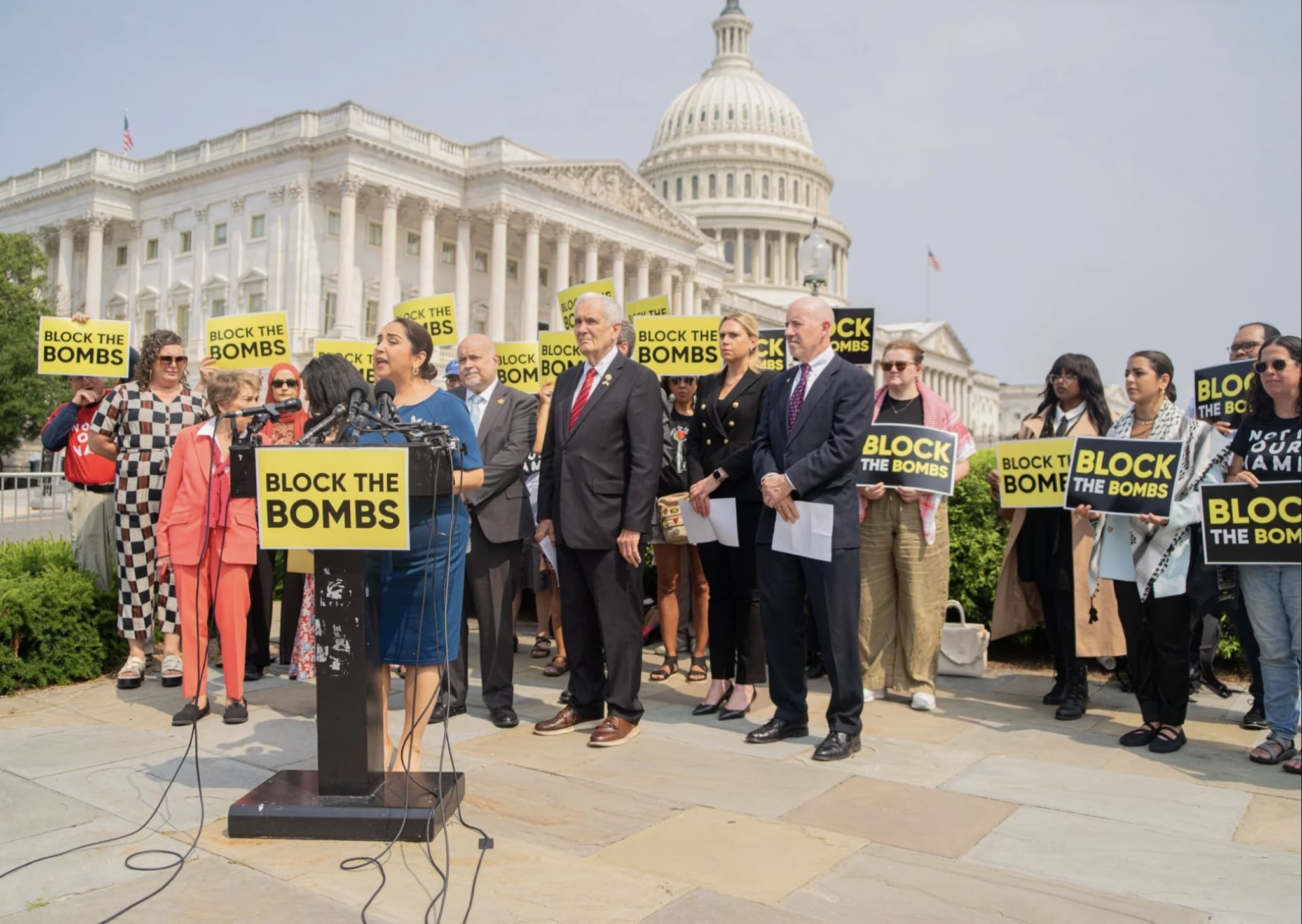
One year after the introduction of the Block the Bombs Act, calls to condition or cut US military aid to Israel are gaining traction in Washington. Once treated as politically untouchable, the unconditional flow of US weapons to Israel is now the subject of congressional legislation, public pressure campaigns, and growing debate inside the Democratic Party.

Yet even as more lawmakers criticize Israel’s actions in Gaza, the deeper question remains: Is the Democratic establishment actually confronting the “special” US-Israel relationship in a way that will challenge it as a system of impunity? Or are members simply adjusting their rhetoric to symbolically placate an increasingly disillusioned base?

In this policy lab, Josh Ruebner and Ahmed Moor join host Tariq Kenney-Shawa to examine the fight over the Block the Bombs Act, wider efforts in Congress to restrict US military support for Israel, and what these battles reveal about the future of Palestine advocacy in US politics.
Tariq Kenney-Shawa is Al-Shabaka’s US Policy Fellow and co-host of Al-Shabaka’s Policy Lab series. He holds a Masters degree in International Affairs from Columbia University. Tariq’s research and writing have covered a range of topics, from the role of open-source intelligence in exposing Israel’s war crimes to analysis of Palestinian liberation tactics. His writing has appeared in The Los Angeles Times, Foreign Policy, and The Nation, among others. Follow Tariq on Twitter @tksshawa and visit his website at https://www.tkshawa.com/ for more of his writing and photography.

In this article

Latest Analysis

 Civil Society
We cannot understand Gaza’s endurance through a binary that casts Palestinians, individually or collectively, as either heroic in their resistance or passive victims. Rather, we must approach it through a decolonial conception of sumud (steadfastness): a historically situated, relational, and materially conditioned practice of collective endurance that emerges, shifts, and persists within ongoing colonial violence.
Abdalrahman Kittana· May 12, 2026
 Politics
This policy brief argues that, by maintaining the classification of such zones as provisional security arrangements rather than permanent borders, the Israeli regime exercises territorial control while limiting the immediate legal and political costs associated with declared annexation.
Ahmad Ibsais· Apr 21, 2026
 Civil Society
In February 2021, Defense for Children International–Palestine (DCIP) reported that Israeli interrogators had raped a 15-year-old Palestinian boy in detention. Rather than investigate the allegation, Israeli forces raided DCIP’s offices and later designated it—along with five other Palestinian human rights groups—as a “terrorist organization.” While such abuses and crackdowns are not new, this moment marked a decisive escalation: the shift from harassment of Palestinian civil society to its outright criminalization with the full support and participation of the US. In 2025, the Trump administration designated six Palestinian organizations under counterterrorism frameworks before advancing even further, sanctioning leading human rights groups for engaging with the International Criminal Court. These measures move beyond targeting individual actors to undermining the very infrastructure of international accountability. This policy brief argues that the campaign by the US and the Israeli regime against Palestinian civil society and international law carries global consequences, threatening mechanisms designed to hold state violence in check. It concludes with recommendations for how Palestinian organizations and their allies can adapt, defend themselves, and pursue justice in an increasingly hostile environment.
Al-Shabaka Tariq Kenney-Shawa
Tariq Kenney-Shawa· Mar 31, 2026