




Introduction
After Hamas’s recent announcement that it will hand over governing authority in Gaza to the National Committee for the Administration of Gaza (NCAG), urgent questions about who will shape Gaza’s future and on whose terms have reemerged. These questions are particularly salient given that the NCAG’s framework reflects the same technocratic and externally imposed logic that has come to characterize the dominant international proposal for Gaza’s reconstruction: one that treats it as a technical exercise in disaster management, sidelining Palestinian sovereignty, return, and self-determination.1
In contrast, this roundtable asks what it means to understand Gaza as an Indigenous region rather than simply a besieged strip or humanitarian space. Nour Joudah and Dena Qaddumi explore how Indigenous frameworks reshape prevailing understandings of urbanism, reconstruction, and governance; why reconstruction must begin with Palestinian agency and reclamation rather than externally designed colonial master plans; and how rebuilding is already taking place through everyday forms of Indigenous endurance, social organization, and spatial resistance under conditions of ongoing genocide.
This roundtable is adapted from a conversation recorded on May 21, 2026. It has been edited for publication.
What does it mean to understand Gaza as an Indigenous land rather than a besieged strip or humanitarian space?
Dena Qaddumi
The straight lines that define Gaza on a map are not natural geographic boundaries; they are products of colonial military and political processes. As a result, the concept of “the strip” tends to portray Gaza as an island, even though it has never historically functioned as one. Gaza has long existed at the crossroads of cultural, economic, political, and social networks that connect it to wider Palestine and the region at large.
This framing has helped normalize Gaza as a place of isolation. Terms such as “open-air prison” have also been used to describe Gaza. While such language seeks to capture the severity of confinement imposed on Gaza, it can also reinforce the tendency to understand the territory primarily through the lens of enclosure and separation.
Reconstruction proposals reproduce familiar colonial assumptions by treating Gaza as a space to be redesigned according to external priorities through hyper-capitalist, financialized models of development Share on X
Approaching Gaza as an Indigenous land requires a different perspective. It means situating Gaza within broader historical and spatial frameworks while recognizing how multiple temporalities intersect in the present. From this perspective, trade, exchange, mobility, and regional connection are not secondary features of life in Gaza; they are fundamental to its historical development, just as they are elsewhere.
One of the consequences of treating Gaza as a bounded and isolated territory is the implication that the people living there ought to be self-sufficient within its imposed borders. When that self-sufficiency proves impossible, the failure is often attributed to Gaza itself. Yet the problem does not lie with the people who live there but with the colonial borders and restrictions that have severed Gaza from the networks on which it has historically depended. For this reason, we must be attentive to the language we use to describe Gaza. The categories through which we understand territory can easily normalize conditions of fragmentation and isolation, obscuring the broader regional relationships that have long shaped Gaza’s history and continue to shape its present.
Nour Joudah
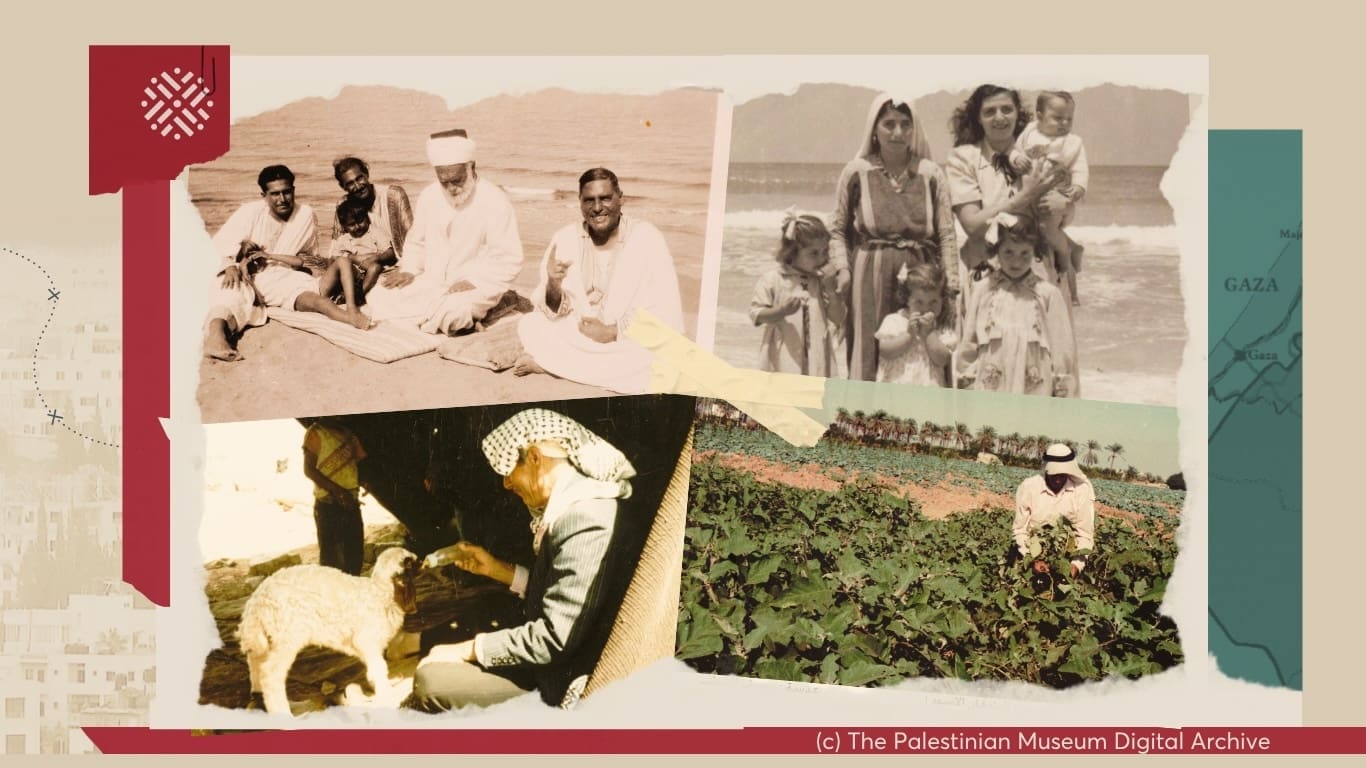
Historically, Gaza was the largest district in Palestine, encompassing an area roughly 38 times larger than the present-day Gaza Strip. Referring simply to Gaza, therefore, carries an implicit understanding of the region’s relationality and historical connectedness. For me, that is precisely what it means to think about Gaza as an Indigenous region.
If we understand a place as something that develops through the social, economic, and political life of its people rather than through colonial intervention, Gaza becomes an extraordinary case. Gaza was built and sustained despite repeated efforts to constrain and economically subordinate it. As scholars such as Sara Roy have argued through the concept of “de-development,” Israeli policy sought to create a captive economy. Nonetheless, Palestinians responded through education, labor migration, remittances, and forms of urban and social development that refused to conform to the logic of occupation.
We also often forget that Gaza’s isolation is historically recent. Until 1967, my father would take the train from Cairo to Gaza during academic breaks. Following the 1967 war, the railway was dismantled, and its materials were repurposed to support the Israeli occupation’s physical infrastructure in the Sinai. Such examples remind us how mobility, connection, and regional integration were once ordinary features of life in Gaza.
For me, Gaza is therefore not defined primarily by siege, even if it has become an unavoidable reality. Nor is it defined solely by humanitarian catastrophe. When I think of Gaza, I think of the beach and family homes in Rafah and Deir al-Balah, my father’s stories of traveling by train, and the arrival of displaced families in 1948. I think of places such as Shuja‘iyya, which grew from a relatively small locality into a vibrant urban community through the efforts of its people. I think of my mother being trained in civil defense work in 1967. These are the histories that continue to shape the present.
Such experiences are often difficult to convey to non-Palestinians, particularly to those who engage with Gaza primarily as a site of elimination, genocide, or siege. Gaza—and southern Palestine more broadly—has never been confined to the territory we now call the Gaza Strip. When I hear the same dialect features spoken in the Hebron Hills that are associated with Gaza, I am reminded of the broader historical and social geography of southern Palestine.
One of the defining features of settler colonialism is its tendency toward presentism. This is not to say that settlers do not imagine futures for themselves, but rather that they seek to delimit the past, to render it closed and irrelevant, and to present the current reality as fixed and inevitable. Palestinian experiences of time operate differently. Past, present, and future are not neatly separated categories, nor are they experienced in a strictly linear fashion. They coexist and inform one another continuously.
For that reason, Gaza—as with Yaffa, Nablus, or any other Palestinian city—cannot be understood solely through its present condition. To engage with Gaza as an Indigenous region is to engage with its entire history, its future possibilities, and its organic relationships with surrounding places and communities. It is to understand Gaza not as an isolated enclave but as a living and evolving part of a broader Palestinian geography.
How can we understand the devastation we are witnessing in Gaza today in light of the Indigenous history embedded in its landscape?
Nour Joudah
I recently read an article by Eyal Weizman that draws on the testimony of an Israeli bulldozer operator. The title comes from the operator’s claim that, after the destruction, “all they will find is sand.” The implication is that Palestinians will return and find nothing recognizable, that the landscape itself has been erased. More recently, reports have emerged of Palestinian detainees being taken blindfolded to devastated areas and then having their blindfolds removed to disorient them and demonstrate that there is supposedly nothing left to return to. In both cases, physical destruction is accompanied by an attempt at psychological destruction. The objective is not only to demolish buildings but to convince people that their relationship to place has been severed.
To engage with Gaza as an Indigenous region is to engage with its entire history, its future possibilities, and its organic relationships with surrounding places and communities Share on X
I find that claim deeply troubling. Not because the destruction is unreal—it is devastatingly real—but because it assumes that places can be erased simply by clearing the built environment. It assumes that spatial belonging depends entirely on the continued existence of buildings and streets. We do not live in a world where people lose all orientation because a landscape has been altered. More fundamentally, places are not reducible to their physical structures.
Still, if I am being completely honest, something in me broke when Rafah fell. But Rafah has not disappeared. There is knowledge embedded in that landscape that no bulldozer can remove. I do not mean this romantically. Rather, I mean that relationships to place are carried through memory, practice, kinship, and accumulated experience. That does not diminish the enormity of what has been lost. Nor does it lessen the reality of dispossession. But destruction alone cannot achieve the kind of disinvention that its architects imagine. Places do not simply end.
This realization informs much of my current work on temporal topography, which recognizes that places contain histories, memories, and embodied forms of knowledge that accumulate through generations of inhabitation. What does it mean to understand time as embedded within landscapes? In Rafah, people once spoke of knowing exactly how many steps it took along the beach from the Egyptian border to the most dangerous place to swim. Forms of knowledge like this do not disappear because a road is destroyed or a neighborhood is flattened. They are part of a deeper relationship to place.
For that reason, it is important to allow ourselves grief, rage, and heartbreak while also resisting the idea that destruction can entirely erase a place. The built environment can be devastated. Communities can be displaced. But the histories, memories, social relations, and forms of knowledge that constitute a place endure in ways that are far more difficult to destroy. That persistence, too, is part of the landscape.
Dena Qaddumi
I think we now have an enormous body of documentation that has sought to catalog, classify, quantify, and make sense of the destruction that has taken place across virtually every sphere of life in Gaza. Analytically, one important insight that emerges from this destruction, particularly when viewed through the lens of Indigenous urbanism, is that urbicide has become a central tactic of genocide. The destruction of urban environments is not merely collateral to broader processes of violence; it is often integral to them.
Yet alongside this destruction, we are also witnessing competing visions for Gaza’s future, particularly through debates surrounding reconstruction. Reconstruction proposals reproduce familiar colonial assumptions by treating Gaza as a space to be redesigned according to external priorities through hyper-capitalist, financialized models of development. This vision disregards existing social, cultural, and spatial relationships while obscuring the responsibility of those who contributed to the destruction in the first place.
Beyond these analytical questions, however, there is also a deeply personal dimension. Like Nour, I have also experienced moments of heartbreak throughout this genocide that have felt almost physical. For me, one of those moments came early on, when people were being displaced from northern Gaza and forced to move southward. I suddenly found myself imagining my own family in 1948 making a similar journey from Yaffa. My father was not yet a year old at the time. I pictured him as a baby alongside his siblings, and for the first time, that experience felt immediate and embodied in a way it never had before.
I have never been to Gaza myself. Yet after everything that has happened, the connection I feel to Gaza as a Palestinian has only deepened. What has been reinforced for me over this period is not simply Gaza as a site of destruction, however immense that destruction has been. Rather, Gaza has been consolidated in my mind as a site of resistance, creativity, and sumud (collective endurance).
That does not diminish the suffering or the losses that have occurred. But it does mean I have a responsibility, for myself as someone in the diaspora, to engage with Gaza beyond the devastation inflicted upon it. Even amid extraordinary destruction, it remains a place shaped by the capacities, histories, and aspirations of the people who continue to define it.
What forms of colonial spatial governance are present in recent plans for Gaza promoted by the Trump administration and segments of the international community?
Nour Joudah
What these proposals reveal most clearly is a broader imperial and neo-colonial logic. They rest on the assumption that powerful external actors are entitled to redesign Palestinian space and determine Palestinian futures.
These plans mostly take the new spatial realities produced by the genocide as their starting point. They assume that the new patterns of concentration and displacement in places such as Khan Younis and Deir al-Balah will endure, while treating the devastation of northern Gaza and Rafah as the new spatial baseline. By taking the geography produced by genocide as their starting point, these proposals fail to confront the fundamental question of whether and how those communities should be able to return. Instead, they risk normalizing displacement as the basis for reconstruction.
At the same time, they overlook that Palestinians are already rebuilding infrastructure from below. Friends and family describe communities improvising water distribution systems, repairing local services, and developing new ways of sustaining daily life despite the collapse of municipal structures. People are not waiting for external reconstruction plans; they are finding ways to reproduce everyday life under extraordinarily difficult conditions.
Dena Qaddumi
Many of these proposals imagine Gaza as a kind of city-state, even though no one seriously regards it as a sovereign state. This is reflected in recurring comparisons to places such as Singapore or Dubai, as well as in the envisioning of Gaza as a site for real estate speculation, tourism, and the extraction of exchange value from coastal land. Such approaches treat Gaza’s relationship to the sea primarily as an economic asset rather than as part of a broader social, historical, and spatial geography.
These proposals also raise questions about surveillance and technological governance. The same actors who have promoted the use of artificial intelligence in military operations are now increasingly involved in discussions about reconstruction, planning, and urban design. This raises the possibility that Gaza could become a site for experimenting with new forms of AI-driven urban governance, where questions of efficiency, monitoring, and data extraction are built into the reconstruction process itself and subsequently marketed elsewhere.
These risks are significant and deserve careful attention. At the same time, I remain wary of devoting too much energy to analyzing every detail of plans that may never be realized. Part of their function may be to absorb our attention away from the ongoing genocide.
What would an Indigenous vision of reconstruction in Gaza look like?
Nour Joudah
We often frame this in academic language as a question of who is “centered,” but what we are really asking is: who leads? Who has the authority to shape the future of a place?
The vision I associate with Indigenous reconstruction is grounded in land reclamation, which has long been central to Indigenous struggles for liberation. In the Palestinian context, it also means situating reconstruction within the broader project of liberating Palestine—for Palestinians living on the land and for those displaced from it.
Rebuilding does not begin with construction but with reclamation. The first step is to return. The first step is for people to be able to inhabit a space together again. Share on X
I often think of the village reconstruction competition organized by the Palestine Land Society, in which architecture students redesign depopulated and ethnically cleansed Palestinian villages. One of my favorite projects came from a group of students at the American University of Beirut. Their proposal was striking because, unlike most others, they did not produce a detailed plan to rebuild the village itself.
Instead, they designed a central communal structure. There was a beautiful proposal for a dam that would restore the village’s water system and revive the ‘ayn (water spring) alongside other interventions intended to support collective life. When I asked why they had not planned the village, they explained that they did not want it to resemble a settlement.
Their argument was simple: villages and cities do not emerge because someone draws them on a map and then builds them. They grow organically over time through relationships, practices, and the everyday lives of the people who inhabit them. There is something deeply compelling about that approach. It speaks to fundamental questions about habitation, the built environment, and the ways people create places through social relations. It also suggests a different way of thinking about reconstruction.
In this view, rebuilding does not begin with construction but with reclamation. The first step is to return. The first step is for people to be able to inhabit a space together again. Only then can the form of reconstruction emerge through the people who will live there.
Many of the plans currently being proposed assume that decisions about Gaza’s future can be made externally and then imposed upon its population. An Indigenous approach would begin from the opposite premise: that the people most affected by destruction must be the ones who determine what rebuilding means and what kind of future they wish to create. Whatever the obstacles, the people in Gaza have not surrendered that right.
Dena Qaddumi
The challenge is that reconstruction in Gaza must operate simultaneously on multiple levels. On the one hand, there are immediate and urgent needs: access to water, sanitation, housing, healthcare, education, and other essential infrastructure. On the other hand, there is the longer-term question of planning and designing for a future that remains deeply uncertain, particularly when the broader Palestinian political struggle for liberation continues to be marginalized in discussions of Gaza’s future.
Any meaningful approach to reconstruction must also engage with Gaza’s existing urban histories. These histories include not only the city of Gaza but also its refugee camps and the social relationships that have emerged through decades of displacement, adaptation, and community-building. Reconstruction cannot simply be a technical exercise of replacing damaged infrastructure. Rather, it must also grapple with the historical and social landscapes that give those spaces meaning.
Toolkits and models can be useful, but reconstruction in Gaza will ultimately be shaped by the priorities, circumstances, and aspirations of the people who live there Share on X
At the same time, reconstruction may involve building in ways that differ from what existed before, particularly if communities themselves identify alternative arrangements that better serve their needs. This raises fundamental questions about participation, representation, and decision-making. Who determines priorities? Who decides what is rebuilt, where, and for whom? Any discussion of reconstruction ultimately requires not only technical expertise but also collective political deliberation about the kind of future being built and for whom.
When vast areas are planned and constructed all at once, the social relationships that ordinarily emerge through the gradual production of space are not generated in the same way. Cities and neighborhoods evolve through iterative processes of inhabitation, adaptation, and collective life. That organic quality cannot simply be designed into existence.
At the same time, I do not subscribe to the view that planned environments are somehow inauthentic or incapable of becoming meaningful places. Urban spaces are always shaped by time. People inhabit them, adapt them, build relationships within them, and ultimately transform them through everyday spatial practices. The concern, therefore, is not planning itself but who benefits from reconstruction and who exercises agency within it. The people who live in Gaza should not merely be consulted; they should benefit from every stage of reconstruction and be the ones shaping those spaces over time.
This returns us to the point about an ethic of reclamation and stewardship. Indigeneity is not simply an individual identity or subjectivity. It is fundamentally collective. The question, then, is how reconstruction can support and strengthen the social relationships through which collective life is sustained.
How can external reconstruction efforts support, rather than supplant, Palestinian expertise and initiatives in Gaza?
Dena Qaddumi
On the ground in Gaza, local actors, including those with experience in municipal governance and public service, continue to search for ways to secure resources and sustain everyday life under extraordinarily difficult conditions. A range of initiatives is already emerging, some involve larger reconstruction proposals, such as the Phoenix Plan, while others focus on more immediate and localized interventions. These include experimentation with alternative construction materials, community-based efforts to restore access to water, sanitation, electricity, and other improvised infrastructure that responds to urgent needs.
I do not believe that Palestinians in Gaza lack the expertise necessary to rebuild their own communities. They know their environment better than anyone else. They have lived through these conditions, navigated them, and developed forms of knowledge rooted in place. Good design is always context-specific. It emerges from particular landscapes, histories, relationships, and needs. No external blueprint can substitute for that. Toolkits and models can be useful, but reconstruction in Gaza will ultimately be shaped by the priorities, circumstances, and aspirations of the people who live there. Any meaningful reconstruction process must begin from that reality.
For those of us outside Palestine, our role is necessarily different. In my view, it includes continuing to expose and protest the violence and injustice embedded in externally imposed reconstruction schemes, highlighting Israeli responsibility for the genocide and the accompanying process of urbicide. Architects, planners, engineers, and other professionals should not participate in projects that reproduce conditions of dispossession or facilitate colonial forms of reconstruction.
How should reconstruction in Gaza be understood within the broader Palestinian struggle for liberation?
Nour Joudah
One point that remains particularly important is the need to continually foreground responsibility, not only for the destruction of the past few years, but for the longer century of dispossession and colonial violence that produced the present situation. Any discussion of reconstruction that loses sight of that history risks treating what is happening in Gaza as an unfortunate event rather than the outcome of a sustained Israeli settler-colonial project. It also obscures the long history of Palestinian spatial resistance that has consistently contested that project.
At its core, spatial resistance is a refusal not only of dispossession and erasure but also of imposed mappings of who Palestinians are and where they belong. We see it in everyday practices throughout Gaza: community kitchens, schools, local reconstruction efforts, and countless acts of mutual support. But we also see it historically, in the aftermath of the Nakba, after 1967, throughout the Intifadas, during the Great March of Return, on October 7, and in countless other forms of collective action across generations.
Many of the questions we have discussed today are therefore not specific to Gaza. Consider Jenin and the repeated assaults on the refugee camp in recent years. What does reconstruction mean for a population whose presence in that space was always understood as temporary, even after 80 years? Refugee camps were never intended to become permanent settlements, yet many evolved from tent encampments into vibrant urban communities. The same is true of many places in Gaza. What began as temporary shelters became neighborhoods, towns, and cities through the lives of the people who inhabited them.
Time changes our relationships to one another and to the spaces we occupy. It is precisely for that reason that so much of the Palestinian liberation struggle can be understood as a struggle over space, and so much of Palestinian sumud as a form of spatial resistance.
- To read this piece in French please click here. Al-Shabaka is grateful for the efforts by human rights advocates to translate its pieces, but is not responsible for any change in meaning.
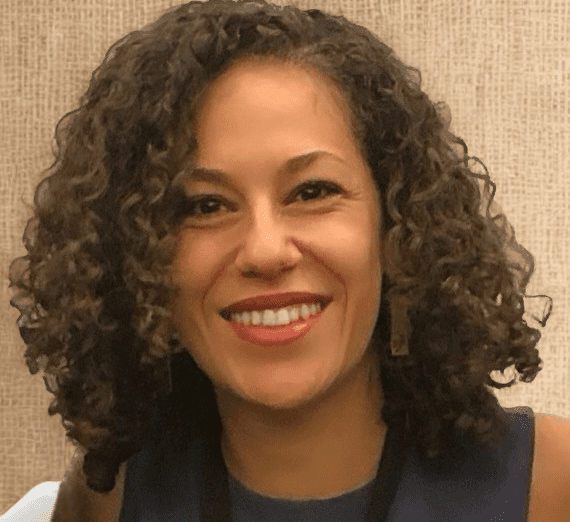
Nour Joudah is Assistant Professor in the Department of Asian American Studies at UCLA. She holds a PhD in Geography from UCLA, where her dissertation examined Palestinian and native Hawaiian communities’ efforts to imagine liberated futures through indigenous countermapping practices. She is working on a book manuscript, Future Histories, exploring how indigenous experiences of time in Palestine and Hawaii inform liberation struggles. She also holds an MA in Arab Studies from Georgetown University.
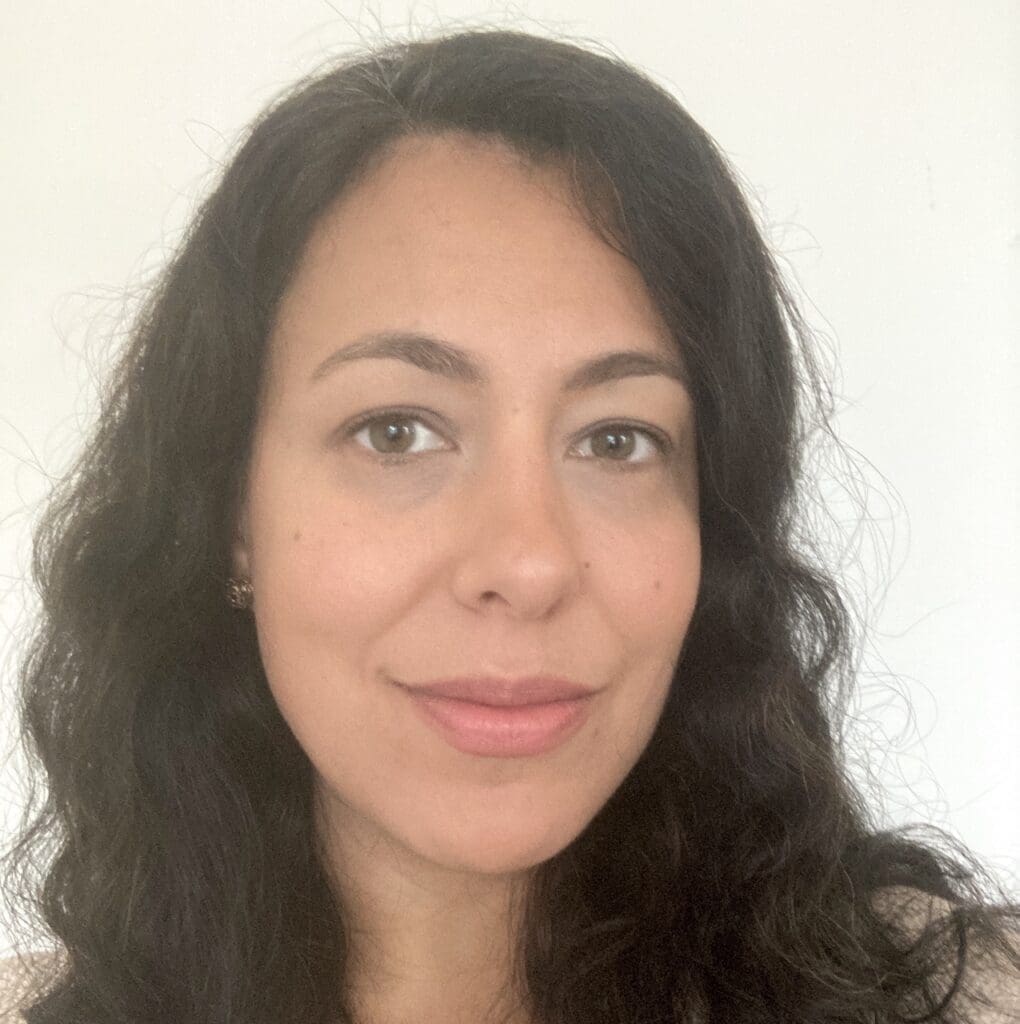
Dena Qaddumi is a scholar of urban politics and the built environment, currently a visiting fellow at the Middle East Centre at the London School of Economics. She is writing a monograph based on her doctoral research, tentatively titled City in Revolution: Encounters of People in Regime in Tunis, and is beginning new research on indigenous urbanism and futurity in Palestine. She coordinated the Palestine: Spaces and Politics curriculum, and holds a PhD in Architecture from the University of Cambridge.