

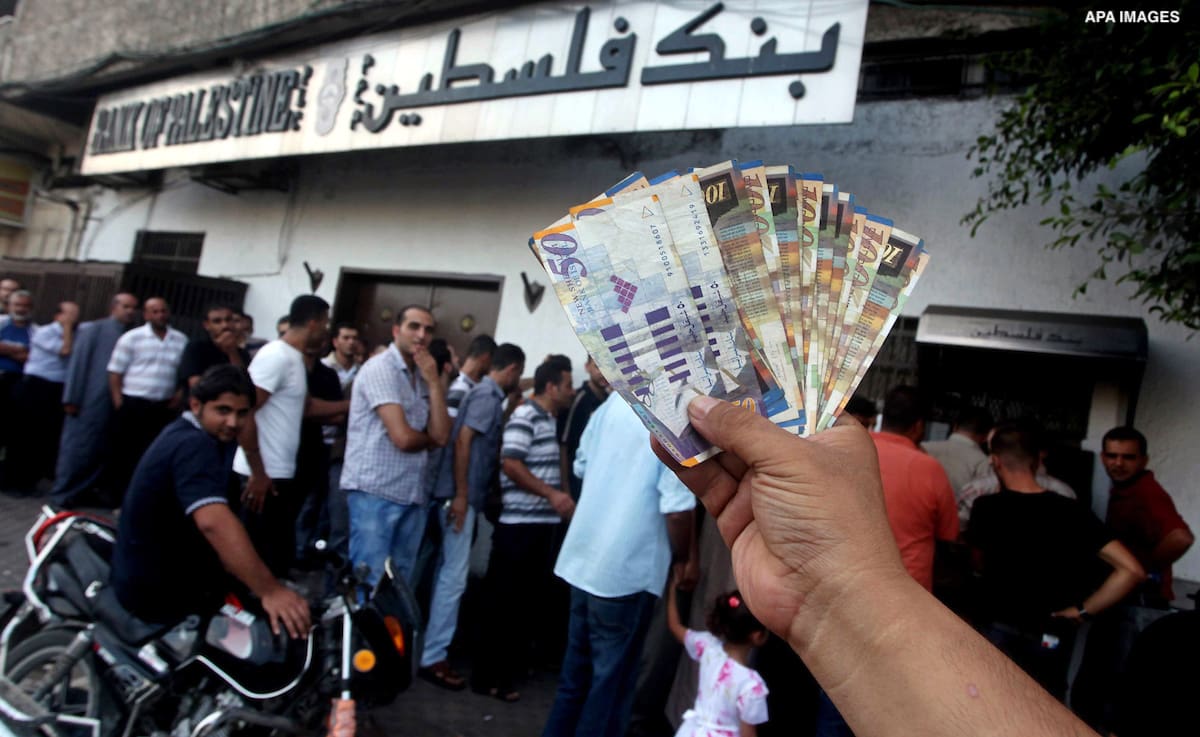
The First Intifada in 1987 took place within an economic system that was based on localized economic solidarity, helping Palestinians resist Israeli economic dominance. At the beginning of the intifada, popular committees spread in a decentralized manner and provided grassroots solidarity, educational support to students while schools were closed, and an alternative development vision. The land rental system, based on product sharing, contributed to making land available for agricultural development. Self-sufficiency, return to the land, agriculture, and food security helped build an autonomous economic structure and contributed to economic resilience. Trade unions also served as a base for activism. Their work focused on resistance to the Israeli occupation as the main concern of the Palestinian people, including workers.
Nonetheless, the end of the First Intifada, adoption of the 1993 Oslo Accords, and parameters introduced by the Palestinian Authority (PA) have rendered any resurgence of this economic model unlikely in the case of a new intifada. The NGOization of Palestinian civil society in the West Bank and Gaza has replaced popular organizing with professionalized organizations, compelled to compete with one another for donor funds in order to survive. Once-thriving cooperatives and associations are also subject to intense government oversight, thanks to a 2017 PA decree that restricts their independence and places further authority in the hands of ministry representatives.
In light of these challenges, reviving the resistance economy of the First Intifada is unrealistic. Moreover, without the dismantlement of the PA and the reconstruction of the national liberation movement (or revival of the Palestine Liberation Organization), a new Palestinian uprising would take the form of discontinuous outbursts. In this context, the alternative to a unified resistance economy may entail various localized grassroots economies boycotting Israeli goods and promoting collective production.
The continuity of these grassroots economies and their ability to develop are contingent on four conditions. The first is trust, which can be achieved through democracy, independence, and transparency. The second is social capital, which exists when a group of people have the same concerns and objectives. The third is the ability, capacity, and willingness to struggle against impediments and abuses. The fourth is the formation of a structure that unifies the efforts of the grassroots economies, transforming them into a national struggle against the dominance of the neoliberal system and toward a resistance economy.
The concept of a localized resistance economy can unite communities around collective resistance. However, bridging the gap between different actors in different communities and across different social classes necessitates a larger framework. Given the weakness of Palestinian political factions and of most donor-funded civil society organizations, the aggregation of localized collectives into a powerful political movement remains unclear. Trade unions are a potential initial framework, since they represent a group with common concerns and defend workers’ rights while also resisting the Israeli occupation. However, democracy among trade unions in the West Bank and Gaza needs to be further addressed.
In a resistance economy, Palestinians must boycott Israeli products and all forms of cooperation with the Israeli regime. Although some sectors could be negatively affected, dependency on the Israeli economy would be undermined. The neoliberal elites may resist such a framework and try to flood the Palestinian markets with Israeli products. For this reason, the involvement and democratization of trade unions would be necessary to monitor their activities and challenge their power.
Tareq Sadeq is Assistant Professor of Economics and Dean of the Faculty of Business and Economics at Birzeit University. He holds a Ph.D in economics from the University of Evry Val d’Essonne in France, where he was engaged in the Palestine solidarity movement and served as head of the General Union of Palestinian Students (GUPS). Tareq has published on monetary policy, macroeconomics, econometrics, labor economics, income inequalities, and entrepreneurship. He is also a researcher in Palestine’s Global Entrepreneurship Monitor (GEM).