



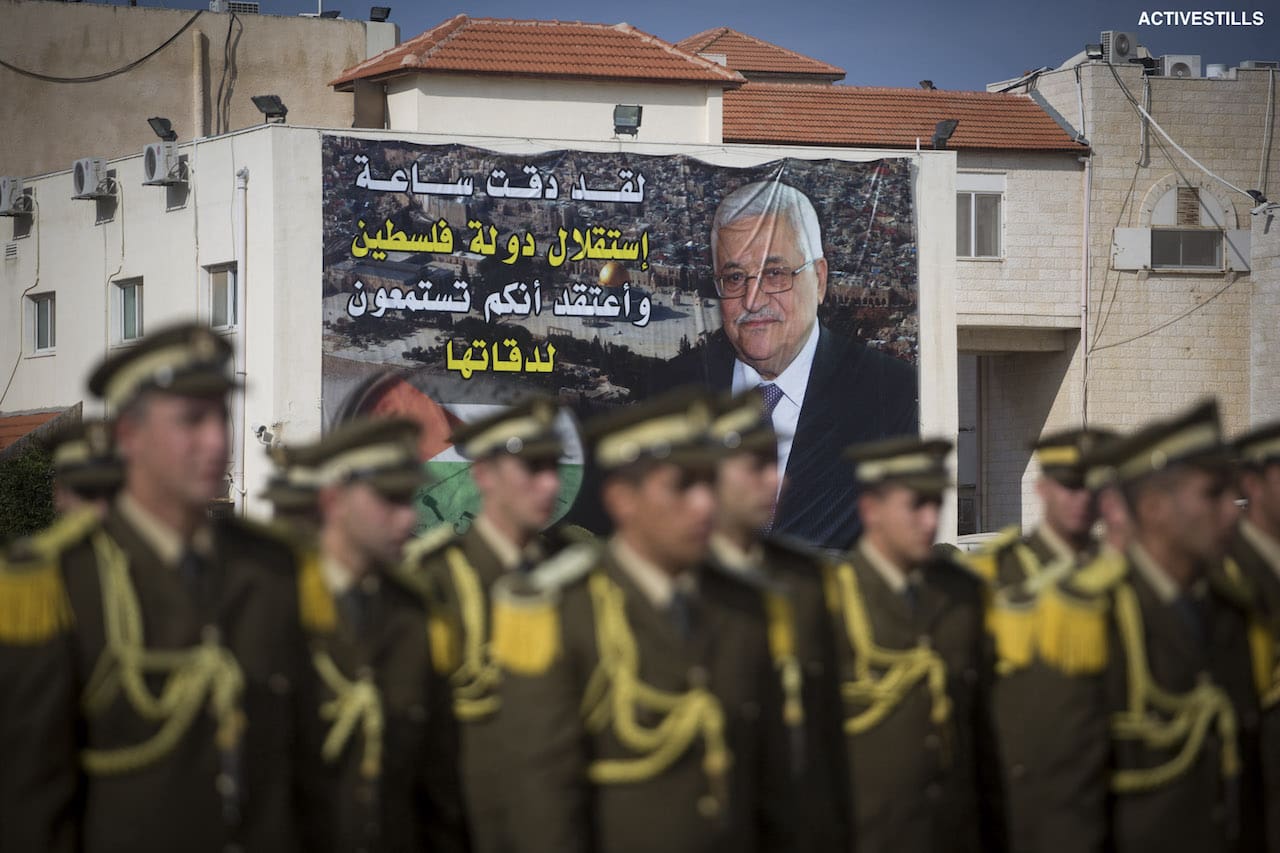
In the event of a succession issue stemming from President Abbas’s death due to natural causes, one of five possible nominees will likely replace him. The leading four are former or current security sector heads: Jibril Rjoub, former head of preventive security forces; Majed Faraj, current head of general intelligence; Hussein al-Sheikh, who served briefly in the preventive security forces following the establishment of the PA; and Mohammed Dahlan, former head of the preventive security forces in Gaza who is now in exile in the UAE after falling out of favor with Abbas. The fifth potential candidate is Marwan Barghouti. Barghouti is a popular political figure and the only possible nominee who has never held an official security sector role. He is currently being held in an Israeli prison for alleged attacks against Israeli civilians during the Second Intifada.
These candidates illustrate how effectively the Israeli regime and international community are regulating the Palestinian Authority’s (PA) political system. Those with the greatest chance of taking control of the PA and its institutions have risen through, and been vetted by, the internationally sponsored security infrastructure. Moreover, it has become clear that no one may assume leadership of Palestinian structures of power without gaining the approval of the leaders of the security sector and its interlocutors.
In this instance, the sociopolitical and economic spheres will likely remain the same. Power will continue to be held in the hands of a few, preserving the status quo. International support and security coordination with the Israeli regime will no doubt continue, particularly as three of the four candidates have served as interlocutors between the PA and Israeli occupation authorities.
Another potential disruptive scenario is Palestinian elections. Broadly speaking, Palestinian elections would likely create three potential outcomes: the re-creation of the status quo with a renewed veneer of legitimacy; the expansion and entrenchment of fragmentation between and within Palestinian political factions; and an electoral victory for a social movement that upends the status quo either positively or negatively. The latter is the least likely outcome.
Elections almost occurred in January 2021, when Abbas announced they would be held for all three Palestinian administrative bodies: the Palestinian Legislative Council (PLC), the PA presidency, and the Palestinian National Council (PNC). These would have been the first national elections in 15 years following renewed reconciliation talks between Fatah and Hamas. The elections were intended to overcome a crisis of legitimacy and devastating polarization within the Palestinian polity. The more contentious issues between the two ruling factions were to be dealt with after the elections, the most significant being the political and technical issues involved in merging the two respective security sectors in the West Bank and Gaza, as well as the independence of Hamas’s armed military wing.
However, in April 2021, Abbas indefinitely postponed parliamentary elections amid a dispute over voting in occupied East Jerusalem and splits in his Fatah party. The role of the Palestinian Authority security services (PASF) during elections has typically been one of obstructionism given its partisan nature. Yet during electoral preparations in the first half of 2021, PASF interference was limited to cyber surveillance and verbal threats toward candidates and their supporters.
Although democratization in the West Bank and Gaza has always been tenuous, the attempted Fatah-led PA coup that followed Hamas’s victory in the 2006 elections – with significant western and Israeli backing – destroyed further prospects for democratization and the rule of law. Since then, Abbas has continued to consolidate his power, churning out presidential decrees to limit competition. The PASF has been central to this, not only in suppressing dissent, but also in coopting large segments of the Palestinian population. The latter is achieved through direct employment in the PASF or through informal channels, such as patronage networks headed by security figures who have direct access to international aid and weapons.
The implications for the justice sector in the event of any elections would be twofold. A change in presidency would necessitate revisions to decrees and changes to legal personnel, including the appointment of a new minister of justice, attorney general, and legal advisor, among others. Second, a newly elected PLC would mean that all previous presidential decrees would be put to the PLC, which could create stagnation unless the different parties worked together. The PLC would need to devote its entire legislative timetable for the next four years to debate the slew of decrees since 2007.

Tahani Mustafa is a lecturer in International Relations in the Department of War Studies at King’s College London, and a visiting fellow at the European Council on Foreign Relations (ECFR). She holds a PhD from the School of Oriental and African Studies (SOAS), University of London, and previously served as senior Palestine analyst at the International Crisis Group. Her research explores international mechanisms of security sector reform and governance in the occupied Palestinian territories.