






Introduction
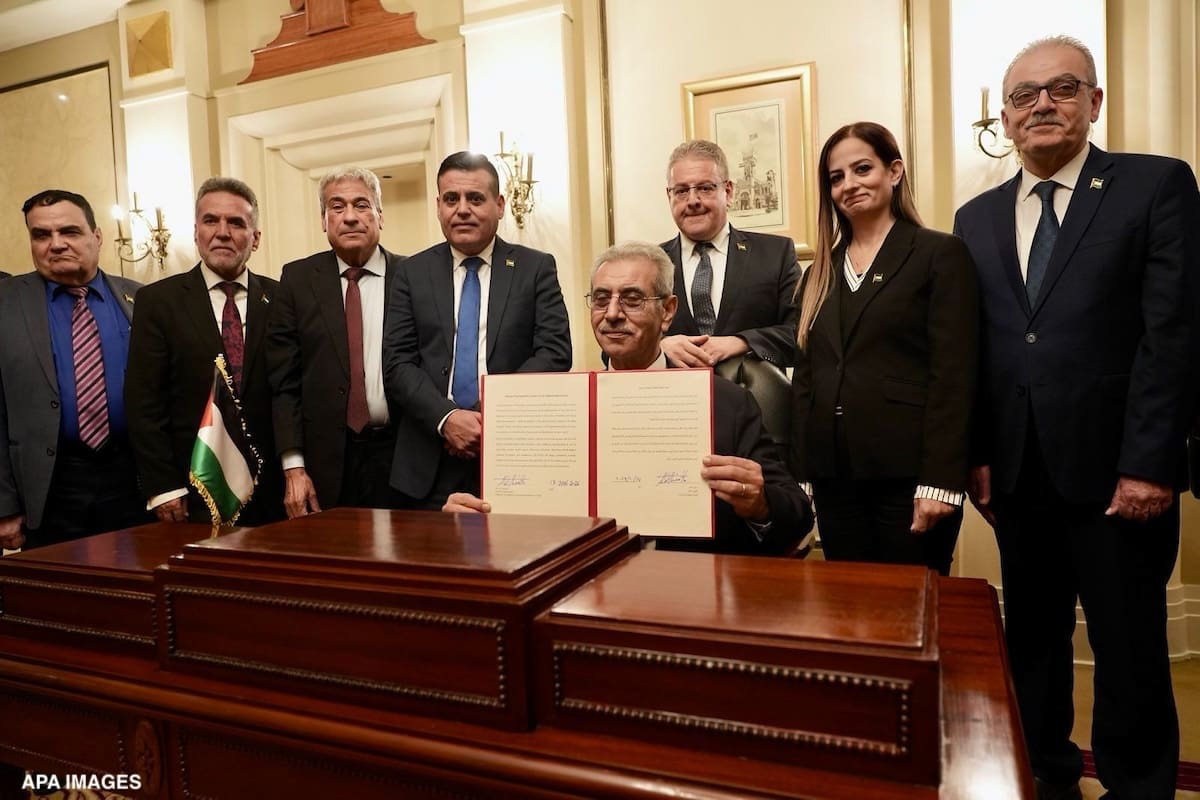
The announcement of the National Committee for the Administration of Gaza (NCAG), a 15-member technocratic body chaired by Ali Shaath, signals a shift toward depoliticized governance in Gaza amid ongoing genocide. Shaath, a Palestinian civil engineer and former deputy minister of planning and international cooperation, is positioned to lead an interim governing structure tasked with managing reconstruction and service provision under external oversight. While presented as a neutral technocratic governing structure, the NCAG is more likely to function as a managerial apparatus that stabilizes conditions that enable genocide rather than challenging them.1
This policy memo argues that technocratic governance in Gaza—particularly under US oversight, given its role as a co-perpetrator in the genocide—should be understood not as a pathway to recovery or sovereignty, but as part of a broader strategy of genocide management.
The Turn to Technocracy
The NCAG was established under the oversight of US President Donald Trump’s Board of Peace (BoP) as part of the second phase of the ceasefire deal, which the Israeli regime has repeatedly violated. The BoP’s composition and mandate remain unclear, despite its endorsement by UN Security Council Resolution 2803 as the primary body overseeing reconstruction and interim administration in Gaza. Yet, according to its draft charter circulated to prospective member states, Trump, as BoP chairman, is granted sweeping authority to shape membership, control subsidiary bodies, and exercise decisive influence over strategic policy and implementation.
Most glaring in Trump’s plan for Gaza is the absence of any discussion of Palestinian sovereignty Share on XMost glaring in Trump’s plan for Gaza is the absence of any discussion of Palestinian sovereignty. Indeed, Palestinians have been excluded from any meaningful decision-making, effectively stripping Gaza’s population of political agency and once again subordinating them to external colonial control.
The composition of the NCAG illustrates how technocratic administration is being operationalized in practice. The committee convened for the first time on January 15 in Cairo. Its 15 Palestinian members are all originally from Gaza, and most are affiliated with or close to the Palestinian Authority (PA) in the West Bank. Their expertise spans infrastructure, finance, telecommunications, and waste management. Notably, there is only one woman on the committee, Hana al-Tarazi, tasked with the social affairs portfolio.
The committee’s chair, Shaath, is an engineer from Khan Younis who has held various positions within the PA and played a prominent role in the development of Palestinian industrial zones. In his first interview following his appointment, given to a radio station owned by Palestinian businessman Bashar al Masri, Shaath repeatedly emphasized that the NCAG will play no political role in governing Gaza. He deferred questions on ceasefire arrangements and territorial demarcations—including the expansion of the “yellow line,” which Israeli authorities treat as Gaza’s new de facto boundary—to Trump’s BoP. He was also deliberately vague about the committee’s funding, citing Arab states as potential sources, and was notably evasive when asked about the salaries of committee members.
Ali Shaath spoke of the need for Palestinians to unite under 'one system, one law, and one president,' signaling the PA’s return to governing Gaza and the expansion of President Mahmoud Abbas’s authoritarian rule Share on XIn the same interview, Shaath spoke of the need for Palestinians to unite under “one system, one law, and one president.” Later, at the Davos signing of the BoP, Shaath amended this formulation to “one law, one authority, one weapon”—language that appeared verbatim in Jared Kushner’s presentation explaining Hamas’s demilitarization and the NCAG’s role in authorizing all weapons in Gaza. This language clearly signals the PA’s return to governing Gaza and the expansion of President Mahmoud Abbas’s authoritarian rule. The appointment of Sami Nasman to the internal security portfolio, reportedly at the insistence of Mohammed Dahlan’s faction within Fatah, further underscores the NCAG’s political alignment. A former PA intelligence official and longstanding opponent of Hamas, Nasman has been accused in media reports of collaborating with Israeli forces during the genocide.
Depoliticization as Policy
Gaza is in urgent need of immediate relief, recovery, and reconstruction, some of which the NCAG might facilitate. Yet it is also in need of a political solution that ends the genocide, siege, and occupation. Without a political solution, the NCAG will serve as a mechanism of genocide management and a political instrument that entrenches the very conditions that made it possible.
The formation of the National Committee for the Administration of Gaza is part of a deliberate approach by the US to depoliticize the Palestinian struggle Share on XIndeed, the formation of the NCAG is part of a deliberate approach by the US to depoliticize the Palestinian struggle. It creates the appearance of Palestinian participation while operating under Trump’s BoP, effectively eroding Palestinian political agency. In practice, the NCAG is positioned to play a role similar to that of the PA in the West Bank: a service provider operating under colonial oversight. This arrangement effectively defers political resolution indefinitely. Worse yet, by advancing technocratic governance in place of justice, self-determination, and accountability, this arrangement sustains the structural conditions that enable genocide. Ultimately, treating Gaza’s governance and reconstruction as mere technical challenges requiring technocratic expertise masks the ongoing genocide and facilitates the evasion of accountability for it.
Refusing Colonial Control
Palestinian civil society, grassroots movements, political organizations, and international solidarity actors should reject depoliticized frameworks that operate without an immediate and permanent ceasefire. They must also press for enforceable guarantees against renewed military assault and for accountability for the genocide. They should insist that both reconstruction and governance arrangements are grounded in Palestinian political agency and collective decision-making rather than technocratic neutrality imposed under external colonial control. One such example is the Gaza Phoenix Framework, a reconstruction plan developed by Palestinian experts in Gaza and the West Bank.
Moreover, security arrangements that prioritize internal policing among Palestinians over civilian protection and collective recovery and healing should be closely scrutinized and challenged. Finally, international engagement with Gaza must reject “stabilization” paradigms and insist on the dismantlement of the structures that enable genocide, siege, and occupation.
- To read this piece in French please click here. Al-Shabaka is grateful for the efforts by human rights advocates to translate its pieces, but is not responsible for any change in meaning.
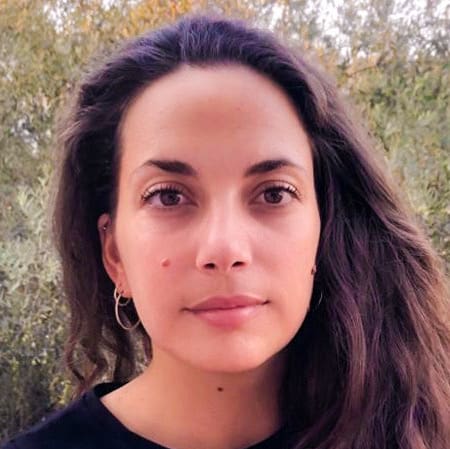
Yara Hawari is Al-Shabaka’s co-director. She previously served as the Palestine policy fellow and senior analyst. Yara completed her PhD in Middle East Politics at the University of Exeter, where she taught various undergraduate courses and continues to be an honorary research fellow. In addition to her academic work, which focused on indigenous studies and oral history, she is a frequent political commentator writing for various media outlets including The Guardian, Foreign Policy, and Al Jazeera English.