





This roundtable is published in partnership with the British Palestinian Committee.
Introduction
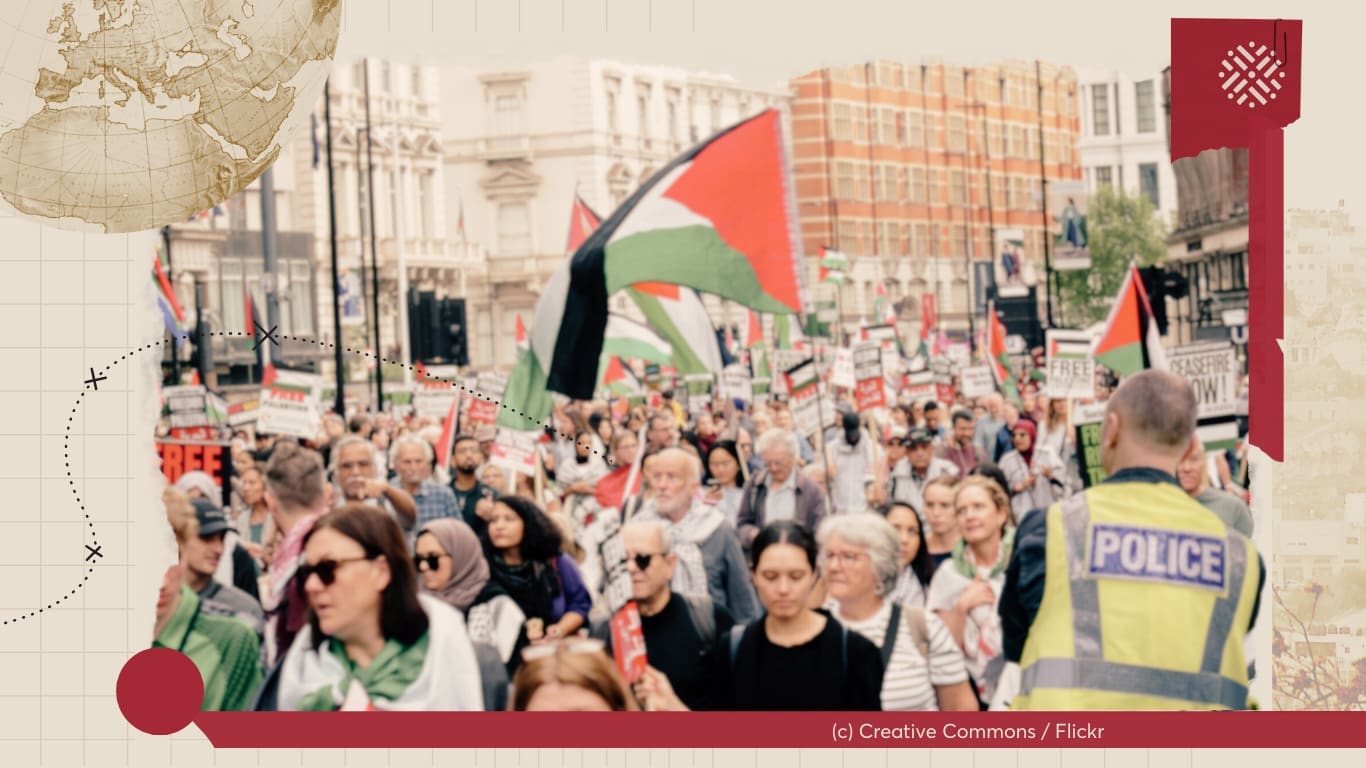
On November 4, 2025, the UK government tabled an amendment to the Crime and Policing Bill to curtail protest rights under the pretext of “cumulative disruption.” The revised Bill is now in the House of Lords Committee, where it is scrutinized before advancing toward final approval. The amendment signals a profound shift in how the state regulates public protest. While the government presents the Bill as a neutral public order measure, it emerges directly from sustained national demonstrations for Palestinian rights and introduces new legal concepts that threaten long-established democratic freedoms.
This roundtable examines the Bill’s political drivers, legal architecture, and wider implications for social movements and civil liberties in the UK. It shows that the amendment is not simply a public order measure; it is a coordinated political and legal project to narrow the space for dissent in the UK. While Palestinian solidarity is the immediate target of the crackdown on freedom of assembly, the roundtable argues that the consequences will reverberate across labor organizing, racial justice, climate activism, and broader democratic participation.
Cumulative Disruption: Legal Transformation of Protest Rights
Salma Karmi-Ayyoub
The Bill introduces the concept of “cumulative disruption” into protest law. It modifies sections 12 and 14 of the Public Order Act 1986, which govern when police may impose conditions on public assemblies and processions, including changes to their route and location.
Currently, police may impose conditions where a protest causes “serious disruption to the life of a community.” The amendment would alter this by requiring a senior police officer, when assessing whether a public assembly (a static protest) or procession (a march) “may result in serious disruption to the life of the community,” to take into account any “relevant cumulative disruption” arising from the protest.
By empowering police to prevent this accumulation of protest activity, the amendment strikes at the core of what gives protests their force Share on X“Relevant cumulative disruption” is defined as disruption resulting from the procession or assembly in question together with any other protest that “was held, is being held, or is intended to be held in the same area,” regardless of whether those protests are organized or attended by the same individuals. This expansive definition permits police, when assessing the disruptive impact of a particular protest, to consider past and future protests that are entirely unconnected to it in terms of organizers or participants.
While the government claims the amendment protects communities and preserves protest rights, its potential to undermine the latter is clear. The capacity for protests to recur is central to their political effectiveness, enabling sustained pressure on decision-makers to pursue change. By empowering police to prevent this accumulation of protest activity, the amendment strikes at the core of what gives protests their force. Paradoxically, it may also result in greater restrictions on protests concerning salient political issues, as these are more likely to prompt sustained mobilization and repeat demonstrations.
The current government’s introduction of this amendment continues the approach of the previous Conservative government, which also sought to severely curtail the right to protest. Notably, former home secretary and recent defector to the right-wing Reform Party, Suella Braverman, attempted to introduce a similar change through secondary legislation in 2023, but the High Court struck it down as unlawful.
The current amendment must be understood in the context of recent legislation, notably the Police, Crime, Sentencing and Courts Act 2022 and the Public Order Act 2023, both of which significantly restricted protest rights. The 2022 Act granted police authority to impose conditions on demonstrations based on the inherently subjective criterion of “noise” causing “serious disruption.” The 2023 Act further widened police powers by expanding stop-and-search authority and criminalizing certain protest tactics, including “locking on,” where individuals attach themselves to people, objects, or land.
These developments have already prompted serious concern regarding the UK’s human rights record. UN High Commissioner for Human Rights Volker Türk described the Public Order Act 2023 as “incompatible with the UK’s international human rights obligations regarding the rights to freedom of expression, peaceful assembly, and association.”
The concept of cumulative disruption would seem to depart from European Court of Human Rights (ECtHR) jurisprudence, which affirms that organizers’ autonomy to determine the location, timing, and manner of a protest is integral to the effective exercise of freedom of assembly. In contrast, the amendment is likely to incentivize police to limit assemblies at prominent or strategically significant locations, precisely because such sites attract higher levels of protest activity and therefore reach the threshold of cumulative disruption more quickly.
Moreover, ECtHR case law holds that justification for state interference turns on whether a protest is organized in a way that disrupts ordinary life “to a degree exceeding that which is inevitable in the circumstances.” This standard necessarily requires an individualized assessment of a specific protest’s conduct and impact, rather than an evaluation based on the cumulative effects of unrelated protests. As drafted, the amendment could permit police to restrict protests that are not themselves disruptive solely because of the aggregate impact of other protests in the vicinity. It is difficult to see how restrictions imposed in such circumstances could be consistent with the right to freedom of assembly.
Palestine Solidarity: Litmus Test for Acceptable Political Expression
Celie Hanson
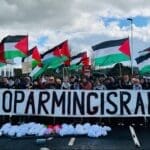
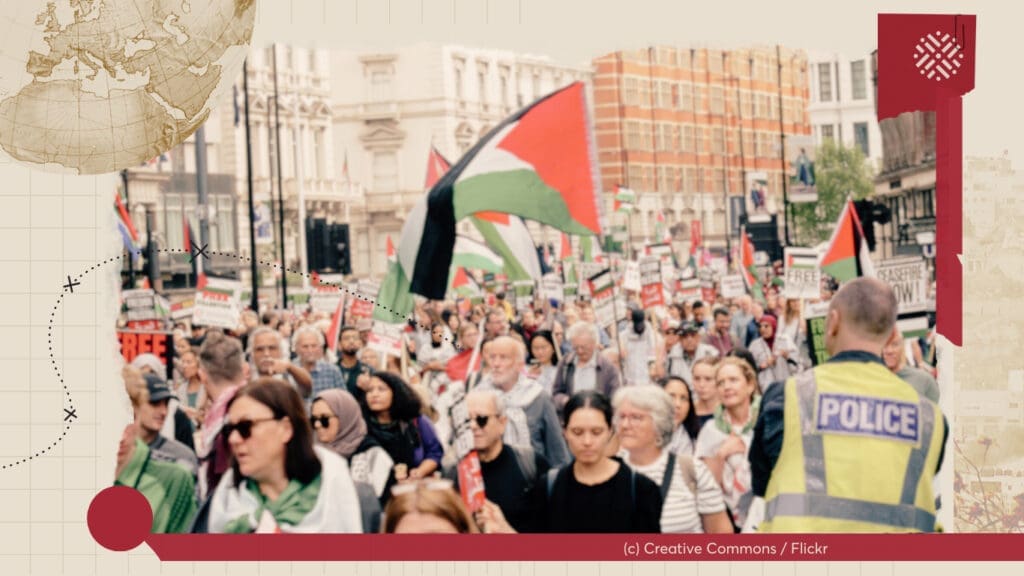
The Bill’s protest-related provisions represent the British government’s latest effort to erode civil liberties as part of a broader project to delegitimize Palestine solidarity organizing. The Palestine Solidarity Campaign (PSC) and coalition partners have built one of the largest and most sustained protest movements in British political history, mobilizing against Israel’s ongoing genocide and apartheid and challenging the government’s complicity. We must therefore understand these proposed measures within the context of Israel’s strategy to constrain this growing Palestine solidarity movement, willingly enacted by the British government.
Police could confine protests to an ever-shrinking number of locations and then impose further restrictions by citing cumulative disruption within those same areas Share on XIn tandem with the “cumulative disruption” amendment, the Bill also seeks to extend existing police powers under the Public Order Act 1986 by adding a new statutory authority to restrict protests in the vicinity of places of worship on grounds of perceived intimidation. Former Home Secretary Yvette Cooper framed this provision as necessary to protect worshippers from intimidating demonstrations, stating that the national demonstrations for Palestine are its principal target, while press coverage has falsely portrayed expressions of support for Palestine as a threat to the religious freedom of Jewish people. Contrary to the outrageous accusation that participants are motivated by antisemitism—a strategy used to justify crackdowns on solidarity protests across the West—Jewish people are integral to the marches. Every march has been attended by thousands of Jewish people, many of whom march in an organized Jewish Bloc. Civil society organizations and parliamentary briefings note that police have repeatedly invoked this rationale to justify limiting national protests for Palestinian rights through central London, citing alleged disruption near synagogues. In fact, no threats to synagogues have been linked to any of the marches.
What is clear is that the curtailment of Palestine solidarity marches is political rather than a genuine question of public order. Since 2023, police have employed sections 12 and 14 of the Public Order Act 1986 to restrict the duration, routes, and locations of every national march for Palestine in London. These measures may be unlawful in light of a High Court ruling in May 2024, in which Liberty, a British civil liberties organization, successfully challenged government regulations that unlawfully expanded police powers under the Act—a judgment directly relevant to the sweeping conditions imposed on national Palestine marches.
More recently, authorities have imposed conditions criminalizing the banging of pots and pans, the use of drums and megaphones, and the chanting of slogans at national Palestine demonstrations. As the Institute of Race Relations has documented, these practices reflect an expansion of racialized policing driven by pro-Israel opposition to the aims of the demonstrations and hostility to the Palestine solidarity movement. Such policing has both mirrored and reinforced racism and related prejudices against Palestinians, Arabs, Muslims, and other marginalized groups.
Despite the legal requirement for police to act in accordance with the European human rights standards and facilitate peaceful protest, existing restrictions have already made it extremely difficult to organize major pro-Palestine marches in central London. The proposed amendment would deepen this constraint, creating a Kafkaesque trap for organizers: police could confine protests to an ever-shrinking number of locations and then impose further restrictions by citing cumulative disruption within those same areas.
By contrast, police have permitted far-right and anti-immigration protests outside hotels housing asylum seekers, despite existing legal provisions designed to protect people from this kind of violence, where the purpose is to threaten, intimidate, and harass. It is grotesque that the British government is attempting to present the measures in the Bill—its latest bid to shield itself and Israel from accountability— as protection for vulnerable groups.
These repressive measures will not make anyone safer. Instead, they could be used by this or any future government to stamp out protests altogether. Palestine solidarity has thus become a litmus test for the forms of public political expression the British state is willing to permit, revealing how far authorities are prepared to go in redefining the boundaries of acceptable dissent.
Democratic Erosion: Curtail One Cause, Others Follow
Zena Agha
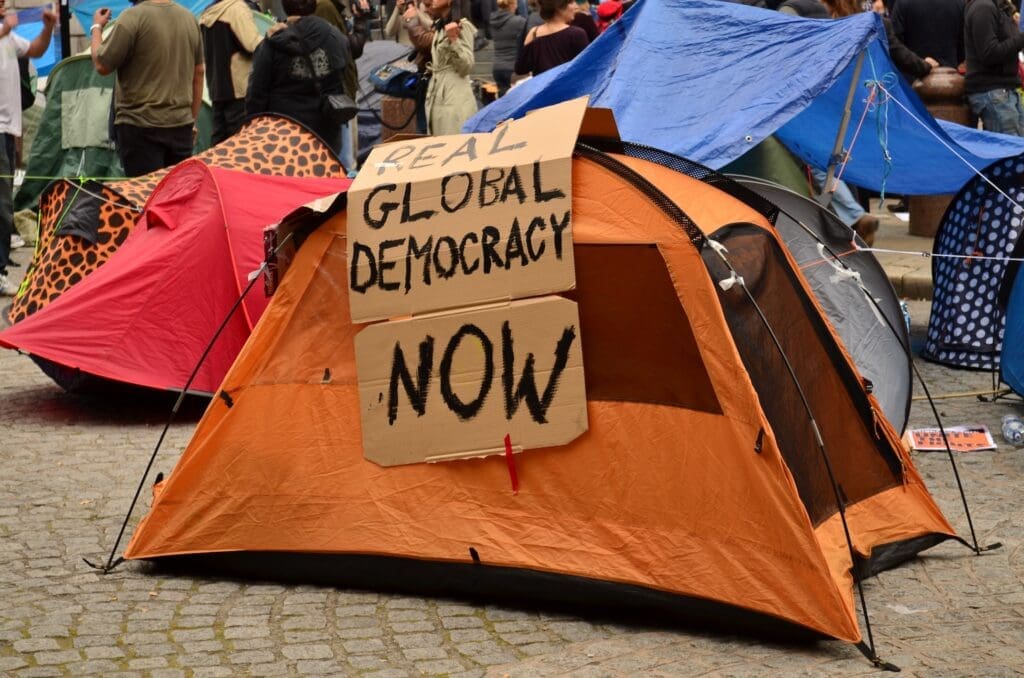
While Palestine solidarity protests are the immediate political target, the impact of the proposed changes to protest law extends well beyond them. The implications of the so-called “cumulative disruption” provision, along with restrictions on demonstrations in the undefined “vicinity” of places of religious worship, have prompted widespread concern across multiple sectors. In a statement published on January 12, 2026, more than 45 organizations—including Amnesty International UK, Greenpeace, Liberty, the PSC, Quakers in Britain, the Trades Union Congress, and the British Palestine Committee—declared their opposition to what they described as the government’s draconian crackdown on freedoms of expression and assembly. The signatories include trade unions, charities, NGOs, faith groups, and organizations working in climate justice, human rights, culture, campaigning, and solidarity.
The legislation risks excluding marginalized groups from sustained public organizing, particularly under a far-right government Share on XThe widespread opposition underscores the far-reaching implications of the proposed legislation for a broad range of causes across British society. One key concern is the Bill’s potential to erode workers’ rights. During strike action, picketing is a foundational organizing strategy: workers gather outside their workplaces to explain the rationale for industrial action, build solidarity, encourage participation, and generate public support. Under the proposed provisions, police would gain new powers to restrict pickets based on alleged “cumulative disruption.” This development could place future industrial action across the UK—from rail strikes to junior doctors’ walkouts and university disputes—at risk, which explains the strong opposition from trade unions beyond those directly involved in Palestine solidarity organizing.
The Bill also endangers long-established protest traditions. As drafted, it would empower police to prohibit demonstrations by striking graduate students on university campuses, for example, by referencing unrelated earlier protests at the same location. Similarly, events such as Pride marches could face restrictions if, for example, a far-right demonstration had previously taken place in the same town or city. These provisions illustrate how the government could use this legislation to suppress a wide range of lawful, peaceful public assemblies.
The Bill’s potential impact on the climate movement further illustrates its gravity. Direct action, employed by organizations such as Greenpeace, has long been central to environmental activism. Recent climate protests—already subject to extensive policing and surveillance—have relied on disruption, agitation, and civil disobedience to draw attention to the accelerating environmental crisis. Activists from groups such as Just Stop Oil and Extinction Rebellion already face disproportionately high conviction rates and pre-emptive arrests.
By constraining how the UK’s diverse communities are permitted to mobilize and reclaim public space, the legislation risks excluding marginalized groups—including working-class, queer, and Black and Brown communities—from sustained public organizing, particularly under a far-right government. From this perspective, the proposed legislation should be understood as anti-protest lawmaking, which could set back progressive movements by decades. It is draconian in substance and a grave threat to democratic life. It normalizes and legally sanctions state repression and curtails civil liberties.