







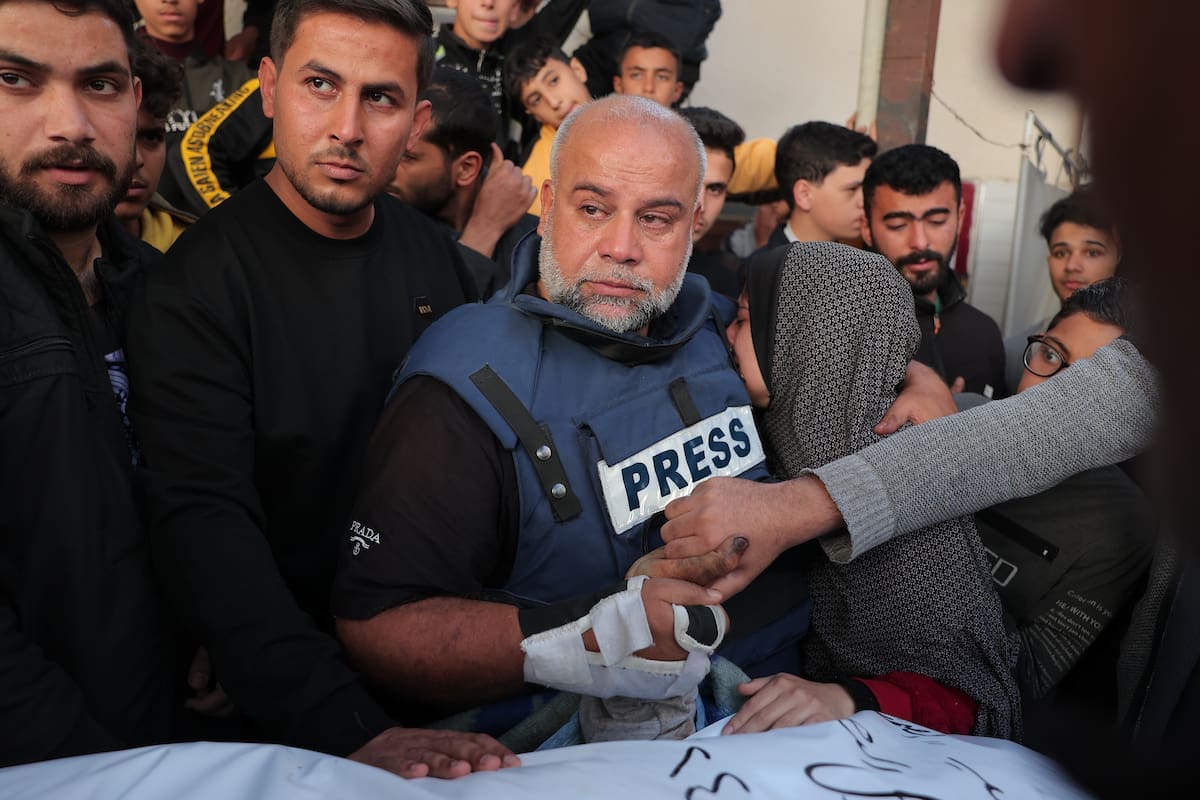
Palestinians attend in the funeral of Hamza Wael Dahdouh, a journalist with the Al Jazeera television network, who was killed in a reported Israeli air strike

Over the last 18 months, Israeli forces have killed more than 230 journalists, primarily in Gaza but also in Lebanon and Syria. To put this in perspective, more journalists have been killed during Israel’s ongoing genocide than in both world wars, the US invasions of Vietnam and Afghanistan, and the war in Ukraine combined.

All of this is by design. These journalists are not being killed in crossfire—they are being deliberately targeted in a mass assassination campaign intended to prevent news of Israel’s war crimes from reaching an international audience. Despite the scale of this assault, Western journalists and media outlets have remained silent, allowing Israel’s unprecedented attacks on press freedom—and on the Palestinian people—to continue unchecked.

In this policy lab, Mariam Barghouti and Sharif Abdel Kouddous join host Tariq Kenney-Shawa to discuss Israel’s targeted assassination campaign against Palestinian journalists, the complicity of Western media in normalizing these crimes, and how this silence allows Israel to get away with genocide.
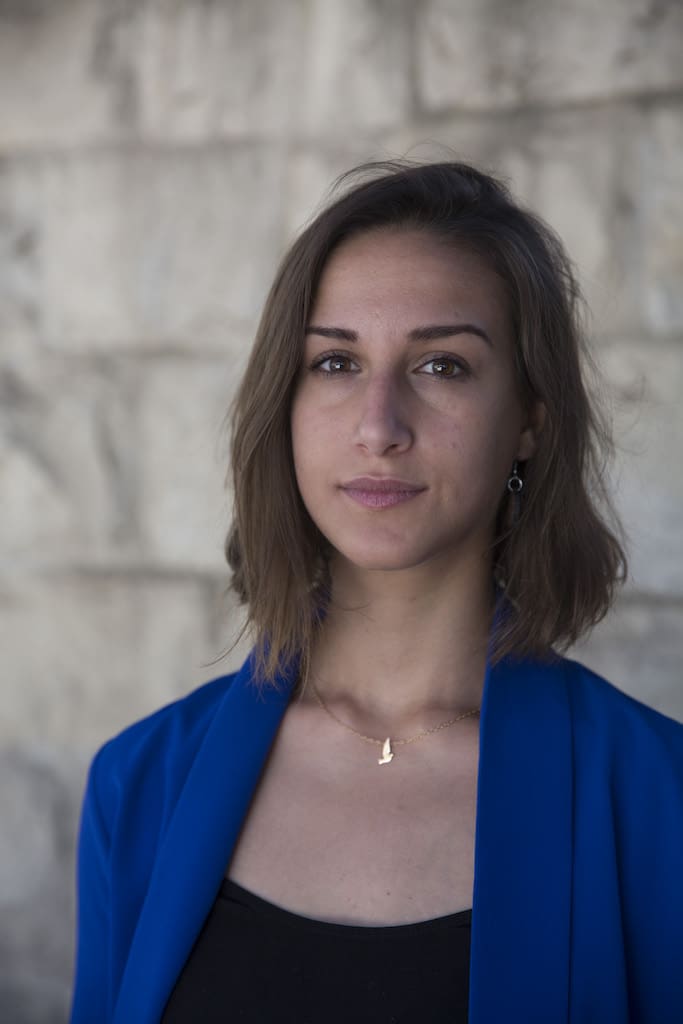
Mariam Barghouti is a Palestinian writer and researcher based in Ramallah. She earned a BA in English Language and Literature from Birzeit University, and an MSc in Sociology and Global Change from the University of Edinburgh. She worked as a journalist and reporter with a focus on the Levant, and published various sociopolitical commentaries from Palestine. She has undertaken monitoring and evaluation missions of humanitarian and development aid in Jordan, Palestine, and Lebanon for various governmental and non-governmental organizations. Her reporting and analysis have been featured in Al-Jazeera English, the New York Times, the Guardian, BBC, and Middle East Eye, amongst others.
With: Sharif Abdel Kouddous
In this article

Latest Analysis

 Politics
When four donkeys were evacuated from Gaza to a German zoo in November 2025, their rescue was celebrated as a humanitarian success. Yet while the animals were transported to safety, given new names, and described as leaving behind "hunger and misery, beatings and hardship," Palestinian children have been unable to evacuate amid a relentless ongoing genocide. In this commentary, Asmaa Abu Mezied examines how humanitarian concern operates through racialized hierarchies of grievability that render animal suffering more visible and rescue-worthy than Palestinian human life. She further argues that animal welfare interventions are materially entangled with the dispossession of Palestinian survival infrastructure, showing how it can become an enabling mechanism of colonial violence rather than its interruption.
Asmaa Abu Mezied· Aug 11, 2026
 Civil Society
After Hamas’s recent announcement that it will hand over governing authority in Gaza to the National Committee for the Administration of Gaza (NCAG), urgent questions about who will shape Gaza's future and on whose terms have reemerged. These questions are particularly salient given that the NCAG’s framework reflects the same technocratic and externally imposed logic that has come to characterize the dominant international proposal for Gaza's reconstruction: one that treats it as a technical exercise in disaster management, sidelining Palestinian sovereignty, return, and self-determination. In contrast, this roundtable asks what it means to understand Gaza as an Indigenous region rather than simply a besieged strip or humanitarian space. Nour Joudah and Dena Qaddumi explore how Indigenous frameworks reshape prevailing understandings of urbanism, reconstruction, and governance; why reconstruction must begin with Palestinian agency and reclamation rather than externally designed colonial master plans; and how rebuilding is already taking place through everyday forms of Indigenous endurance, social organization, and spatial resistance under conditions of ongoing genocide.
Nour Joudah,Dena Qaddumi· Jul 23, 2026
 Politics
The advisory opinions issued by the International Court of Justice on Palestine reveal both the possibilities and the limits of international law, which has come under intense scrutiny amid the Israeli regime’s ongoing genocide in Gaza and broader settler-colonial project across Palestine. Acknowledging the persistent gap between legal principle and political enforcement, this policy brief examines how these opinions can be leveraged to strengthen legal and diplomatic accountability at both the international and domestic levels. It argues that the opinions provide an opportunity to move legal discourse on Palestine beyond the dominant UN framework of statehood within the 1967 borders and to reassert the Palestinian people’s right to self-determination within a broader liberation-oriented framework aimed at ending settler colonialism and advancing justice for Palestinians as a whole.
Al-Shabaka Dana Farraj
Dana Farraj· Jul 1, 2026