



Executive Summary
The Israeli regime is drawing a "Yellow Line" across Gaza to consolidate territorial control without formal annexation. This policy brief argues that:
- The Yellow Line functions as a de facto military demarcation that shapes civilian movement and territorial control while being framed as a temporary security measure.
- By avoiding formal annexation, the Israeli regime exercises territorial control while limiting immediate legal and political costs.
- This strategy follows a historical pattern: ceasefires and agreements since 1948 have repeatedly facilitated Israeli territorial expansion under the guise of provisional arrangements.
- The Yellow Line operates alongside the weaponization of humanitarian aid, which blocks reconstruction materials and renders Palestinian return materially impossible.
- International law prohibits such practices, yet sustained inaction has enabled territorial transformation on the ground.
Recommendations
- Intensify ICC pressure to prioritize land theft-related charges in war crimes prosecutions.
- Third states should intervene in the ICJ genocide case, identifying the Yellow Line as a manifestation of genocidal conditions.
- The UN General Assembly should request an ICJ advisory opinion on the Yellow Line and states' obligations of non-recognition.
- Civil society organizations and media outlets should document every Yellow Line shift through satellite imagery and testimony for future legal proceedings.
Introduction
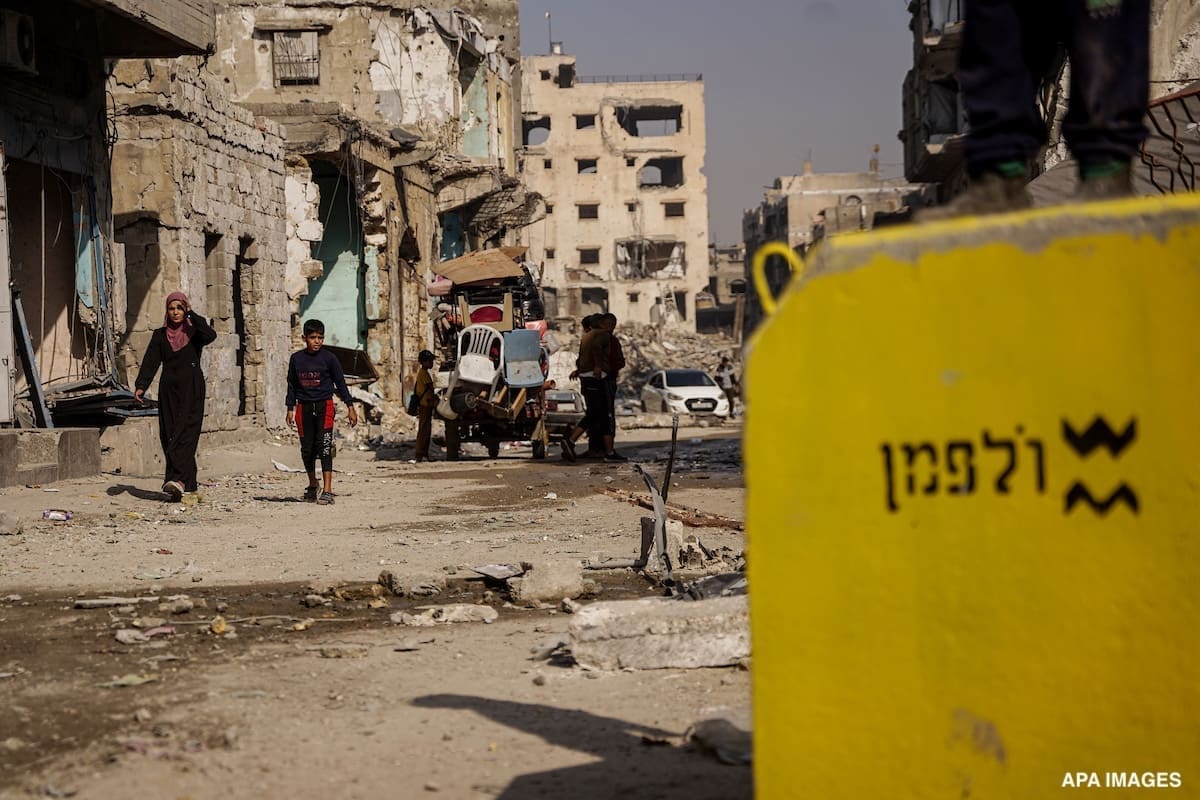
The Israeli regime is drawing a “Yellow Line” across Gaza to consolidate what it has always wanted: Palestinian land. The Yellow Line is not an internationally recognized border. Borders are typically established through bilateral agreements, adjudication, or mutual recognition under international law. By contrast, the so-called Yellow Line in Gaza functions as a de facto military demarcation associated with ceasefire arrangements and enforced through Israeli operational control. In some places, it is marked by yellow-painted concrete barriers, cleared corridors, and restricted access zones. It shapes civilian movement and territorial control without constituting a formally delimited boundary. In effect, it constitutes territorial theft with better branding, operationalizing US President Donald Trump’s plan for the continued colonization of Gaza.
The Yellow Line operates within a broader settler-colonial structural context: Israel has never finalized its permanent borders. Several territorial boundaries remain governed by armistice lines, military occupation, or disputed sovereignty claims. This enduring ambiguity creates space for the expansion of settlements, buffer zones, and restricted military areas under the guise of security.
The ambiguity is not incidental; although Israeli regime authorities frame the Yellow Line and similar demarcations as temporary security measures, their enforcement can produce enduring territorial control. Formal annexation would carry clearer legal and diplomatic consequences, including heightened exposure to international legal scrutiny. This could include a potential investigation by the International Criminal Court (ICC), which has affirmed jurisdiction over alleged crimes committed in the Occupied Palestinian Territory, as well as the possibility of sanctions or other measures should international bodies choose to act. This policy brief argues that by maintaining the classification of such zones as provisional security arrangements rather than permanent borders, the Israeli regime exercises territorial control while limiting the immediate legal and political costs associated with declared annexation.
Instruments of Territorial Expansion
Since the October 2025 “ceasefire” began, the Israeli regime has moved the Yellow Line deeper into Gaza—approximately 300 meters west in al-Shujaiya and another 500 meters into residential neighborhoods in eastern Gaza City. Day by day, it advances, burying evidence of genocide against people and land while the destruction continues.
Although Israeli authorities frame the Yellow Line and similar demarcations as temporary security measures, their enforcement can produce enduring territorial control Share on XIsraeli forces have destroyed vast swathes of Gaza’s built environment: homes, hospitals, universities, and places of worship. Families have been forcibly displaced as Israeli forces advanced and artillery intensified. Those able to return days later have found concrete blocks where their homes once stood, as the Israeli army shifts the yellow boundary markers to expand the zone it controls under the pretext of security. In fact, Defense Minister Israel Katz has announced plans to establish “new military-agricultural outposts” in northern Gaza, making explicit what the Yellow Line already accomplishes through incremental encroachment.
De facto annexation operates through a sequence that the Israeli regime has long practiced in the West Bank and across the rest of colonized Palestine, and has more recently intensified during the genocide in Gaza. As the Israeli onslaught persists, people are forced to leave their homes and lives behind and become internally displaced. Homes and civilian infrastructure are destroyed, rendering return physically impossible, while administrative designations, such as security or buffer zones, further prevent return through regulatory measures imposed by the Israeli regime. This cycle has repeated for decades, each time transforming displacement into permanence.
While the latest Gaza ceasefire agreement required a partial Israeli army withdrawal, the regime is actually doing the opposite. Because Israel’s territorial expansion unfolds through administrative boundaries rather than formal annexation declarations—and is shielded through media silence—the international community treats its advancement as a technical breach rather than what it is: the continuation of nearly a century of theft of Palestinian land.
Since 1948, ceasefires, armistice arrangements, and political agreements have repeatedly coincided with—and, in practice, facilitated—the Israeli regime’s territorial expansion. The 1949 armistice following the Nakba was intended as a temporary military arrangement; however, the Green Line became the Israeli regime’s de facto border, leaving it with significantly more territory than allocated under the UN partition plan. The 1993 Oslo Accords similarly framed Palestinian self-governance as an interim step toward statehood. Yet, settlement expansion accelerated during the agreement’s implementation, with the settler population in the West Bank increasing from roughly 110,000 in 1993 to more than 700,000 today.
Subsequent diplomatic frameworks reinforced these dynamics. The 1998 Wye River Memorandum and the 2000 Camp David negotiations were presented as pathways toward de-escalation and final status resolution, yet territorial fragmentation and settlement growth continued throughout this period. Israel’s 2005 disengagement from Gaza—widely characterized as a territorial withdrawal—functioned operationally as a redeployment of control, consolidating Israeli authority over borders, airspace, and maritime access while institutionalizing Gaza’s geographic and political separation from the West Bank.
In reality, these agreements have served to obscure the Israeli regime’s territorial expansion. Indeed, they signal a rhetorical de-escalation even as military operations and spatial control continue. The Israeli regime operationalizes this temporality as a strategy, using provisional frameworks to secure permanent territorial control. The Yellow Line in Gaza represents the latest expression of this longstanding approach. Framed as a temporary security demarcation, it reproduces the same settler-colonial logic that presents administrative boundaries as provisional, when they are implemented in ways that consolidate enduring control over land and the ethnic cleansing of the Palestinian population.
The Fiction of Temporality
The UN’s condemnation of Israel’s 1981 annexation of the occupied Syrian Golan Heights as “null and void” illustrates the formal legal consequences that accompany declared annexation. Yet the limits of that response are equally instructive. Despite Security Council censure, no coercive enforcement measures followed, and Israeli control over the territory has only consolidated over time. A similar pattern is evident in Jerusalem, where annexation was likewise declared “null and void,” yet where Israeli authority has continued to expand in practice despite sustained international opposition.
Through administrative demarcation rather than formal declaration, Israel consolidates territorial control while preserving the appearance of temporariness Share on XBy contrast, the Israeli regime’s de facto annexation of Area C of the West Bank—implemented through settlements, bypass roads, and layered administrative control—has proceeded without formal declaration but under sustained, if uneven, international scrutiny, including resolutions, legal opinions, and regulatory measures targeting settlement activity. In practice, the lesson of the occupied Syrian Golan is not that formal annexation triggers decisive enforcement, but that it clarifies legal violation. In contrast, prolonged de facto annexation, as in Area C, normalizes territorial change without ever forcing a singular moment of accountability.
The Israeli regime has therefore favored administrative demarcations over formal borders, as de facto control exercised through security zones achieves territorial acquisition while preserving the legal fiction of temporality. The Yellow Line operates within this deliberately ambiguous space that is undefined in law yet materially decisive for Palestinians whose land, homes, and livelihoods fall within its expanding perimeter. Official Israeli announcements regarding settlements or agricultural outposts in “secured” zones remove any remaining ambiguity about intent being territorial acquisition.
International law contains enforcement frameworks designed to prevent precisely such outcomes. Article 49 of the Fourth Geneva Convention prohibits occupying powers from transferring their civilian population into occupied territory or altering its demographic composition. The International Court of Justice (ICJ)’s 2004 advisory opinion affirmed that the Convention applies to all Palestinian territory occupied since 1967, including Gaza, and found that Israel’s barrier construction violated Palestinian rights under international law. The Court further confirmed that Israel cannot invoke military necessity to justify the mass displacement and murder of the protected population it occupies. The Hague Regulations likewise prohibit the confiscation of private property except where absolutely required by military operations. The Yellow Line clearly violates these prohibitions by creating spatial conditions conducive to Israeli settlement while facilitating Palestinian displacement—practices the ICJ has found to be unlawful.
In the face of such violations, states have a duty to act to prevent genocide, war crimes, and crimes against humanity, including through mechanisms such as the Responsibility to Protect (R2P). The prohibition of genocide carries erga omnes obligations, imposing duties on all states to prevent and punish the crime, as well as on Israel not to commit it. Yet the persistence of practices such as the Yellow Line underscores a structural failure between legal prohibition and political enforcement. By the time judicial determinations emerge, settlement outposts may already be normalized and territorial control irreversibly consolidated.
Within this framework, the R2P doctrine, while not legally binding, provides an emerging basis for collective action to protect populations from mass atrocities. The UN Security Council has invoked R2P more than 90 times since 2005. Pillar III of R2P states that “if a state is manifestly failing to protect its populations, the international community must be prepared to take appropriate collective action, in a timely and decisive manner and in accordance with the UN Charter.” Thus, mechanisms to counter and halt wrongful and violent colonial expansion exist; the international community, however, has repeatedly failed to deploy them.
This failure has directly enabled territorial transformation on the ground. In fact, the Israeli regime has refined a model of annexation without formal annexation through decades of settlement expansion in the West Bank—illegal under international law yet entrenched in practice. Sustained inaction in international enforcement has enabled this model to consolidate over time, as legal prohibitions have rarely been matched by coercive measures capable of reversing territorial change. The Yellow Line extends this model into Gaza, translating temporary military administration into permanent territorial control. While security discourse provides the legal cover, administrative demarcation delivers the territorial outcome.
Weaponizing Humanitarian Relief
The Yellow Line’s function extends beyond physical demarcation. Under this regime, territorial control and humanitarian relief governance converge, transforming survival into an instrument of dispossession. Access to homes, farmland, and family networks becomes contingent on military designation. Aid delivery into areas beyond the Yellow Line requires Israeli army approval, effectively placing food, water, and medicine within a securitized administrative framework. Moreover, this strategy of territorial acquisition operates alongside the systematic denial of reconstruction materials and the weaponization of aid as an instrument of genocide. Israeli authorities prohibit or severely restrict the import of cement, steel, timber, plywood, sandbags, and water pumps by classifying them as “dual-use” items. Materials essential for civilian shelter and infrastructure are thus recast as security threats.
Land that is seized and held without legal or political consequences results in de facto recognition through inaction Share on XAs administrative designation becomes the mechanism through which survival is regulated, the resulting humanitarian consequences are immediate and lethal. Palestinian infants have died from exposure during winter storms, as families displaced into makeshift shelters remain unable to weatherproof tents or rebuild damaged homes. The Fourth Geneva Convention obligates an occupying power to ensure the provision of food, medical supplies, and public health protections; systematically blocking the delivery of materials necessary for shelter and survival constitutes a breach of these obligations.
Aid restriction also operates territorially. By destroying homes while simultaneously prohibiting reconstruction, Israeli authorities render return materially impossible. Over time, displacement hardens into permanence: families forced into prolonged tent encampments face the choice between indefinite precarity or forced departure. The severance between Palestinians and their land becomes not only physical but political, eroding the lived basis of return, sumud (steadfastness), and karamah (human dignity). In other words, without the ability to rebuild, the right of return is hollowed of material meaning, and self-determination is undermined in practice.
This strategy is not new. Following the 2014 bombardment of Gaza, reconstruction was delayed for years under restrictive material controls, leaving thousands displaced and entire neighborhoods in ruins. The Yellow Line builds on this colonial policy by introducing internal territorial segmentation. Israeli authorities now control not only what materials enter Gaza, but where they can be distributed. Communities beyond the Yellow Line remain effectively cut off from reconstruction, even where aid is nominally permitted, as security zones prevent delivery.
More urgently, these restrictions extend far beyond construction materials. Limitations on medical aid, food delivery, desalination equipment, and agricultural inputs deepen structural dependency, targeting Palestinian self-sufficiency across water, livestock, fisheries, and farming sectors. Under this framework, survival becomes contingent on occupier authorization.
Consequently, the right to self-determination—enshrined in Article 1 of both the International Covenant on Civil and Political Rights and the International Covenant on Economic, Social and Cultural Rights—is eroded in practice as it presupposes meaningful territorial and economic agency. As a jus cogens norm, self-determination is a peremptory principle from which no derogation is permitted. Yet, administrative demarcations that fragment land access and obstruct reconstruction undermine this right, even in the absence of formal annexation. This is precisely because, without reconstruction, return becomes untenable. Without return, territorial dispossession consolidates. Without return, there is no Palestine.
Ultimately, the Yellow Line is neither isolated nor unprecedented. It reflects a broader Israeli settler-colonial strategy sustained by ceasefire arrangements that treat seized land as a negotiating baseline, legal regimes that prohibit formal annexation yet tolerate indefinite “temporary” control, and aid restrictions that foreclose reconstruction. It is further enabled by the international community’s repeated failure to impose meaningful consequences for violations, thereby reinforcing a climate of impunity.
Recommendations
Because the Yellow Line is a method of annexation deliberately designed to evade legal consequences, it must be treated for what it is: a form of territorial annexation in violation of the Fourth Geneva Convention and the Rome Statute. As affirmed in the ICJ’s 2024 advisory opinion on the illegality of the Israeli occupation in the West Bank and Gaza, the Israeli regime’s continued presence and appropriation of land constitute an ongoing violation of international law.
By advancing through administrative demarcation rather than formal declaration, the Israeli settler-colonial state consolidates territorial control while preserving the appearance of temporariness. When this process continues without response, international inaction operates as a form of recognition. In other words, land that is seized and held without legal or political consequences results in de facto recognition through acquiescence. Following the ICJ’s 2024 opinion, however, states can no longer invoke legal ambiguity to justify inaction. To the contrary, the opinion has made clear what Palestinians have long argued: inaction is a deliberate political choice.
Any appeal to international law must remain cognizant of its constitutive role in enabling and sustaining the colonization of Palestine. Nevertheless, states and legal advocates must continue to resist the expansion of Israeli settler-colonial violence by utilizing international law as a tool and a site of political struggle. Consequently, the following measures should be taken without delay to challenge the Israeli regime’s territorial expansion in Gaza.
First, those working in the international law arena must intensify pressure on the ICC, whose investigation into Israeli settlement crimes has been open since 2021, to escalate proceedings and prioritize land theft-related charges in war crimes prosecutions. The prosecutor should issue arrest warrants for officials responsible for formulating and implementing these policies.
Second, third states—particularly those in the Hague Group that have already demonstrated the political will to pursue accountability—should intervene in the existing ICJ genocide case brought by South Africa by filing declarations of intervention and written observations that identify the Yellow Line as a continuing and documented manifestation of genocidal conditions under Article II(c) of the Genocide Convention.
Indeed, it should be argued that the Yellow Line is part and parcel of the Israeli settler-colonial policy to permanently destroy the conditions of Palestinian life in Gaza through systematic confiscation and destruction of Indigenous land and property, the forced displacement of civilian populations from areas beyond the Line, and the deliberate deprivation of natural resources, including the seizure of over 75% of Gaza’s agricultural land.
Third, the UN General Assembly should request an advisory opinion from the ICJ on the Yellow Line and on states’ obligations of non-recognition. International and regional bodies should suspend normalization processes and institutional cooperation that entrench the Israeli regime’s ongoing settler-colonial appropriation of Palestinian land in Gaza.
Finally, for those working beyond the international law arena, land theft must be documented and made visible. Media and civil society organizations should document every shift of the Yellow Line through satellite imagery, precise mapping, and on-the-ground testimony, with findings preserved for future legal proceedings. Media, diplomatic missions, and international organizations must abandon language that describes these processes as security measures and instead name them accurately as territorial annexation. What is not named cannot be challenged.





Ahmad Ibsais is a Palestinian American immigrant and law student pursuing a Juris Doctor at the University of Michigan. He is the author of the newsletter State of Siege, and his writing has appeared in The Guardian, Al Jazeera, Time, and other international outlets. Through his work, he seeks to preserve Palestinian memory in the face of ongoing erasure. His legal research has focused on humanitarian aid in Gaza and the history of Israel’s systematic constriction of Palestinian development.