



About This Episode
Episode Transcript
The transcript below has been lightly edited for brevity and clarity.
Shahd Hammouri 0:00
This ultimate contradiction between the UN Security Council, where they are policing the world and where international law and peace and security is whatever the needs of the status quo are, in comparison to an actual logical law — a resolution like this, that is in violation of the most basic principles of international law: right of return, reparation, self-determination — it agitates that contradiction directly and puts us back to the paradigm of: while international law is not going to save Palestine, the question is whether or not Palestine will be the last straw that breaks the system apart.
Yara Hawari 0:41
From Al-Shabaka, the Palestinian Policy Network, I am Yara Hawari, and this is Rethinking Palestine.
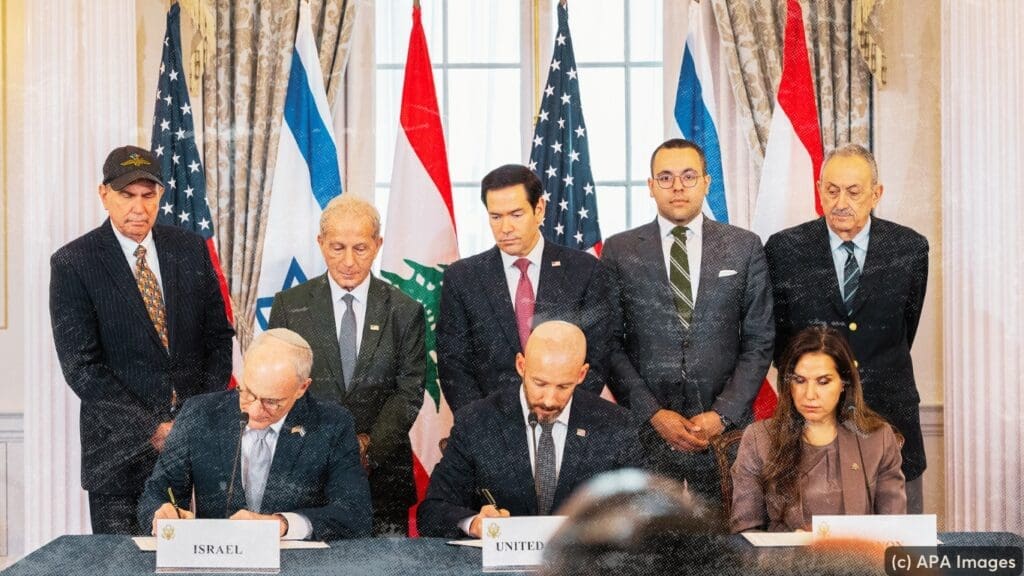
On November 17, 2025, the UN Security Council passed Resolution 2803, endorsing US President Donald Trump’s twenty-point plan for Gaza. The vote follows weeks of political pressure from Washington on Security Council members. The resolution ultimately passed with 13 votes in favor and two abstentions from Russia and China.
In addition to an overall endorsement of the plan, the resolution calls for the establishment of two supposedly transitional bodies to take control of Gaza. The first is the Board of Peace, a governing body tasked with overseeing aid delivery, reconstruction, and day-to-day administration. The second is the International Stabilization Force, mandated to take over security and disarm Hamas and other Palestinian political factions. Notably, the resolution does not refer to the genocide of the past two years, nor does it address accountability for it.
For many, this resolution reads as repackaged colonial control over the Palestinian people in Gaza, who have faced more than two years of genocide at the hands of the Israeli regime.
Joining me to discuss this resolution and its ramifications is Shahd Hammouri, legal scholar and Al-Shabaka member. Shahd, thank you for joining me on this episode of Rethinking Palestine.
Shahd Hammouri 2:08
Thank you for having me.
Yara Hawari 2:10
Shahd, perhaps you can give us an overview of the lead-up to this resolution. How did it come about? What’s the story behind it?
Shahd Hammouri 2:19
As you’re all very much aware, for the past two years, Israel has been conducting its genocide in Gaza, and the carnage led by the settler colonial entity was never-ending. And the horizon of a political solution really was completely faded out by both the US and Israel. All efforts in order to take third-state obligations forward were repeatedly blocked, and most importantly by the United States.
Attempts to use the Security Council for this, as we all know, were repeatedly vetoed by the United States. The International Court of Justice accepted delay tactics by Israel and the US when judging on its case. The case is still going to be heard almost mid-next year, which is far too late, far too lacking in diligence and care for the need for justice.
So we were particularly stuck in the sense that every day we had this never-ending carnage. And despite all the movement in the world, we were able to stop just a little bit of the arms flow, a little bit of the energy flow, but really it was on full speed. So at that moment, we were looking very hopefully towards coalitions like the Hague Group that sought to enshrine their obligations under international law, and Global South states that were not complicit in the genocide. So these were states that the Palestinian people were able to trust to act in solidarity with them, because they were states that on one level or the other were trying not to be affiliated with the supply chain of genocide, even though some of them did have on some level or the other some ties.
So building on that, and after the Bogotá meeting in July, there was a movement towards taking advantage of the UN General Assembly meeting in order to push for a Uniting for Peace resolution. And that had anticipated that the UN Security Council would fail once again to call for a ceasefire, and there we would be able to leverage the General Assembly for ourselves.
However, the sad thing there is that after Colombia had a draft resolution calling for a stabilization force — yes, but that stabilization force would have been manned by friendly states, states that bear good faith and would engage with the United Nations. This wasn’t an ideal solution, but in supporting that plan, we hoped to circumvent what had happened now.
So halfway through work for this, and almost a few days before Colombia was seeking to table its resolution, Trump announced his twenty-point plan. As most likely we’ll be discussing going forward, that plan is normalizing the illegal in its entirety. And then other states who wanted to work with the US on this plan had noted that they would only accept it if it has a UN mandate. So the US sought to do what it did with Iraq, what it did with Kosovo, which is seeking a UN mandate in order to normalize its illegal action and its imperial hopes and dreams in the region.
So suddenly we heard of this draft resolution going around in the Security Council. And we knew that Algeria was pushing for amendments. And according to diplomatic circles that we engaged with during this period, people who have been working in the United Nations for over 30 years report that they’ve never in their whole careers seen this level of coercion used by the United States of America to ensure that a resolution goes ahead.
Indeed, the US was supported by Gulf states in the twenty-point plan. Also in the New York plan that was facilitated by European Union members, which is not very far off — it really lacked engagement with the Palestinians. The difference between the New York plan and what we ended up with was that the New York plan was much more trusting of the Palestinian Authority. This plan is much less so.
First, the Palestinian Authority rejected this plan because it undermined their position. However, the position of the Palestinian Authority changed quite a short while after. And before that happened, there were two attempts to modify this by Russia, who put forward a set of amendments. So we have multiple amended forms, and Russia put an alternative resolution that sought to evade the Board of Peace itself. So it was an attempt to seek a way whereby the US isn’t given full reign, and this would be more of a UN mandate. However, the US basically said it’s this or nothing. And if you remember in the news, they were basically threatening the states that if they don’t accept this, the genocide will be restarted again. So not only were they coercing the Palestinians, they were also coercing other allied states to say that you either accept this or not.
The fatal blow came when multiple states — including Turkey, Jordan, the UAE, Saudi Arabia, Indonesia, and if I remember correctly, Pakistan — came out with a statement saying that they fully support the UN Security Council resolution. And that was the moment when all the pieces fell apart. All attempts at that time to discuss with diplomats in informal channels, to try to sound the red alert for this resolution — everything suddenly was completely, absolutely blocked.
We had diplomats who were asking a lot of questions. Everyone we spoke to had noted how fearful they were, as well as their concern that this was going ahead. However, after that statement, shortly after, the Palestinian Authority said that they too support this resolution, only a few days after we saw it. And basically, the US put the resolution in: you either take it or you leave it. And if you leave it, not only will the Palestinians suffer, but also the other state that goes against this will suffer.
And that’s how we got where we are now — through a long game of coercive tactics, as well as — if you would like to call it — treason by other states whose whole populations would completely be against this if the people understood the legal technicalities underlying their state’s position.
Yara Hawari 8:50
And I think it’s not particularly surprising that certain states went along with this. But I do recognize that there must have been quite a massive amount of political pressure to get that kind of consensus at that kind of level. But what I find quite ironic about all of this is that the US has been seeking a UN mandate when it has consistently steamrolled over the international legal system, continuously for the last two years, including sanctioning the ICC. So why was it important for them to get that resolution? Could they not just move forward with the Trump plan regardless of resolutions from the UN or any kind of consensus from the international community?
Shahd Hammouri 9:34
Well, to start with, actually, this was the conditionality of the UAE as well as Saudi Arabia, who asked for a UN mandate to legitimize this. And there are multiple reasons why.
First of all, this makes it absolutely difficult to contest this in courts around the world, because there is a paper that says that the highest authority in the world has approved this. That’s the ultimate contradiction in the international legal system.
And so I also feel that this was also a way to evade what otherwise would be dissent by the local populations — to say that this is something that the UN has signed onto. And you will very clearly note the complicity of the media in this. Mainstream media has been insanely complicit. I myself have tried to publish about this multiple times. I have one op-ed that went through seven different channels of rejection that was kind of trying to call the red flag on this.
However, the moment we got the UN Security Council resolution, all of the mainstream media now want to talk. And I’m like, you know — and not only that, they talk and then they edit out my talk in ways whereby they don’t demonstrate the other points of contestation that I’m trying to speak about. So there is this kind of, let’s say, fake legitimacy that this piece of paper is giving.
And not only that — also the people of Gaza had this fake propaganda thrown down at them saying that this is the best solution for you, and that this is what’s going to bring prosperity for Gaza and investment. So it’s one way where we could think of the reason why they sought the Security Council resolution: to ensure that they have a way to respond to the masses and dilute the perception of the masses and make them feel that, “Oh, this is actually absolutely legitimate. You’re the ones who are contesting nothing. And perhaps you shouldn’t contest things you don’t understand,” by making it legally complex and sound legitimate and picking and choosing bits and pieces of what does this actually mean.
And the second thing I believe would be to guard them against more strategic things that we would have been able to use and tactical things that we would have been able to use had this plan gone forward without a UN mandate, because this limits our capacity to contest this in legal circles through advocacy as well as diplomatic circles, because everyone responds saying that.
I would also have to add that even though everyone was coerced — the Palestinians were coerced to accepting this — this piece of paper still says, on one level or the other, you consented to this. So it’s a good way to distort the whole thing all the way around.
Yara Hawari 12:25
If you’re enjoying this podcast, please visit our website, al-shabaka.org, where you’ll find more Palestinian policy analysis, and where you can join our mailing list and donate to support our work.
And it’s ironic that Trump’s plan now has this official endorsement from the UN because it actually violates international law in multiple ways. But perhaps we’ll go into that a bit later. I wanted to ask a bit more about the passing of the resolution itself. It passed with 13 votes in favor and two abstentions from Russia and China. Do you think there’s any significance to those abstentions?
Shahd Hammouri 13:03
Indeed. So first of all, Russia, as I noted before, had put forward an alternative resolution. So it wasn’t really in favor of this, nor was China. And my understanding is that both diplomats from China and Russia were trying to work against this. However, their position wasn’t that invested to lose political leverage in all of their other fights with the United States of America. Perhaps this wasn’t the hill that they wanted to die on or to escalate on, more or less.
And it’s indeed something that does signal to the Palestinian community that this is a strategic space that we haven’t been capable of leveraging. So when I first heard about this, my first question to diplomats was: do you believe that at any point the Russians or the Chinese would veto this? And they said, they don’t have enough interest to do this. And then the question is: how is it that we would have been able to make it more of an interest to them? And I think there are multiple ways that this could be useful in the future.
But indeed, from a geopolitical perspective, the US further entrenching its control in the Middle East is not good for either China or Russia, in the sense that they are trying to compete. However, China’s imperial policy is rather different and not that offensive. So this is not inherently in our favor. But if anything, this signals a future path of collaboration and focus for us.
As far as my understanding goes, we actually have very minimal engagement with the Chinese and the Russian authorities, who in this case were able to perhaps provide us a little bit of their leverage to protect us or give us alternatives. And historically, people who were struggling for their liberation did leverage when imperial powers had conflicts with each other to their benefit. And perhaps this is a lesson for us going forward. But sadly enough, yeah, we weren’t interesting enough for a veto.
Yara Hawari 15:05
Not interesting enough, but also perhaps it signals how much deference there is to the Trump administration globally.
Shahd Hammouri 15:14
Absolutely. And how much also a level of fear and coercive power. But at the same time, I believe that China and Russia are quite smart in their moves with the US, with the Trump administration so far. I just think there wasn’t enough profit. We’re not that profitable.
Yara Hawari 15:33
So the resolution obviously endorses Trump’s twenty-point peace plan, as we mentioned. Does it do anything else? Are there any deviations, anything particularly interesting in the text of the resolution?
Shahd Hammouri 15:47
It actually provides us with a much more extensive comprehension of the plan going forward. But only if you read the resolution hand in hand with the intelligence that we have had so far — you’ll be able to bring in the pieces of the puzzle.
So the first of which is this Board of Peace that we’ve heard about. So this Board of Peace will be there until the Palestinian Authority is deemed competent. According to Israeli officials, the level of competency that would be sought is, quote unquote, “the level of Sweden” by the Palestinian Authority. And this was one of the biggest things that actually Russia had rejected — this whole Board.
Yara Hawari 16:30
I don’t think anyone can achieve the level of competency that the Swedes have achieved.
Shahd Hammouri 16:38
Indeed. And also for them, you know, a “competent authority” is a subjugated authority and a submissive authority. Nothing more than that.
So it gives us — while it doesn’t give us any details to the construction of the Board — we now know that it will also be led by business leaders from the US, from the Gulf, as well as Palestinian “technocrats,” who are basically Palestinian businessmen. A lot of the names that have been thrown around are also people who are complicit in the genocide themselves and people who have profited off the pain of the Palestinian people.
The structure really reminds us of the Coalition Provisional Authority, which was established under UN Resolution 1483. Except in this context, rather than it being a declared official occupation of Gaza, this is a de facto occupation, because that’s the complete power that is being given here. And actually, this is on one level or the other worse than the powers given in Kosovo in 1999, because in Kosovo, the administrative body at least was UN-administered. And as we know, that was also the resolution that facilitated the NATO intervention in Kosovo, which was completely disastrous.
The power of this civil authority is more or less that of an interim government, and it will oversee humanitarian aid. And according to intelligence we have up until now, as we expect, they will be administering the aid again in a form that’s a weaponization of food. So they will get to decide who eats and who doesn’t, and there will be quite an expansive comprehension of who is “resistance.” Anyone who refuses this plan will be punished, and that will start with prohibition of getting food.
So also, so far we know that this will also be run by a very similar private military contractor. It would be run by GDC Solutions, I think — the same company that was running the Gaza Humanitarian Foundation. So with complete lack of transparency. Even some of the latest reports say that when you enter now this newly administered body, it’s a mix of people with very different understandings of what this is. One person in the room actually asked, “Who is Hamas?” And they were just shooting around ideas into how they will take this forward. So this is completely taken forward by this resolution.
Yara Hawari 19:20
And so there’s zero transparency. Zero. So there is no mechanism for any kind of accountability. The Board of Peace is not answerable to anyone. There’s no kind of oversight mechanism. The International Stabilization Force is in turn accountable to the Board of Peace. So really, this issue of transparency and accountability can lead to corruption on all levels, but just a deterioration of the situation on the ground for Palestinians.
And I think one of the bizarre things about this resolution is also how much it contradicts previous resolutions from the UN and rulings — countless — including the ICJ advisory opinion from October, which reaffirms UNRWA and other agencies as the agencies through which humanitarian aid should be delivered and coordinated through. And this resolution really completely steamrolls that.
And just on the point of the Palestinian Authority, this word “reform,” which has been the sort of condition for which the PA can take over Gaza, has been completely emptied of any kind of meaning. The reform of Palestinian leadership was once a popular demand from Palestinian civil society to challenge corruption and to end collaboration with Israeli security forces. And now that term has been completely emptied of any meaning. In fact, it doesn’t mean reform at all. It means capitulation. It means depoliticization. And it means, importantly, key figures in key positions — those figures that would be in complete deference to the US and to the Israeli regime.
Shahd Hammouri 21:06
Which is why, again, this brings back very sharp memories of Iraq and the de-Ba’athification — even though it’s not like we have something to undo, but basically the promise to sell Palestine in bits and pieces. And which is also why this brings back to mind Bremer’s orders — that we have a very wide set of orders that really sought to entrench dependency and corruption in the Iraqi state, in a way that we of course see very clearly now.
So which is why this is a de facto American occupation. And one other thing that this resolution brings is a direct reference to the World Bank and the IMF. So instead of paying the Palestinians reparations, what they are proposing is to drown Palestinians in debt, which is another form of subjugation and domination. Like in Latin American people’s tribunals, they have even called IMF loans to be a form of a crime against humanity due to the damage that they cause.
And this is also where we should be really worried about the natural resources in Gaza, because the Board of Peace has the authority as an international legal person to actually sell off Gaza’s land, Gaza’s resources, and to develop it as they wish, and to incur debt on the Palestinians as they go about “developing” it. So here we really should be fearful for Gaza’s gas resources, especially the untapped energy resources that UNCTAD — which is the UN Conference on Trade and Development — estimates that that’s billions of income that has been lost to the Palestinian people.
They would do to it what they did to the energy resources of Iraq. Sell them off for the highest bidder with zero income coming back to the Palestinian people. I promise you, tomorrow morning Chevron will be coming in — and they already have. Chevron’s already been in discussions around this gas, and Eni and BP as well.
So, and the worst thing is that, with that piece of paper, they will be selling it “in the name of the Palestinian people” due to a false economic presumption that free-market selling off your whole country to multinational corporations is good. And very little amount of Palestinians will benefit from this.
Like as Ghassan Kanafani tells us, when the horizon of the political solution is completely killed by Israel, what they do is that they open up a small window that fits only a small amount of Palestinians, and thereby they sow fragmentation because people will see. So, for example, they will indeed build malls or fancy buildings, but those will not be affordable to most Palestinians in Gaza, who will be living in ghettos away from the sea. And then the bits around the sea will be developed and sold to the highest bidder. And here we will expect that people from the Gulf would actually be buying that real estate. And little by little, this would facilitate foreigners — and maybe also Israelis, if the Palestinians are sedated enough.
So this plan in the UN Security Council doesn’t mention, of course, the reformation of the Palestinian curriculum, but the twenty-point plan, as well as the New York plan, does. So there is indeed that hostility.
And even though — and this is something that I always love reminding people, because people keep telling us a good Palestinian is a “peaceful” Palestinian — however, under international law, Israeli and American aggression are always unlawful. Meanwhile, Palestinian violence is a lawful act of resistance. So it’s like — if anyone has the right to use violence in this case, it’s the Palestinians. But nothing in this resolution actually seeks to apply the Hague Regulations, because according to the Hague Regulations, the people under occupation don’t owe a duty of allegiance to the occupying power.
What we expect here is mass incarceration and other Abu Ghraibs. Like, you know, these are the same minds. We have Tony Blair, like revived from the dead to come and give us the blessings of how to do that.
Yara Hawari 25:28
I mean, Tony Blair and his think tank, the Tony Blair Institute, have actually been working on so-called reconstruction plans and so-called day-after plans for quite some time — since probably the beginning of the genocide, in a very nefarious and very secretive way. So they have actually been key in some of those private discussions where Palestinians, of course, have not been involved.
So none of this is new. We have a lot of lessons that we can learn from our history — the financial domination, making sure that the Palestinian people are indebted, take on loans. I mean, that just reminds me of Fayyadism, the Salam Fayyad era. The weaponization of aid as well is something that has been continuously present throughout Palestinian history, including by international organizations and UN agencies.
So I think that there is a lot to learn, and sadly we’re going to see a lot of these power structures on steroids as this plan unfolds.
But Shahd, I wanted to ask you — and perhaps this is a bit of an obvious question — but what does the passing of this resolution say about international law and the UN as an institution? And specifically, in the case of Palestine, what does it say for our struggle moving forward?
Shahd Hammouri 26:55
So in international law, there is a battle, and it’s actually a battle that is as old as the creation of the international legal system itself. So once states started to gain their independence — previously colonized states — they called for the reimagination of this system. And for example, you had Judge Álvarez in the Anglo-Iranian case say that we need a different philosophy of international law that is premised on the idea that international peace and security is only going forward if we have equality and if we rethink our perception of the world through understanding interrelationships with each other.
On the other hand, you had this other philosophy of international law that is the mainstream one — that international peace and security is the status quo and upholding it as it is. And these two streams have been in conflict with each other for quite a long time.
And what I call the people’s international law was much more visible in the General Assembly, especially in the sixties and seventies, when we had the UN Declaration on Friendly Relations and the Declaration Ending Colonization and whatnot. And those perspectives — the Global South perspectives, as well as important Arab names like Georges Abi-Saab and Mohammed Bedjaoui — were very much convinced that this law is only useful if it’s just. And they really pushed the boundaries of this law. Georges Abi-Saab is the reason actually why we have an official recognition of the right to resist.
But what happened is, ever since the end of the Cold War, because it’s a unipolar world, it has become very difficult to use that platform and that space. Very institutionalized, very bureaucratic. And even those trying to contest it are civil society actors funded by the same actors that build us in.
So the UN Security Council, when it comes in with a resolution like this, that is in violation of the most basic principles of international law — right of return, reparation, self-determination — and the Stabilization Force indeed, to me, is a hostile occupying army.
And most importantly in this is that the notion of coercion, which is very important for states of the Global South ever since that era, is completely overlooked. And the idea that the Palestinian Authority didn’t say yes until it was coerced. And it’s not like the Palestinian Authority represents the Palestinian people. But nevertheless, all of these risks were taken away.
So this ultimate contradiction between the UN Security Council — where they are policing the world, and where international law and peace and security is whatever the needs of the status quo are, creating this parallel what we call “rules-based order” — in comparison to an actual logical law. So this move comes in really — it agitates that contradiction to its core and really puts us back to the paradigm of: while international law is not going to save Palestine, the question is whether or not Palestine will be the last straw that breaks the system apart.
With the Security Council — African states have been asking to be in the Security Council forever. There are so many movements to destroy the Security Council forever. And not only that, the fact that Palestinians were barred from going to the General Assembly while Israelis were completely allowed to go and roam free. All of that puts to the question of: why is the UN, which actually hardly has money now because the US cut most of its funding, still in the US? Why do I have to get these long visas to go to Geneva? Why can’t we just meet in Senegal and Kenya? And why can’t we talk to each other in a more logical way?
And hopefully, what people are hoping is that what is happening now — this destruction of the system — will lead to its rebirth. Sadly enough, again, with Russia and China not willing to help us, our hopes and dreams of that are not perhaps clear in the near future, but in the longer future. Indeed, the US is willing to take down international law and European states are also willing to take down international law, all for the sake of Israel.
Yara Hawari 31:12
Shahd, is there any way for this resolution to be reversed?
Shahd Hammouri 31:18
As an international lawyer, I could tell you — this is the highest power on earth. And again, that’s the ultimate contradiction in this law. So the only way to reverse it is through another UN Security Council resolution.
There was a question of whether or not we could take this to the International Court of Justice. That is a possibility. It hasn’t been tried. There is case law by the International Court of Justice that did actually say that if there is a contradiction between the Security Council resolutions and international law, that we can override it. However, that’s not consistent precedent.
There is also work by the International Law Commission that also states the same thing in relation to peremptory norms of international law. And this is a direct case of that contradiction. So the question of whether or not we could contest it — perhaps there are ways that we can strategically seek to do that. However, they are bureaucratic and very long and draining.
The other path is: if this path is completely catastrophic — which it will be — the people of Gaza are not going to accept this resolution. Attempts to displace them away from the sea into the ghettos will not be met. The Gazans are very much willing to stay on the rubble of their own homes. After they’ve lost — every single person in Gaza has lost at least two family members, and a good number of family members maimed and injured. So they’re very much not willing to move.
Of course, the sad thing is that what we understand is that the authority will also facilitate emigration and will deny those who emigrate their right to return, which is another very red flag about this.
But to reverse it — in reality, the main problem is, and this is why we were really trying to warn from this, because that will give the US and Israel the excuse to kill and maim much more people. However, if that happens, then the question is: will we go back to where we were, where we’re able to hone in or harness any alternative?
But this really means that in the meantime, as we see how things shape up, I think rather than getting ourselves lost in endless bureaucracy, the question is: how is it that we’ll be able to unify our voice and be able to override all of these limitations that were put on us in expressing our right to self-determination? And that’s the most important thing — finding out who our allies are and building our relationship with them. Because whatever the outcome is, once we are asked, “Okay, what do you want to do now?” — we need to have a viable answer. And in the past two years, we haven’t been capable of giving that viable, sustainable answer. Of course, under coercion, we are incapable of uniting our voices. But still, it’s very important that we now really think of that.
Yara Hawari 34:04
Shahd, thank you so much. We’ll end it there for this episode of Rethinking Palestine.
Shahd Hammouri
Thank you for having me.
Yara Hawari 34:13
Rethinking Palestine is brought to you by Al-Shabaka, the Palestinian Policy Network. Al-Shabaka is the only global independent Palestinian think tank whose mission is to produce critical policy analysis and collectively imagine a new policymaking paradigm for Palestine and Palestinians worldwide. For more information or to donate to support our work, visit al-shabaka.org. And importantly, don’t forget to subscribe to Rethinking Palestine wherever you listen to podcasts.
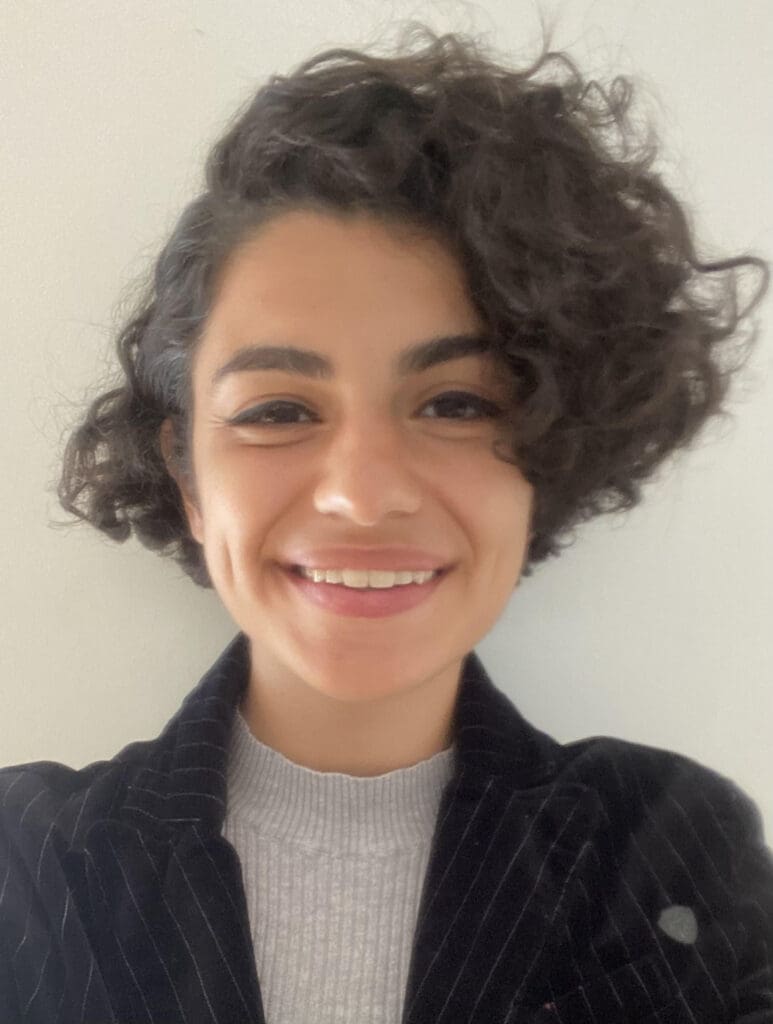
Shahd Hammouri is a lecturer in International Law and Legal Theory at the University of Kent and Senior Legal Consultant at Law for Palestine. She is the author of the forthcoming Corporate War Profiteering and International Law (Cambridge University Press, 2026). Shahid’s work examines public and international economic law from a critical and decolonial perspective. In 2023, she drafted submissions for the International Court of Justice on the legal consequences of the Israeli occupation of Palestinian territories. She holds a PhD in International Law from the University of Manchester.

Al-Shabaka: The Palestinian Policy Network is an independent, non-partisan, and non-profit organization whose mission is to convene a multidisciplinary, global network of Palestinian analysts to produce critical policy analysis and collectively imagine a new policymaking paradigm for Palestine and Palestinians worldwide.