



About This Episode
Episode Transcript
The transcript below has been lightly edited for brevity and clarity.
Diana Buttu 0:00
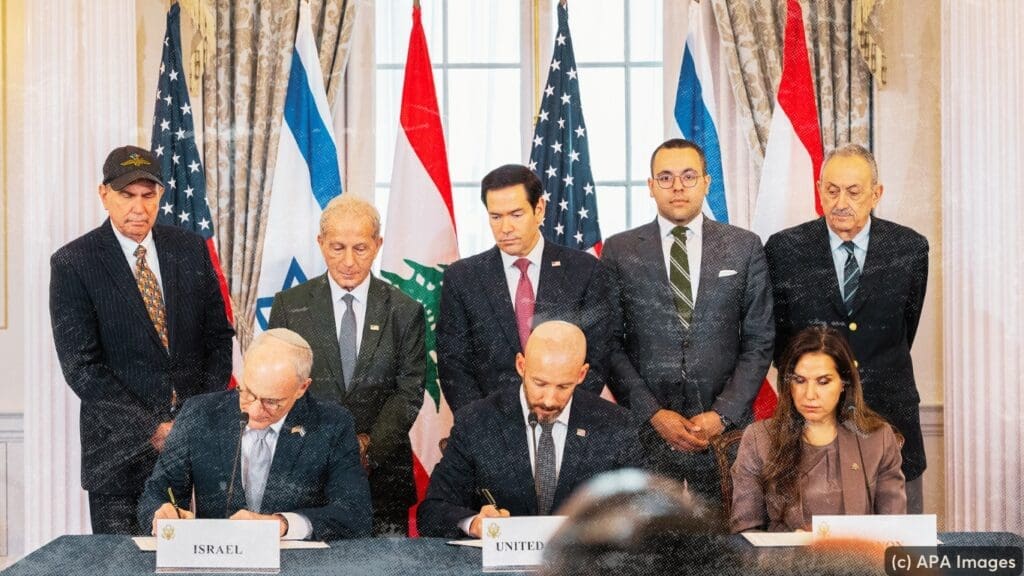
Before October of 2023, there was a real push within Israel to push forward this normalization project. And the normalization project was, in large part, to send the message to the Israeli public that they never really need to do anything with Palestinians, but instead they can have peace and they can have economic ties with the Arab world without ever ending the occupation, without ever getting rid of the colonial project, and of course without ever addressing Palestinian refugee rights and the right of return.
Adam Hanieh 0:38
What the United States is attempting to do is to reassert its primacy in places like the Middle East. And one way it sees of doing that is to bring together these two pillars under kind of a bigger American umbrella. And this is, in particular, in response to the rise of challenges like China and the centrality of the region’s energy supplies for China. China depends upon the Gulf states for about 60% of its oil and gas imports. And I think the bigger part of this American strategy is to push back against China’s connections and bigger influence in the region through this normalization project.
Yara Hawari 1:22
From Al-Shabaka, the Palestinian Policy Network, I am Yara Hawari, and this is Rethinking Palestine.
The consequences of the US-Israeli war on Iran and the ongoing genocide in Palestine are rippling across the entire Middle East, reshaping alliances, redrawing political boundaries, and exposing the fault lines of US imperial power in the region.
In this episode, we’re joined by Palestinian scholars Diana Buttu and Adam Hanieh to analyze what this moment reveals about the architecture of US empire, about the regional order being remade in real time, and about what it means for the Palestinian liberation struggle at the center of it all.
Diana and Adam, thanks for joining us on this episode of Rethinking Palestine.
Yara Hawari 2:17
So the Arab Gulf states and the Israeli regime have long been pillars of the US imperial project in the Middle East. How is this relationship changing today in light of the current regional war, the ongoing genocide in Gaza, and the shifting global dynamics?
Adam Hanieh 2:34
I think the first thing to say is, you’re absolutely right. It is a long-standing strategy. And I think what we’ve seen in the last two decades or so is an attempt by the United States to normalize the relationships between these two pillars — the Arab Gulf states and Israel. Normalize the political, economic, and diplomatic relationships between these two pillars. And this, I think, is something that clearly predates the genocide in Gaza and obviously the current war.
And I think understanding that trajectory of US strategy needs to be put in the context of the bigger geopolitics, the geopolitical moment that we’re living today. In particular, I think we can identify the relative decline of American power globally. In response to that, the United States is attempting to reassert its primacy in places like the Middle East. And one way it sees of doing that is to bring together these two pillars under kind of a bigger American umbrella.
And this is, in particular, I think, in response to the rise of challenges like China, and the centrality of the region’s energy supplies for China. China depends upon the Gulf states for about 60% of its oil and gas imports. And I think the bigger part of this American strategy is to push back against China’s connections and bigger influence in the region through this normalization project.
Diana Buttu 4:07
I can’t agree more with Adam. And so maybe I should turn to looking at it from the perspective of what Israel is trying to do, because I think that’s the perspective that really hasn’t been analyzed very much. And on that front, there’s two things.
The first is that, prior to October of 2023, there was a real push within Israel to push forward this normalization project. And the normalization project was in large part because they wanted to sideline Palestinians and instead send the message to the Israeli public that they never really need to do anything with Palestinians, but instead they can have peace and they can have economic ties with the Arab world without ever ending the occupation, without ever getting rid of the colonial project, and of course without ever addressing Palestinian refugee rights and the right of return.
And so that was something that existed before October of 2023. In the aftermath of October of 2023, the Israeli public just, quite frankly, didn’t care for normalization. It wasn’t something that was top of agenda, and it’s still not something that is top of agenda. And so instead, Netanyahu turned his sights on how to weaken the Arab states and how to weaken the impact and the economic effect of these states.
And so that’s why, in large part, as we’ve seen over the course of the past few months with this war — a war that was pushed forward by Israel — one of their goals has been to drive a rift between these Arab states. And there has been a rift, as well as to try to weaken them economically, with the attempt being that Israel becomes the regional power and that the issue is no longer one of normalization but instead of these countries being forced to deal with Israel. Because the only way that they can get to the United States is through Israel.
And so we’ve seen that this shift has happened over the course of the past few months. But it’s in part because of the shift that Israel has been putting forward over the course of the past few years as well.
Yara Hawari 6:47
Diana, sticking with you, it feels like we are seeing a weakening of US dominance and a reconfiguration of how it operates through regional allies. Do you think this is the case?
Diana Buttu 6:55
I do. And I think that there’s a few things that are happening now. The first is that we’re seeing that within the Gulf — and again, I’m no expert on this, but just from the things that I’m seeing and hearing — we’re seeing that there are now different camps that are emerging.
Some actors are saying, “Why is it that we’ve invested so heavily in the United States, given that the United States was unable to protect them?” Similarly, when it came to the Emirates investing not only in the United States but also these agreements with Israel, and in neither case was the United States nor Israel able to assist them. And then others who are doubling down and saying that this is going to be the only way to move forward — is to double down.
So there is a split, but what’s interesting in this split is that it’s no longer the case of one blanket policy that seemed to be the policy of the past. Where we end up remains to be seen, because as of the time that we’re recording right now, there are threats of the United States and Israel resuming their attacks on Iran, but it hasn’t yet happened. And so I think it remains to be seen.
Yara Hawari 8:12
Adam, you mentioned China. What do you think they’re doing amidst this weakening of US dominance in the region?
Adam Hanieh 8:20
I certainly think that China does recognize, number one, the significance of the region for those factors I mentioned earlier — in particular the energy dependence that China has. China imports about a quarter of the world’s crude oil imports — one in four barrels. And the largest source is from the Middle East region, in particular the Gulf states.
There’s that dynamic. There’s also the dynamic of the link between the oil trade and US dollar dominance globally, which I think is also an important factor in terms of the ability of the United States to place sanctions on states and companies in China and elsewhere. So for these reasons, I do think China recognizes — and it’s not a new factor, I think this is something that’s been a long-standing consideration of China.
And we can see actually in the last few years, China has made a determined effort to build up its stockpile of oil. And so the current war hasn’t impacted it that directly because of this stockpile, and also to diversify energy imports away from the region and to partners such as Russia. And as we are speaking today, there are intensive discussions between China and Russia about new gas pipeline projects linking the two states.
So I do think China is very aware of these dynamics. But I think there is perhaps a debate within China itself about the ability of — or what China should do in this context — to take more of an active role in the Middle East, or to essentially let the United States fail in the context of this weakening US dominance. And I think that question is still open.
I do think it is very difficult to envision China playing the same kind of security role that the United States plays in the region. It doesn’t have the kind of network of military bases and military projection that the US does. So that, I think, is certainly a consideration in terms of the Chinese perspective towards the region.
But we can see questions like the Belt and Road Initiative and a key node of that being the Gulf states. We can see, for instance, that 60% of China’s trade with Europe and Africa passes through Dubai. And so there’s a logistics importance to the region also in China’s bigger global trade projection.
So for all of these reasons, I do think that Chinese policymakers are very cognizant of what is happening in the region and the future of American power in the Middle East.
Yara Hawari 10:46
Do you think that the current moment signals a shift away from fossil fuel-dominated global economic architecture and towards a renewable-centered economy, increasingly led by China?
Adam Hanieh 11:01
My opinion on this is, unfortunately, no. We are not moving away from a world that is centered on fossil fuels. And if you look at total energy production globally, last year was actually the record level of fossil fuel production globally — of oil, coal, and gas, each of those three major fossil fuels. So obviously renewables did increase as well, but it’s a larger absolute production of all these both fossil and non-fossil fuel sources of energy.
And this is true generally, historically — that we’re not seeing a move. This kind of energy transition is not a move away from fossil fuels. It’s an additive process where renewable energies are being added upon a fossil fuel base. And that’s true, I think — it’s definitely true at a global level, and I think arguably it’s even true in the case of China, that we see certainly a massive increase in renewable capacity in China, but up until now that hasn’t meant an absolute decrease in oil and gas consumption.
And interestingly, that is the case also in the Gulf. The Gulf monarchies, which if you look at it at a regional perspective, are really leading the introduction of renewable capacity in the Middle East — solar and wind and also battery storage. But this is not because they’re moving away from oil and gas production. Actually, projections are to increase oil and gas production. Rather, what this increase in renewables in the Gulf is designed to do is to lessen the domestic consumption of oil and gas — which is primarily how electricity is produced in the Gulf — and thereby freeing up more oil and gas for export. And this is explicitly stated by the Saudi oil minister and others.
So again, it’s about actually enabling the growth in fossil fuel production — this expansion of renewables in the Gulf. So unfortunately, even though the war really does demonstrate why the move away from fossil fuels is so imperative, and it’s not simply a question of the climate, it’s also for all the reasons that we’ve spoken about — but unfortunately, I think we’re seeing the opposite. And in fact, countries doubling down on energy security, loosening regulations on oil and gas production, and really hunkering down in terms of domestic policies around these. So unfortunately, I don’t think that we’re seeing a real green transition at the current moment.
Yara Hawari 13:32
If you’re enjoying this podcast, please visit our website, al-shabaka.org, where you’ll find more Palestinian policy analysis, and where you can join our mailing list and donate to support our work.
So in light of all of this, can we say that the US is ceding global leadership to China? And if so, what are the implications for the Palestinian struggle? And maybe a follow-up question: would such a shift create more favorable conditions for Palestinians, or simply reproduce existing politics?
Adam Hanieh 14:04
Well, I think what we are seeing is the relative weakening of American power globally. I still think that the United States remains dominant — certainly militarily, that’s the case, and also financially. The power of the US dollar is still dominant, and that comes with a lot of benefits for the United States because it enables them to be able to place sanctions on other countries around the world because everyone depends upon the US dollar. So those two levels in particular — the military and financial — US dominance, I think, is still present despite a relative decline in its global ranking or its global power.
So I think to come back to that question you raised earlier about what does this mean for the region: it means that the United States is seeing its energy dominance as another mechanism through which to reassert its global power — or to push back against this relative decline. And that, I think, is why the fossil fuel sector is such a prominent part of the Trump administration’s policies. We can see it in the case of Venezuela. Also, very similarly to what is going on in Iran and the kind of expansion of oil and gas projects in the United States. The way in which the US has really moved now to become a major exporter of LNG to Europe in the wake of Russia’s invasion of Ukraine.
So in all these ways, I think the United States sees fossil fuel dominance as another quiver in its bow, if you like, to push back against this relative decline.
Diana Buttu 15:36
It’s hard to say when it comes to China, or at least maybe I don’t have the answers. And the reason that, for me, it’s hard to say is because China has taken the position that, of course, it’s opposed to the occupation and that it believes in the two-state solution along the same lines as so many of the other countries. But like so many other countries, it hasn’t really ever gotten involved in Palestine — with one minor, or one maybe major, exception, major-minor depending on how you view it, which is that it hosted the reconciliation talks during the period of the genocide.
And the reason that they hosted those talks was because they were hoping that there was going to be some form of reconciliation so that at least there would be a unified strategy to then be able to confront Israel. That being said, that’s where it ends. And in all of my conversations with people from China, their view has always been that China’s position is that they’re very supportive of Palestine, but that’s where it ends. That their foreign policy is not about interfering. It’s not about doing anything beyond that.
So it’s hard for me to say. They certainly have taken the position that they are anti-occupation, that they believe in Palestinian freedom along the form of the two-state solution — I have to add. That’s, of course, different from the US, who has never taken the position that Palestinians should be free. But beyond that, it seems to be no different from many of the other countries. So I really don’t have an answer beyond that.
Yara Hawari 17:19
And Adam, what about normalization? Diana mentioned the fact that the Israeli regime is not only interested in normalizing diplomatic and trade relations, but also about causing serious rifts between different regimes. What is the fate of the normalization project in this current regional crisis?
Adam Hanieh 17:37
In some ways, I think it’s perhaps too early to make a judgment on this. I do think it’s clear over the last weeks that the UAE in particular is deepening its relationship with Israel and with the United States and the kind of — as Diana put it — doubling down on the normalization project. I think that’s the case.
And we can see this with the various stories that have been coming out about Israel supplying weapons systems to the UAE during the current war, and the speculation in the Israeli press about the visit of Netanyahu to the UAE a few weeks ago. So I think at that level, and certainly in the case of the UAE, that normalization is deepening.
However, I wouldn’t be surprised that there would be debates within the UAE political elites around whether this is the correct strategy to follow. And I do think in the case of Saudi Arabia, it’s more complicated, and it partly reflects that rift that Diana spoke about between the UAE and Saudi Arabia — whether Saudi will follow the same path as the UAE. But I do think partly it will depend on the character of any kind of resolution of the war, what happens with this normalization project.
Yara Hawari 18:51
Diana, just sticking with the theme of normalization — what is the conversation that’s happening within Israel on normalization? Does the Israeli public even care?
Diana Buttu 19:04
Nope. Not at all. It’s really interesting when you look at what the Israelis say that they want and then what their behavior is. So, for example, they’ve always said that they want peace, but they’ve never had any sort of warm peace with Egypt, and yet they’ve had an agreement with them since 1979. They’ve certainly never had any warm peace with Jordan, and they’ve had an agreement with them since 1994. They were never at war with the United Arab Emirates. And you certainly see Israelis traveling to the United Arab Emirates, but you don’t see people from the Emirates traveling in the other direction.
And since October of 2023, all of that discussion has completely fallen off the table. In fact, I’d be surprised if Israelis could name five Arab countries other than the three that I’ve just listed. And it’s because Israel views itself as an island. They don’t bother to learn to speak Arabic. And because it’s a colony, they view themselves as European. It is a colony, and they don’t want to be part of the region — nor should they.
And so for this reason, and since October 2023, for Israel the world became divided into two: those who are genocide supporters and those who are not. Which is very much the case when it comes to Palestinians as well — those who are genocide supporters versus those who are not. And so for them, they don’t care about normalization any longer.
Instead, what Netanyahu, what his government — and not just Netanyahu and his government, but the polls are showing this — what they’re looking for is regional dominance. And not just regional dominance in the way that we’ve seen before, in terms of arms and in terms of political dominance in the way that we saw with their relationship with the United States, but a much greater regional dominance. So that their idea of regional dominance means that there really can be no other power that is in the region — so that any economic power that the Gulf states may have becomes completely weakened.
And this is why we saw Netanyahu didn’t even think twice when he bombed Qatar on September 9, 2025, and there were no repercussions for it. And why he continues to push for the bombing of Iran and is quite frankly happy with the repercussions of that. It doesn’t matter to him that Israel is being bombed in turn, because for him the bigger picture is one of being able to take more land — whether that’s in Lebanon, Syria, Gaza — as well as to try to bring down that economic superiority within the Arab states.
So Israelis don’t care about normalization. They never really have. They claim that they want to have peace, but they really don’t want it.
Yara Hawari 22:21
So on UAE-Israel relations — in late April, we heard the surprising announcement that the UAE was going to leave OPEC. Adam, do you think this signals a consolidation of its alliance with the Israeli regime, or is it something else?
Adam Hanieh 22:38
I think there are various factors involved in the UAE withdrawal from OPEC. I think firstly, we need to understand OPEC — its primary role has been to moderate the supply of oil onto the world market. And in the current context where the price of oil is very high and is likely to remain high for the foreseeable months, the UAE is seeking to basically lift any shackles on its ability to produce and export oil. And I think that’s part of the calculation there. And in this way, it does reflect, I think, some of these tensions that exist between the UAE and Saudi Arabia, because Saudi Arabia is the dominant force within OPEC.
Another factor within this, I think, is the more diversified structure of the UAE economy in recent years. Oil obviously remains absolutely central, but if you look at the place of other sectors like logistics — that I mentioned earlier — through the port networks in Dubai and Abu Dhabi, as well as sectors like AI, IT, data centers, and even renewable energy, which has grown significantly in the UAE, the oil is playing less of a role in the UAE economy than it did previously. So I think that’s part of the calculation of the UAE.
But I do think behind all of this, there is a desire to strengthen those ties with Israel through the normalization project that you mentioned, and that was really building upon the Abraham Accords as well.
Yara Hawari 24:12
Now, all of this has created a global economic shock. And I think that was something that was long predicted by experts. What does this mean for the most vulnerable, particularly in the Global South?
Adam Hanieh 24:25
Yeah, I think this is actually a critical question that hasn’t received adequate acknowledgment. And it goes far beyond simply the oil price rise and energy price rises that we’ve seen in recent months. Obviously, that’s key for oil-importing and dependent countries in the Global South.
But there are other aspects to this as well. And I think one of the key things that’s happened in recent years in the Gulf Arab states is the way that these economies have diversified beyond simply the export of crude oil and gas. They have become major exporters of key chemicals, as well as fertilizers and other kinds of petrochemicals. So about a third of the world’s fertilizers are transported now through the Strait of Hormuz. And there are other chemicals like helium, like sulfur, which is a major export product. And the impact of both the price rises of these key chemicals, as well as the potential for actually supply shocks, means that countries in the Global South that depend upon fertilizer imports, for instance, or food imports, really are facing, I think, the potential of shocks to the food system itself.
So I was recently in Thailand and I met with a rice exporter in Thailand. Thailand is a major exporter of rice to Southeast Asia. And he told me that there are real fears in Thailand about the impact of the war on Thailand’s rice exports. Partly because the cost of gas is increasing and that affects the price of machinery and irrigation and so forth and shipping rice around. Secondly, there’s the problem of fertilizer costs also going up. And thirdly, there’s the cost of plastics, which are also supplied predominantly from the Gulf region, and they are worried about the ability to actually bag the rice, because those bags are produced from plastic petrochemical products.
So for all of these reasons, there are real considerations about the planting season that’s beginning in Thailand. And this obviously will impact not just Thailand but other countries in Southeast Asia that depend so heavily on rice exports from that country. So that’s one instance.
The other thing that I think we need to consider here is that many of the countries that import heavily from the Gulf region are also countries that are reeling from other forms of crises prior to the war. So Sudan, for instance — there’s been a three-year civil war in Sudan. Some of the major actors in that civil war, of course, are the UAE and Saudi Arabia on opposite sides. But Sudan depends very heavily on the Gulf for its fertilizer imports. And it’s a country that is also one of the sites of one of the largest forced displacements in the world and already suffering food insecurity prior to the war itself.
So these potential shocks that we see emanating from the Gulf are really amplified through these other pre-existing crises — in places like Sudan, in Yemen, and today in Lebanon as well is another example. So I think in all of these ways, countries in the Global South are going to be very deeply impacted, much more than the UK where I am or places in Europe and elsewhere.
Yara Hawari 27:49
Adam, I’m wondering if that is also coming with political consciousness — that US and Israeli imperialism comes at a cost not just to the Palestinians, but also to ordinary working people around the world.
Adam Hanieh 28:02
I think that’s the case. And I do think, looking at places like Sudan, Yemen, South Asia that are very vulnerable to these kinds of dependencies — we need to go beyond simply looking at the region as the giant oil spigot, if you like. It also is deeply embedded in all these other supply chains. And that’s why the US-Israeli war against Iran — and against Lebanon, which we shouldn’t forget here as well — really does reverberate very deeply across countries in the Global South.
Yara Hawari 28:30
So how is all of this affecting the struggle for Palestinian liberation? It’s a big question, I know.
Diana Buttu 28:38
It doesn’t take much to get the world not to focus on Palestine. It’s that issue that people want to turn their eyes away from. And the genocide forced people to look at Palestine because it was genocide. And because there were tens of thousands of children being shredded, being slaughtered — close to 100,000 people that we know of that have been killed, entire cities wiped off the map. And so that forced the world to look at Palestine, forced them to look at Gaza.
But there was so much that they didn’t look at. Everything from what the Israelis are doing in the West Bank and what they continue to do in the West Bank, what the Israelis are doing in Jerusalem, what they’re doing inside ’48, what they’re doing inside Lebanon, which we mentioned.
And so now with this war, it’s so easy for the world to go back to — and I hate using this term, but this is the term — business as usual. And that business as usual means to ignore Palestine once again. Because to not ignore Palestine means to confront Israel. And all of these countries do not want to confront Israel. And by all these countries, the countries that have been empowering Israel for all of these decades — primarily the United States, Canada, Western Europe — these are countries that simply don’t want to confront Israel.
So now, with the war, with everything that’s happening in the greater region, we’re back to a situation where nobody’s again focused on Gaza. Since the ceasefire began in October of 2025, Israel has killed 887 Palestinians and injured over 1,700. Each and every day, Israel is bombing Gaza. They’re bombing tents. And yet very few people are speaking up about this — and very few international actors, allow me to say, are speaking up about this.
And as the US president — not that I believe that the US president is going to lead to Palestinian liberation, but with so much faith that has been put into him by all of these international actors — it doesn’t take much for Donald Trump to be distracted. And now, with his war of choice and with Netanyahu’s, again, war of choice, that attention is now being pushed onto Iran, which is precisely what Netanyahu wanted.
So we haven’t seen any reconstruction equipment get into Gaza. We haven’t seen food get into Gaza. All that we’ve seen is that Israel has gone deeper into Gaza. In fact, Netanyahu was just bragging the other day that he’s now into 60% of Gaza, and that soon he’s going to take over the rest.
So it’s a long way of saying that what’s happened is that people have once again abandoned Palestinians and they’re turning their attention to something else. And this was entirely predictable. We knew that this was what Netanyahu wanted. We knew that this is what he was going to do. And sadly, everybody fell in lockstep to what it is that he wanted.
Yara Hawari 32:12
Adam, how do you think this regional crisis is affecting the struggle for Palestinian liberation?
Adam Hanieh 32:20
Yeah, I very much agree with Diana’s comments here. And I also think what this moment really illustrates is the ways in which these apparent moments of — I don’t want to say peace, but apparent moments of ceasefire and a lessening of direct hostilities — actually always serve historically as moments when Israel’s colonization accelerates. And I think that’s what we’re seeing at this moment.
Gaza has absolutely fallen off the pages of the world’s media and the world’s attention. But as Diana has pointed out, it hasn’t meant that the Israeli project hasn’t continued to move forward. And I really think that we need to reflect on this, because I think too often the attention of the world just focuses on Palestine at these moments of extreme violence and doesn’t consider the ways in which this is an ongoing project that also operates at other moments when the bombs are not falling. And I think that’s a lesson that is evident from the last three decades.
And again, I want to highlight the case of Lebanon here as well, because Lebanon similarly, I think, really hasn’t received the attention that’s needed in the mainstream media, which has tended to focus much more on what’s going on in the Gulf. And it’s a quarter of Lebanon’s population that’s been displaced as a result of Israel’s bombardment. I live in London, and that’s the equivalent proportionally of twice the population of London, which is absolutely horrific when you think of the scale of human displacement that involves. Not to mention the thousands of people that have been killed, and the fact that Israel is now clearly attempting to occupy a zone in Lebanon, in the south of Lebanon — as they have in Gaza, as they have in Syria.
So there is this kind of expansion of territory that we’ve seen really taking place at these moments where the attention of the world is not on this ongoing colonization.
Yara Hawari 34:10
Diana and Adam, thank you so much for joining me on this episode of Rethinking Palestine.
Yara Hawari 34:19
Rethinking Palestine is brought to you by Al-Shabaka, the Palestinian Policy Network. Al-Shabaka is the only global independent Palestinian think tank whose mission is to produce critical policy analysis and collectively imagine a new policymaking paradigm for Palestine and Palestinians worldwide. For more information or to donate to support our work, visit al-shabaka.org. And importantly, don’t forget to subscribe to Rethinking Palestine wherever you listen to podcasts.

Diana Buttu is a lawyer who previously served as a legal advisor to the Palestinian negotiating team and was part of the team that assisted in the successful litigation of the Wall before the International Court of Justice. She frequently comments on Palestine for international news media outlets such as CNN and BBC; is a political analyst for Al Jazeera International and is a regular contributor to The Middle East magazine. She maintains a law practice in Palestine, focusing on international human rights law.

Al-Shabaka: The Palestinian Policy Network is an independent, non-partisan, and non-profit organization whose mission is to convene a multidisciplinary, global network of Palestinian analysts to produce critical policy analysis and collectively imagine a new policymaking paradigm for Palestine and Palestinians worldwide.