

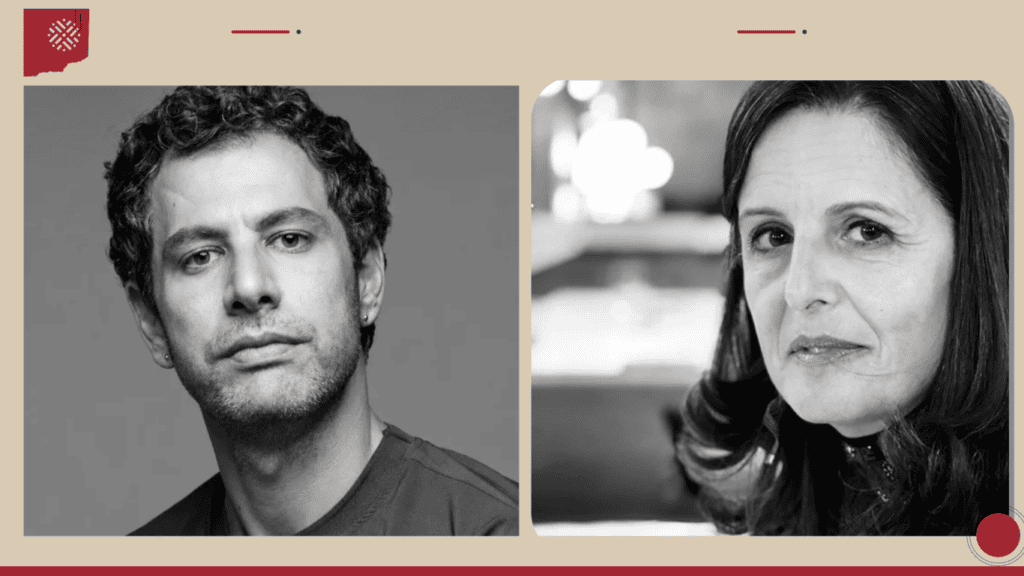
Al-Shabaka: The Palestinian Policy Network is pleased to announce that Leila Farsakh will become president of its board of directors this month, succeeding Tareq Baconi, who has served as board president for the past five years. Tareq will continue with Al-Shabaka as a member of its policy network.
Tareq’s term on the board spanned some of the most consequential years for Palestine in generations. As the genocide in Gaza unfolded, his work shaped how many came to understand it. Through his writings and public engagement, Tareq situated the violence within Israel’s long-standing system of partition and apartheid, warned early of a new Nakba, and insisted that Israel’s impunity rests on Western backing and can therefore be ended. Under his leadership, Al-Shabaka held its ground as a space for rigorous, uncompromising Palestinian thought when it was needed most. His path through the organization, from US Policy Fellow in 2016 to board member, board president, and now as a continuing member of Al-Shabaka’s policy network, reflects our commitment to growing Palestinian leadership from within.
Reflecting on his time with Al-Shabaka, Tareq shared: “It has been an honor and an absolute pleasure to serve Al-Shabaka. I have the greatest admiration for the team and am very proud of its extensive policy network, which brings together some of the most committed and accomplished Palestinian thinkers and practitioners. It offers a model for Palestinian knowledge production that is committed to decolonization and emancipation.”
Leila, a member of Al-Shabaka’s policy network since its launch in 2010, is a Palestinian political economist and professor of political science at the University of Massachusetts Boston. She has spent her career analyzing the power structures that shape Palestinian life. Her book Rethinking Statehood in Palestine: Self-Determination and Decolonization Beyond Partition (2021) challenges the partition paradigm that has long governed thinking about Palestine and asks what self-determination could look like beyond it. Since October 7, 2023, this question has only grown more urgent. She is also the author of Palestinian Labor Migration to Israel: Labour, Land and Occupation (2005) and co-editor of The Arab and Jewish Questions: Geographies of Engagement in Palestine and Beyond (2020). Her writing has appeared in the London Review of Books, Boston Review, and Le Monde Diplomatique, as well as in Al-Shabaka.
On joining the board, Leila remarked: “What draws me to Al-Shabaka is its mission and its vibrancy. It is the first global independent Palestinian think tank, led by a new generation committed to producing knowledge that challenges discourses undermining Palestinian rights and fragmenting the unity of the Palestinian people, land, and struggle for liberation. At this transformative juncture in our history, marked by Israel’s ongoing genocide in Gaza and ethnic cleansing in the West Bank, Al-Shabaka’s voice and policy analysis are particularly vital. I am honored and humbled to become the new president of the board and to work with its brilliant team.”
This transition comes as Al-Shabaka completes a strategic planning process that asks what role Palestinian policy analysis plays in a world transformed by the genocide in Gaza. Drawing on the insights of our policy network and civil society partners, the plan charts our direction for the years ahead and how our network can best serve the struggle for Palestinian liberation. We look forward to sharing that vision with our community in early 2027.
We enter this next chapter as leadership passes among members who have shaped this network together—a testament to the depth of our community. Please join us in thanking Tareq for his years of service and in welcoming Leila to her new role.

Al-Shabaka: The Palestinian Policy Network is an independent, non-partisan, and non-profit organization whose mission is to convene a multidisciplinary, global network of Palestinian analysts to produce critical policy analysis and collectively imagine a new policymaking paradigm for Palestine and Palestinians worldwide.