





About This Episode
Episode Transcript
tThe transcript below has been lightly edited for brevity and clarity.
Hamza Hamouchene 0:00
The dehumanizing and deadly forces of capital and empire are really bent on destroying hope and killing the idea of resistance. We cannot fall in the webs of defeatism. We need to nurture the idea of hope, to find it by drawing linkages across history and geographies. And by doing so, you would realize that not only that a better world is possible, but some parts of it are already present in the histories and practices of solidarity, struggle, care that continue to be remembered, enacted, and lived.
Yara Hawari 0:46
From Al-Shabaka: the Palestinian Policy Network, I am Yara Hawari, and this is Rethinking Palestine.
In this episode of Rethinking Palestine, I am delighted to welcome the co-editors of a new edited volume that reaffirms the Palestinian struggle as an intersectional and transnational anti-colonial struggle: Towards Palestinian Liberation: Global Perspectives on Anti-Colonial Resistance and Solidarity, published by Daraja Press.
The co-editors are Hamza Hamouchene, a London-based Algerian researcher, activist, commentator, and a founding member of Algeria Solidarity Campaign, Environmental Justice North Africa, and the North African Food Sovereignty Network. Hamza is currently the Arab region program coordinator at the Transnational Institute, TNI.
And Abi Bae. Abi is a Korean researcher and activist currently working at the Transnational Institute on trade, justice, and extractivism issues in Asia. Thank you to both of you for joining me to discuss your new book on Rethinking Palestine.
Hamza Hamouchene 1:58
Thanks, Yara, for having us. We are delighted to be in Al-Shabaka’s Rethinking Palestine podcast.
Yara Hawari 2:08
Hamza, let’s start with you. The introduction of the book insists on a longue durée view of Palestine rather than treating events like the, the genocide in Gaza as an isolated moment. Why was that framing so important to get right, and what do you think gets lost when people cover Palestine only event by event?
Hamza Hamouchene 2:28
What we try to do in this book is to convey the complexity of liberation struggles and to emphasize the need to view them as protracted struggles against systems of domination, oppression, and exploitation. And within these struggles, there is always a potential for victory. But victories are not easy, as the Bissau-Guinean leader Amílcar Cabral said at some point, “Victories are not guaranteed. Things can become much worse before they turn to the better.”
But then why do we need to view events and dynamics and phenomena in the longue durée perspective? Because viewing such dynamics as only limited in a given time and in a given space may provide a skewed picture and a distorted analysis. So we feel that it’s really important to view such dynamics, however horrible they are, in the longue durée as an accumulation of experiences, lessons, and contradictions that may culminate in overthrowing systems of domination when the right conditions align at the national, regional, and international levels.
And we feel that the long struggle for Palestinian liberation is no exception to these observations. And honestly, we’re not saying anything new. We just wanted to emphasize that fact during the genocidal times. But then why do we need to avoid seeing things as event by event? Because if we do that, we fall into the misconceptions or the false narratives of the history started in 7th of October 2023.
You forget about the broader and wider political context of more than a century of colonialism, including British colonialism, Zionist encroachment, settler colonialism, occupation, and apartheid. And you wouldn’t understand why Palestinians keep their resistance, why they keep fighting for their liberation, and you don’t understand why 7th of October happened in the first place.
And it’s really important to see things within that broader context, which tends to be very, very long context in certain junctures.
Yara Hawari 4:56
Hamza, as you noted, this project started in the middle of the ongoing genocide in Gaza. What made you feel that a book was the right intervention at this specific moment in the Palestinian struggle?
Hamza Hamouchene 5:11
In fact, Yara, this did not start as a book per se. It started as a collective online dossier. It started with conversations between scholars and activists from various parts of the world and from every continent. And it’s truly a collective, I would say, transnational effort to bring about radical analysis and to center the Palestinian cause within the liberation of the Global South and the liberation of the humanity.
So we brought together a collection of scholars from the Americas, from Africa, from Asia, from Europe, to be in dialogue with each other. And then it turned into a book in order to reach a wider audience. And then when we started doing that project, Abi and myself, in the first few months of the genocide, early 2024, we remembered the words of the late Edward Said when he said that Palestine is the cruelest and most difficult cause to uphold, not because it is unjust, but because it is just and yet dangerous to speak about. And we thought that despite the dangers, despite the censorship, despite the repression and suppression, that we needed to continue talking about Palestine as concretely and honestly as possible.
And actually, the guiding compass of that project is thinking collectively in times of catastrophe to make sense of what is taking place in order to overcome those forms of dominations and oppression. But at the same time, we also wanted to instill a note of hope through also the longue durée perspective, a note of hope and what we call the optimism of the will in the Gramscian sense, even when we realize that this is in constant tension with feelings of despair, powerlessness, and pessimism of the intellect.
Because the dehumanizing and deadly forces of capital and empire are really bent on destroying hope and killing the idea of resistance. And we felt that we cannot fall in the webs of defeatism. We need to nurture the idea of hope, to find it by drawing linkages across history and geographies. And by doing so, you would realize that not only that a better world is possible, but some parts of it are already present in the histories and practices of solidarity, struggle, care that continue to be remembered, enacted, and lived.
And we want to bring these practices and histories to the fore and to foster them. How do we do that? Through the book and its ideas is by analyzing, diagnosing, reframing, but also challenging and debunking certain myths, lies, and misconceptions. And that includes revealing lost or maybe ignored or erased histories of solidarity and struggle, and by saying that the downtrodden and the oppressed, they have this unshakable will to overturn systems of oppression and to vanquish seemingly invincible enemies.
And we knew that words are not enough on their own, and then theory without practice and revolutionary forces is, it remains lacking. But throughout the contributions of the book, we wanted to contribute to the liberatory ecology and the revolutionary praxis, not just for the sake of Palestinians, but for the sake of a humanity and for the generations to come.
Yara Hawari 9:03
Hamza, thanks for reminding us that, that hope exists also in our collective histories, and it’s important for us to, to analyze and, and to, to revisit those histories of, of solidarity, to practice really a, a more radical hope, um, in the present. A hope that is not romantic, but a hope that is generative.
Abi, I want to turn to you now. The, the book is more or less organized geographically, um, Africa, Asia, the Americas, and beyond. Why, as editors, did you choose that particular structure for the book?
Abi Bae 9:45
Firstly, thank you Yara, and thank you Al-Shabaka, the Rethinking Palestine team for inviting us to the podcast to talk about the book, to talk about this collection.
Maybe before I answer your question directly, just to kind of comment on some of the things that Hamza also shared. As Hamza highlighted, this project came out of the genocide during the early months where not only were there misconceptions about the Palestinian struggle as a liberation struggle, but we were also witnessing the genocide live stream, while also witnessing quite clearly a coordinated campaign of Western and global media outlets and governments to isolate Palestine from their own history and from the rest of the world to justify Israel’s genocide and settler colonial expansion.
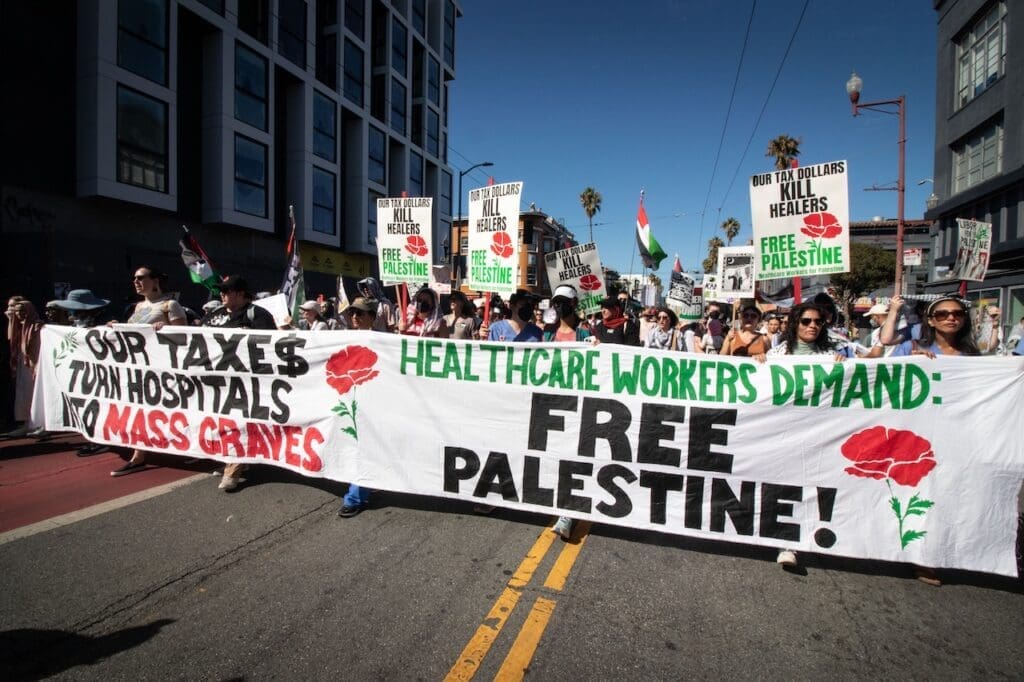
As this was happening, we also saw the world respond, in very much from the Global South, refusing this complicity, refusing justifications for genocide, as literally millions of people took to the streets globally across the Global North and the Global South, and governments were pressured to take some sort of action, most notably with South Africa’s case against Israel and the International Court of Justice.
And looking at the countries that have supported South Africa’s case versus Israel’s case, you can already see that there is a divide in terms of Global North, Global South, the countries like Namibia, Zimbabwe, and Bolivia, and Colombia supporting South Africa’s case, Germany, the US, and the UK supporting Israel’s case.
And as this was happening, in terms of what was going on within movement spaces, the very visible global response in support of Palestinians also drew some curiosity, but also criticisms from within our movement spaces, wondering or questioning why. Why Palestine? Why is Palestine so prominent? Why so prevalent in the global political imaginary compared to other struggles?
So as all of these things were happening and we are putting these collections together, we realized that more and more that actually there is a very clear need for this book, not only to reiterate, but to also demonstrate and to show how the Palestinian struggle is a transnational, intersectional, anti-imperialist, anti-colonial, anti-racist climate justice struggle, to show that through the histories of solidarity and organizing from around the world, and importantly from the Global South.
And so with that, I think what we were doing with this collection is to push back also against these structures of power that continue to fragment and isolate Palestinians in the collective consciousness of people, to separate what’s happening in Palestine from their own history of struggle, to separate it from the history of Palestinians in the history of the world, and the history of liberation in the world.
I think with that is the, the era of Third World internationalism. I think this is maybe more importantly what the collection aims to do, is to retrieve and revive and remember that history and that place, and place that organizing against the genocide that we’ve seen over the last three years, to place it in that history and in that trajectory of struggle, which Hamza was talking about.
As Hamza said, and I think this is where we can find hope, especially in these dark times. And this is where we learn from each other and we learn from our collective histories of struggle. Maybe before I answer your question more directly, the last point that we were trying to do with this book, which is another important point to emphasize and to underline, is with what we’re saying and placing the whole book around towards Palestinian liberation is not an attempt to make Palestine exceptional or Palestinians exceptional, nor the Palestinian is exceptional.
And this is something that we also wanted to at least try to be clear with this book. And then that leads me into my answer to your question in terms of why we organized the book the way we did is the first section, we have four contributions that provide different perspectives of how to understand the Palestinian struggle as a transnational struggle, anti-colonial struggle, climate justice struggle, followed by three contributions from activists and academics per region, Africa, Asia, and the Americas.
And we did this because we wanted to show clearly that the Palestinian liberation struggle is not a single issue struggle and not only a national liberation struggle. It is a struggle against global capitalism. It is a struggle against imperialism. On the one hand, it’s a struggle against imperialism because of the fact that Israel as a settler colony is an imperial outpost for Western capitalism, a capital in the region, as Adam Hanieh, Nihal El Aasar, and others in their contributions have highlighted.
So this means that the challenge that Palestinians face is not only Israel and Zionism, but the world that supports it. And on the other hand, the Palestinian struggle is also a struggle against capitalism and imperialism because of the role and the material connections, the networks, and the support that Palestinians not only received, but helped build with and contribute to with other struggles, other anti-colonial struggles, and anti-imperial struggles in the Global South.
This is something that Wael Omar and Hamza also outline in their chapters alongside others. Therefore, we wanted to make sure that we had several contributions from the three regions to engage with this question of the intersections of the Palestinian struggle to struggles in their own countries and regions, not only through the material connections of colonial and imperial power, but perhaps more importantly, the history of material connections of transnational resistance to it.
As a struggle against imperialism and global capitalism, the Palestinian struggle itself is not exceptional. However, we do think that it is essential to any transnational struggle because of the importance placed on Israel by Western capitalism. But as we have seen clearly with recent events, but also more importantly for us, because of the histories of transnational solidarities, the accumulation of experiences, the successes, the failures, and ultimately the lessons to which we can continue to learn from.
And maybe just to go finish my answer, the late Muzan Alneel reminds us through examining how failing the Sudanese revolution also failed Palestine. She notes that revolutionary solidarity is understanding that failing one will fail both, while undermining the potential for liberation globally. And this is the spirit that we wanna bring with this book.
Ultimately, through bringing together these global perspectives, the collection aims to show how the Palestinian struggle is one part of the history of the Global South. It’s a struggle rooted in a vision of a world free from imperialism, colonialism, and capitalism.
Yara Hawari 15:39
If you’re enjoying this podcast, please visit our website, al-shabaka.org, where you will find more Palestinian policy analysis and where you can join our mailing list and donate to support our work.
Thank you, Abi, for that, that comprehensive answer. I think it really makes it clear why you structured the book the way you did. I wanted to ask, um, uh, about the, the several… There are several chapters in the book that trace Palestine’s cen-centrality to the, the 1960s, ’70s, ’80s Third World internationalism. I was wondering, do you see that particular era as a genuine template for solidarity today, or has too much changed?
Has the world moved on from that moment, from that revolutionary moment?
Abi Bae 16:30
I think this is something that we also did think about throughout this project, and even while writing the introduction for this book. And maybe to help answer that question, I, I wanted to share some reflections of, that we had while we were writing the introduction of the book.
Because another common theme throughout the articles was also the global outpour and con- of condemnation to the genocide, which was aiming also to challenge the moral authority claimed by the West. This moral authority of the West that essentially tore down its own rule-based system to continue to materially and ideologically support and supply Israel’s genocide.
And I think because of the actual insanity of this claim of moral authority while enacting a genocide and upholding system of white supremacy and dehumanizing and killing people across the world, I think that often that insanity can sometimes compel us to try to respond to that and reject that moral authority, and in this case, to show that that moral authority is not true by showing how much the West or imperial powers are complicit in Israel’s occupation, apartheid, genocide, settler colonialism, how much violence is being enacted by Israel, the scale of dehumanization, and so on.
Almost as if the more examples we show, the more chances that the evidence that will prove the fallacy of the moral authority of the West, and hence change its actions. So in the first ki- first few drafts of the introductions, we found ourselves doing that in terms of narrating the, the violence, the death, and the destruction to, to, to sh- to show the, the scale and the weight of colonial violence.
But then we also remembered through that, who is our audience? We asked ourself, “Who are we trying to speak to?” Our goal here is not to talk to those who dehumanize. Our goal here is not to those who enact this violence. Our goal here is to speak to those and between those who are dehumanized by the global capitalist and imperial system.
So in that sense, we do not need to prove our humanity to each other. And I think this is something where the kind of era of Third World internationalism kind of lends itself to, uh, quite naturally in the sense of, in some sense, that that’s w- exactly what the project, the Third World internationalist project was aiming to do.
It was bringing connections across and between colonized, oppressed peoples as a means to try and bring a different world order to change the world. Therefore, while the Third World project and Third World internationalism may mean something different to different people, I think what we’re trying to focus on here is not necessarily the presentation of an alternative, but an active project of building and constructing an alternative with the vision of a world free of imperialism and colonialism. And I think with that, maybe it’s good to also note, when I think about Third World internationalism, I don’t necessarily think of it as a state-led project or only a state-led project, or reduce it to a state-led project.
Because it was anti-colonial and national liberation struggles that seized the national, which we synonymize with state, through the successes of their struggles. Then in doing so, were faced with the structurally unequal and extractive world economic system that was ready to punish them and coerce through soft or military power, for example, to nationalize key resources, industries, or infrastructures.
So in saying this, I don’t want a romanticizing picture of the era, nor place an increased significance to any part of it, but rather to give a sense of the context of the time, which not only embodied the spirit of what was being generated through the success of anti-colonial struggles around the world, but it also came into force because of the transnational solidarities and that we continue to build from today.
And a part of that story is also how peoples learned and built from each other, including the Palestinians, in terms of learning from Vietnam, Cuba, Algeria, and China, and then through that learning, providing support and solidarity with others across the world. And I think this is the spirit of Third World internationalism we’re trying to evoke.
Learning from Third World internationalism is not a call to replicate, but it’s a call to study, to analyze, to be, to build, and to rebuild some of these connections. So then in that sense, I see that it is our job to draw on these linkages across histories, across geographies, not only through how structures of oppression bring us together, but also how histories of struggle bring us together, not in an abstract sense, but in, through the actual histories of solidarities, the actual histories of relations, interactions, and exchange.
I think these connections are a necessity to be able to engage in, in any transnational or international struggle. And maybe just to quote Rafeef Ziadah, who wrote the afterword, quote, “This return is not and should not be an exercise in nostalgia. If there is a danger in looking backwards, it is the temptation to romanticize, to extract fragments of hope without reckoning with complexities that shape them. To resist this, we must approach the past not as a repository of inspiration alone, but as a field of struggle in its own right, marked by contradictions and unfinished trajectories. The question is not how to replicate what came before, but how to learn from it without reducing it.” End quote.
So our emphasis on Third World internationalism is not to say how things should be now, because the conditions of the world today are very different, but to emphasize that the world we live in today was not inevitable, and to recognize that peoples across history have built and sustained solidarities under seemingly impossible conditions.
And that is where we can hopefully derive some hope for the future.
Yara Hawari 21:55
Hamza, in the, in the spirit of pushing back against the, the romanticization of, of solidarity as, as Rafeef Ziadah asks us to do in the, the afterword, which Abi just read to us. A, a few of the chapters in the book deal with countries or movements in the Global South whose relationship to the Palestinian struggle is complicated, um, uh, or shifting.
How do you want readers to sit with those tensions?
Hamza Hamouchene 22:24
As we’ve heard from Abi, clearly we wanted to steer away from romanticizing, you know, long gone era. But also we did not want to shy away from complexity, nuance, and contradictions because these are really present in our daily struggles, but also present in liberation struggles.
That’s what makes them complex. Struggles are not necessarily linear, and seeing your friends and foes in clear binaries as black and white can be really misguided. So we really wanted to say things as honestly as we can and to show that complexity in terms of the shift in the relations between certain states in the Global South and the Palestinian liberation struggles.
Because that, I feel, can help us, first of all, identify our enemies, identify our true friends, but also identify some of the tensions and contradictions within our friends that we need to deal with in order to surmount the challenges and better organize and invest better our times and efforts in certain nodal points of the struggle.
So that’s the first thing in terms of responding to your question. The other element is just to convey the idea that stances, let’s say political stances and positions, are not eternal. They can change. Things shift depending, first of all, on the balance of forces on the ground, depending on the material conditions, depending on the changing times and the changing tides.
And that offers spaces for struggle and resistance. That offers horizons for revolutionary forces to intervene in order to change things. So these are the two main points that we wanted our readers to sit with. But then let’s go into some concrete examples. For example, in the chapter written by Kribsoo Diallo on the African attitudes toward Palestine since the 1950s, which is the decolonization period till today, he tries to assess the positions of the African governments have taken towards the genocide in Palestine.
So alongside widespread popular support, we’ve seen some states come in strongly in support o- of Palestine, like South Africa, the North African states, and some other states like Namibia. But then we saw also other states having unconditional support to Israel. And in here, he wanted really to trace back the history of those relations, to place those attitudes within their longue durée perspective.
What happened to the idea of African unity that was rooted in liberation struggles, that was rooted in South-South relations and solidarity, including with the Palestinians? And the answer to that is the infiltration of Zionism in the continent. And it’s not just in the continent, in other parts of the world.
Which leads us to really rethink our strategies in terms of trying to isolate Israel at the political and economic level in various parts of the world, intensify our BDS efforts, intensify our campaigning in order to stop what Israel is doing. Because Israel, what it’s trying to do, is insert itself in the global capitalist imperialist economy, assert itself economically, and then make itself indispensable in terms of technologies, in terms of providing defense and weaponry a- and so forth.
And that did not just happen in Africa. We look at India, for example. So for people, if they just look at the current period of Narendra Modi and the neoliberal Hin- Hindutva that is really overlapping largely with Zionism and with all the economic and military relations between India and Israel, you would think that India’s stance has been always like this.
Not true. In fact, in 1947, India opposed the UN partition plan of Palestine, and even during its early era of post-colonial India, the Indian ruling classes supported Palestine strongly while trying to open up in pragmatic ways in certain times, mainly I think in the ’80s, to Israel. The chapter that I’ve written about Vietnam and Palestine, they have a special relationship in terms of their struggle being anti-colonial struggles.
The Vietnamese fought the French and fought the Americans. The Palestinians supported the Vietnamese, but also the Vietnamese reciprocated that. When you look at the current situation right now, while Vietnam still strongly supports the right of Palestinian for self-determination, strongly supports an independent Palestinian state, it has big economic and defense relations and agreements with Israel.
The infiltration and the encroachment of Israel and the normalizing of relations with Israel at the economic level, that complicates our struggle. China is, is another story. Palestinian support from China was strong during the Maoist period, but then it started changing and shifting, I think from the ’80s and especially after the Oslo Accords, where we see that China have really big economic deals with Israel.
And I think that tempers their attitudes towards Israel right now and the timid positions that China has taken towards the Palestinian cause right now. The same thing for Latin America as well. There are wonderful chapters by especially María Landi that took a broad picture of the Latin American context, going back also to the partition plan, where she showed that most actually of the countries in Latin America supported that.
Countries in Latin America supported the partition plan, and six abstained, and it was only Cuba at the time that rejected that. But then those positions shifted with the time, and that is due to the popular mobilizing, to the grassroots organizing, to the pressure from below, but also sometimes to the shift in political landscape.
And when we talk about Latin America, shift to the left showed strong support to the Palestinian cause, and we talk about Cuba, Nicaragua at some point, Venezuela. And these are the things that we need to take into account when we design our strategies to support the Palestinian liberation struggles. I wanted to emphasize a point that Abi mentioned is the limitation of a state-centric solidarity or South-South relations, and we are seeing this clearly with the South African case.
South Africa took Israel to the International Court of Justice, accusing it of committing genocide. But at the same time, it continues exporting coal to Israel. And that’s a contradictions that has been emphasized by movements, by trade unionists in South Africa, and trying to push against that, trying to push for more isolation of Israel, for cutting economic deals with Israel, and for stopping sending coal that continues to fuel the genocide.
Yara Hawari 30:04
Abi, the closing chapter of the book draws a line from Turtle Island’s experience of settler colonialism to, to Palestine’s experience. What has that particular solidarity between Indigenous North American movements and, and Palestinians taught us that other sort of more state level solidarities haven’t?
Abi Bae 30:31
I would actually like to hear your thoughts on this question. But to give the best answer that I can, something that I think the solidarity between Indigenous peoples on Turtle Island and Palestinians remind us is that the entire global economic system that we live in today is built on the removal and attempted erasure of Indigenous peoples from their land.
And I think this is something that Ellen Gabriel, in her chapter, highlights quite clearly and tries to remind us, is that Indigenous resistance on Turtle Island has been ongoing for over 500 years, and actually the genocide of the Americas is the longest-running genocide in the world. And this is something that we easily forget or choose to forget, or however you want, you wanna frame it.
And i- in essence, and therefore this fact is, or the surviving Indigenous peoples on Turtle Island are also overlooked in forgetting this fact because of the acceptance of the legitimacy of the United States and Canada as settler colonial states, essentially. So I think what the solidarity reminds us is, for those of us who also, who are neither Indigenous nor Palestinian, it’s also a reminder that both struggles are land-based struggles, and I think this is also something that can sometimes be overlooked as well within solidarity movements.
Meaning that the land and the connection to the land and to their homelands are a, if not the key basis of the struggle. So it’s not about seeking statehood, it’s not about attaining rights in a settler s- society, in a settler state, in a settler world, but about being and existing on their lands, protecting their land, living in dignity on their lands.
Having said that, I think it’s also important, why it’s also important to think about and to reflect on the solidarity between Palestinians and Indigenous people on Turtle Island is not only because of the scale and the weight of the violence that Indigenous people and Palestinians have faced in resisting their own erasure, but, again, to go back to the longue durée perspective, that after 500 years of resistance to genocide and erasure in the Americas, Indigenous people still exist on their lands.
And this is something that we also wanted to highlight in this, and with one of the quotes that was included in the introduction, which is from a speech from the Red Nation, which is a coaliti- coalition of Native and non-Native activists, educators, students, and community organizers who advocate for Native liberation in Turtle Island.
During one of the Palestine demos in Washington, D- DC, in the speech, they said, I quote, “We know the entire history and future of Palestine because we have lived it. We know that Palestine’s future is a certain future because we are still here.” End quote. And I think this is also something that’s powerful or provides some hope to recognize and to remember.
Maybe just as a final point here, and something to add and something that I think is a little bit less known to others than the more recent solidarity efforts between Indigenous people and Palestinians, is the history of relations and political organizing between the two that extend into the era of Third World internationalism, where Indigenous people were also active participants in this vision and era, most notably through the American Indian Movement, which was founded in the 1960s.
And I think in Wael’s chapter, he also notes that US intelligence reporting highlighted that in the ’70s, the Palestine Liberation Organization was a key mediator for the American Indian Movement to link them with other struggles on the continent of the Americas, and therefore linking them into transnational struggles.
And I think maybe to go back to some of the things that I was saying earlier, is also like these are the stories and the histories that, that we want to revive and to remember, and this is something that also that Palestinian and Indigenous activists and academics are uncovering more and more today through their solidarity efforts.
The point of saying that is just to give some more of these examples of how histories and connections that can be lost or forgotten can also easily be uncovered and revived and rebuilt.
Yara Hawari 34:20
Well, Abi, seeing as you threw that, that question back to me, maybe I’ll share, um, some of my thoughts on this. I mean, I think one of the things that we can learn from Indigenous struggles as Palestinians is that, you know, although all cases of, of settler colonialism have their particularities, they also have so much in common.
Um, you know, while there are these unique characteristics to the, the, the settler colonial experience in Palestine, the Zionist project is not exceptional, you know, it’s not unique, and that’s an in- incredibly important point because Zionism draws a lot of its legitimacy from its exceptionality. But the reality is, is that that Zionism is, is a copy.
It’s a copy of so many other patterns of European invasion and, and domination. One of the things that I, uh, I, I often like to share is, um, about, you know, Zion- one of Zionism’s sort of, um, the most famous lines that their, the Zionist project made the desert bloom in Palestine. Even that line of making the desert bloom is stolen.
It’s stolen from another colonial enterprise. It was Mussolini’s enterprise, colonial enterprise in Libya that used the phrase making the desert bloom. So nothing about Zionism is original. And so I think this comparison of the Palestinian struggle to that of Indigenous people, um, in, in the Americas on Turtle Island, I think it allows us an understanding of the structures of power and domination that, that settler colonial states share.
Um, and unfortunately, you know, wh- when we talk about Palestine, uh, and Indigenous folks, um, on Turtle Island, often you’ll hear the, um, the famous quote that, that Yasser Arafat said, um, when he was, um, you know, confined in his, his compound in Ramallah in, um, in 2004, where he said he proclaimed that Palestinians are not Red Indians.
In other words, he was saying that, you know, Palestinians have not yet been defeated, whereas the Red Indians of the Americas had been. And I think that comes from a… That statement comes from a fundamental misunderstanding of the Indigenous struggle in, in Turtle Island and in the Americas. Um, and I think it also highlights how strong the propaganda and, and dehumanization of Indigenous people in the Americas has been.
You know, they’ve been reduced to this, a caricature that is not reflective of their, their past, their present or their future. So I think that solidarity, that understanding between struggles is, is incredibly important to fight back against the, the propaganda and the, the dehumanization, but also to forge links of solidarity against structures that ultimately are intertwined and share power structures of, uh, domination.
Hamza, I wanna turn back to you now. Um, as, you know, editors of a, of a book, I’m sure you’ve thought a lot about sort of concepts and, and terminologies and, and actually in, in the introduction, you, you do write about that. You know, you argue that words like, uh, occupation and apartheid and genocide, uh, feel insufficient, um, on their own, um, to describe the, the reality on the ground.
Do you think that the language available to us to describe what’s happening in Palestine, um, is actually failing us? And, and if so, do you think it’s a case of simply finding better language to describe the reality of the struggle?
Hamza Hamouchene 38:01
That’s a very good question, Yara. You know, when trying to find words and language to describe the utter and horrific destruction taking place in Palestine and the broader region in the West Asia, it’s not just Palestine anymore.
It’s Lebanon, it’s Syria, it’s Iran, it’s Yemen, and of course, other parts of the world. So we see a genocide, and it’s not just Gaza and Palestine. It’s also what’s happening in the West Bank, what’s happening inside. So we see a genocide, we see apartheid, we see a brutal occupation, ethnic cleansing, mass starvation, and also the untold destruction that is taking place, not just in Palestine, but the whole region.
I think that reveals the violent and ugly underpinnings of the imperialist capitalist system and condense its deadly and devastating contradictions. But it also shows the system’s tendency to use much cruel and any imaginable levels of violence. So we find ourselves thinking that what is taking place in Gaza is not just genocide, because when you put all the accumulated destruction, death, trauma, terror, and the erasure that has been unleashed in the last three years, we’re nearing three years of the genocide right now.
We feel that we do not have yet the adequate lexicon to describe the colonial situation in, in Palestine. And as you mentioned, words like occupation, genocide, settler colonialism, when they are put in isolation, they seem insufficient. So a lot of us, it’s not just Abi and myself, find ourself trying to find new words to express what is happening, to make sense of it in order to overcome it.
I’m sure you are aware of all the plethora of terms that came in the first months of the genocide, you know, from urbicide, scholasticide, epistemicide, ecocide as well. But also I heard another word, reprocide, which is like another word of saying reproductive genocide. For me, there is another word that I feel that more encompassing, which is holocide, which means the annihilation of the whole social and ecological fabric of life.
But for me, what matters is not coming up with new terms and concepts for the sake of coming up with them. We come up with them if they are useful to analyze what is taking place, to draw the connections, to reveal certain hidden aspects of oppression and domination, to create linkages, and also to open up our minds, our horizons in terms of how do we address this?
How do we find the solutions? How do we fight those injustices? And for me, it’s up to the Palestinians to see what words and concepts are useful for their own struggles. It’s always up to the oppressed and colonized people to come up with their own concepts or borrow some concepts that are useful. When thinking about concepts like holocide, for example, I don’t know how to translate it into Arabic, to be honest with you.
And does it make sense in Arabic? So what matters is advancing our analysis, deepening our analysis with certain concepts that draw the linkages and make us see horizons of emancipation and liberation.
Yara Hawari 41:34
My final question is for you, Abi. Uh, beyond readers understanding the sort of the history better, what’s the actual practical thing you hope this book changes in organizing, in policy conversations, in how solidarity movements operate?
Abi Bae 41:56
I don’t think we want to change anything about how organizing policy conversations and solidarity move- uh, movements are operating in terms of strategy or tactics necessarily, nor to seek a particular outcome from organizing different to what’s already there. Um, rather, I think what we’d like from this book is to help organizers, help activists, students, trade unionists, Indigenous peoples, and people in general learn from each other across histories, across generations, and more importantly, to connect with each other, if not physically or directly, then through a collective political internationalist consciousness.
Uh, recently, in an event we had, a student from, uh, Students for Justice in Palestine in Indonesia asked us, “How can we convince people to care about issues outside of Indonesia, like the genocide in Palestine, when things are getting worse in Indonesia and people are focused on national issues?” I think this is something that organizers around the world are, are experiencing as the material conditions of people are, are deteriorating everywhere.
Um, and I think maybe a part of the answer of, to that question is that the material conditions are deteriorating everywhere, and that’s not a coincidence. Um, so we need to bring back the international into our political imaginaries, because this is what connects us, and this is where, at least, that I believe that the creation of possibilities lie towards something different.
I think this is kind of part of the impact that we wanna have with this book, is that at this critical juncture in, of world history, um, that’s what we hope to do with this book, is to rebuild the links and the networks of an era of the past, of those that have been forgotten, those that have been destroyed, those that have been ignored, and learn from the past, uh, from both past and contemporary struggles against global imperialism, and ultimately be a resource for those who share this vision and who continue to struggle for a liberated Palestine and a liberated world.
Yara Hawari 43:46
I think we’ll end on that note. Abi and Hamza, thank you s- so much for joining me on this episode of Rethinking Palestine.
Hamza Hamouchene 43:55
Thanks, Yara, for having us.
Abi Bae 43:58
Thank you.
Yara Hawari 44:03
Rethinking Palestine is brought to you by Al-Shabaka: the Palestinian Policy Network. Al-Shabaka is the only global independent Palestinian think tank whose mission is to produce critical policy analysis and collectively imagine a new policymaking paradigm for Palestine and Palestinians worldwide. For more information or to donate to support our work, visit al-shabaka.org.
And importantly, don’t forget to subscribe to Rethinking Palestine wherever you listen to podcasts.

Al-Shabaka: The Palestinian Policy Network is an independent, non-partisan, and non-profit organization whose mission is to convene a multidisciplinary, global network of Palestinian analysts to produce critical policy analysis and collectively imagine a new policymaking paradigm for Palestine and Palestinians worldwide.